
Predicting the next UK unicorn companies
It’s fair to say that UK unicorn company activity has diminished in recent years, certainly following the ‘zero interest year’ of 2021 which saw inflated valuations and a record 11 unicorns minted.
Since then, we have seen just thirteen new unicorns — five in 2023, four in 2024, and four so far in 2025. The 2025 unicorn cohort (so far) includes Cera, Verdiva Bio, Nothing, and Isomorphic Labs.
Looking forward to 2026 and beyond, I’ll lay out our methodology for tracking ‘soonicorns’, the companies on a trajectory for a potential $1b valuation, and reveal how you can find all this information on Beauhurst with ease.
What is a unicorn company?
The definition of unicorn companies vary. Some include exited unicorns, whilst others exclude companies that IPO.
At Beauhurst, we define a unicorn company as a private, non-listed business with a valuation of $1b (or c. £760m) or more.
We do also include exited unicorns in our annual report, because tracking exits is a useful method of measuring how unicorns perform against the scrutiny of the public market.
Mapping the herd: The UK's unicorns
Every year, we produce an annual review of the UK’s unicorn ecosystem. Explore our latest research.
Signs of unicorn potential
Nobody can predict definitively which companies are guaranteed to become unicorns, but there are signs you can follow to help build the case and identify those most likely to reach Unicorn status.
These aren’t guarantees, nor should they be viewed as prerequisites, but they can help build a strong case when evaluating a company’s trajectory. Let’s explore some of the most common indicators.
Serial founders
Why it matters
Serial founders matter because their previous experience reduces some of the classic execution risks that early-stage companies face. Having already built and scaled a business, they are typically more familiar with hiring, fundraising, product development, and the timing of key decisions.
Their existing relationships with investors also mean they can often access capital more quickly and on better terms. This combination of experience, pattern recognition, and established networks can help a company reach major growth milestones faster than a first-time founding team might.
Why you should be cautious
Being a serial founder is not a guarantee of future success. Founders at previous unicorn companies may have transferable knowledge and experience, but what worked in one company or industry might not work in another. This can be especially risky if the market dynamics differ significantly to the founder’s previous experience.
Investors may also inflate valuations based on founder pedigree rather than fundamentals, which can create pressure later if the company does not have a solid product-market fit.
How to find serial founders on Beauhurst
Finding serial founders on Beauhurst can be done with ease by using the People search function on Advanced Search.
Navigate to Advanced Search, select ‘People’ and a person criteria that specifies at least two of their company positions must be ‘founder’.

From here, you can layer on further criteria to your search, for example by increasing the number of founder positions, specifying whether those companies are all still active, adding company valuations, industries, or stages of growth, and much more.
Whatever you want to know on founder activity, you can find it on Beauhurst.
Early (repeated) raises
Why it matters
When a company secures early or repeated funding rounds, it often indicates strong investor appetite and confidence in the business’s potential.
Companies that raise multiple rounds in quick succession usually have the capital required to accelerate hiring, expand internationally, or develop complex products such as AI models or specialised hardware.
Frequent early-stage fundraising from credible investors with a track record for backing successful companies in the same industry can also signal value to the rest of the market.
Why you should be cautious
Repeated fundraising is not always a sign of strength. Rapid access to capital can mask operational inefficiency, particularly if a company is burning money aggressively without clear evidence of sustainable economics.
In some cases, investors may be following trends rather than assessing underlying performance, leading to hype-driven rounds that do not reflect the company’s fundamentals. This is arguably the case in a number of deals for AI companies today, with murmurings of a bubble.
Early, frequent raises can also create dilution challenges for founders, potentially complicating later rounds. Ultimately, the speed of fundraising should not be confused with maturity or long-term viability.
How to find serial investment on Beauhurst
To find early-stage companies with multiple raises in quick succession, visit Advanced Search and navigate to the Companies tab.
For this example, I’ve built a search that returns active companies, based in the UK, that have secured at least two equity investments in the last 12 months at the Seed stage.

As before, finding people and companies can be as simple or complex as required. This example delivers 37 companies, giving you a focused view of the early-stage companies generating serial investment in the UK right now.
Rapid growth (revenue / headcount)
Why it matters
Rapid growth, whether in revenue or headcount, is a clear sign that a company is hitting key milestones quickly. Strong revenue growth, for example, can indicate that the business has found demand, established a scalable model, and is capturing market share.
Similarly, an expanding team can also suggest that the company is investing in product development, sales, and operations at a promising pace. Across a number of industries, particularly SaaS and fintech, these growth indicators tend to correlate with higher valuations.
Why you should be cautious
Growth can be interpreted in a number of ways and must be interpreted carefully. For example, an expanding headcount does not always mean a company is operating effectively, and hiring ahead of demand often ends in layoffs and restructuring further down the line.
Similarly, revenue only tells half the story. Spikes may be driven by single contracts, unsustainable customer acquisition costs, or short-term trends that don’t strictly reflect realistic long-term performance.
Growth also looks different across industries, where what may be considered high-growth in software may be unrealistic in deeptech, life sciences, or hardware.
How to find fast-growing companies on Beauhurst
Let’s say you want to find companies with a certain turnover growth over the past three years.
On Advanced Search, start a company search. Add Financials > Financial statements, and select turnover. You can also use any other item in a company’s financials, such as headcount, EBITDA, profit (before or after tax), or GVA.

Next, change ‘value of’ to ‘change in’ and you can select either a figure, percentage, or even compound annual growth rate — along with the number of previous financial statements, and so the time period, you want to compare with. To compare turnover growth over the previous three years, select ‘3 financial statements’.
Adding a minimum turnover value is also recommended. This is to help avoid instances where a company grows its turnover by 100%+, but from a very low base figure.
Finally, you’ll probably want to add an ‘Active’ Companies House status to filter out companies no longer operating.
Operating in high-growth industries
Why it matters
Companies operating in high-growth industries benefit greatly from investment tailwinds that can accelerate their expansion. Demand tends to rise quickly in tech-based fields such as artificial intelligence, biotech, climate tech, and defence tech, enabling companies to scale faster than they might in more mature markets.
High-growth industries also attract significant investor interest, with specialist funds typically willing to back companies earlier and at higher valuations. This can create an environment where promising businesses can progress toward unicorn valuations more quickly.
Why you should be cautious
Industry momentum does not guarantee success for individual companies. High-growth industries can be crowded and volatile, with hype cycles that inflate expectations and then correct swiftly — as seen in industries like crypto and blockchain.
Regulatory changes can also quickly reshape or slow emerging markets, especially if emerging industries propose to radically alter the status quo, such as fintech’s transformative role in financial services and AI’s impact on knowledge workers.
How to find high-growth industries on Beauhurst
There are a number of ways you can use the platform to identify high-growth industries. For this example, we’ll examine fundraisings in Q3 2025, as covered in The State of Investment Q3 2025, to find the top industries receiving funding at the moment.
To build this search, navigate to Fundraisings on Advanced Search and select the appropriate date range, specify the form of funding as ‘equity’ and select the recipient company’s location as the United Kingdom.

From here, navigate to the Statistics tab and select companies.
Finally, scroll down to the Classification section — here you’ll find a full breakdown of the industries that have raised investment in the specified date range.

All of these elements should be considered supportive rather than wholly indicative. These can be tracked on Beauhurst, with automated updates delivered to your inbox, as they happen.
Three potential unicorns
With all this in mind, we’ll now explore three fast-growing companies (in no specific order) that could secure unicorn status in 2026/27 based on leading signals.
PhysicsX
Founded: 2019
Industry: Artificial intelligence
Location: London
Total raised: £127m
Latest valuation: £439m (June 2025)
PhysicsX is a London-based AI company developing next-generation simulation and engineering platforms for advanced manufacturing industries including automotive, aerospace, defense, and materials.
Led by serial entrepreneur Jacomo Corbo, co-founder and former Chief Scientist at QuantumBlack (acquired by McKinsey), alongside Chairman Robin Tuluie, the company has leadership with deep expertise in AI and data science applications for industrial use cases.
With £127m raised across two funding rounds, including a significant £100m Series B in 2025, PhysicsX has secured backing from major investors including Atomico, General Catalyst, Temasek, and Siemens’ Next47 venture arm.
Recent reports suggest PhysicsX is fast-approaching a $1 billion valuation following potential Series C investment from Nvidia, positioning it as a leading player in the rapidly expanding AI-for-industry sector.
Carbon Clean
Founded: 2012
Industry: Carbon capture
Location: London
Total raised: £151m
Latest valuation: £541m (May 2022)
Carbon Clean develops carbon capture technology that helps industries reduce their carbon emissions. The London-based company has raised £151m across five funding rounds from investors including Aramco Ventures, Chevron Technology Ventures, and Samsung Venture Investments giving the company a post-money valuation of £541m in its most recent round in May 2022.
In addition to forging a series of global partnerships, the business has secured eight international patents for carbon capture technology. Carbon Clean also employs 175 people, up from 114 the previous year, and generated £18.4 million in revenue in 2024, a 58% increase from the previous year.
Allica Bank
Founded: 2011
Industry: Banking
Location: London
Total raised: £445m
Latest valuation: £518m (Aug 2025)
Allica Bank is a London-based digital challenger bank founded to serve UK businesses and consumers through a branchless model, combining online banking with local relationship managers.
Led by CEO Richard Davies, formerly of HSBC and OakNorth, the bank has demonstrated strong growth credentials with leadership bringing traditional banking and fintech experience from major institutions.
With £445m raised across 13 funding rounds, Allica Bank has good potential to reach Unicorn status in the coming months. It achieved revenue growth from £739k in 2020 to £336 million in 2024 — a remarkable 450x increase over four years.
It is also backed by a range of major fintech investors including Technology Crossover Ventures and Atalaya Capital Management, and achieved a valuation of £519 million in its latest August 2025 round.
Take a tour
Find unicorns on Beauhurst
Identifying the UK’s next cohort of unicorns isn’t an exact science — but it becomes far more grounded when you track the right signals.
Serial founders, repeated early-stage raises, rapid commercial or team growth, and strong positioning within high-growth industries all contribute to a broader picture of a company’s potential trajectory. None of these factors should be viewed in isolation, nor treated as guarantees. Instead, they offer a framework for understanding momentum, maturity, and market confidence.
The indicators explored in this article can be tracked directly on Beauhurst, from serial founder activity to rapid revenue growth, funding velocity, and emerging industry trends.
With automated alerts and powerful search tools, you can monitor these signals as they happen — giving you a clearer view of which companies may be the next unicorn.
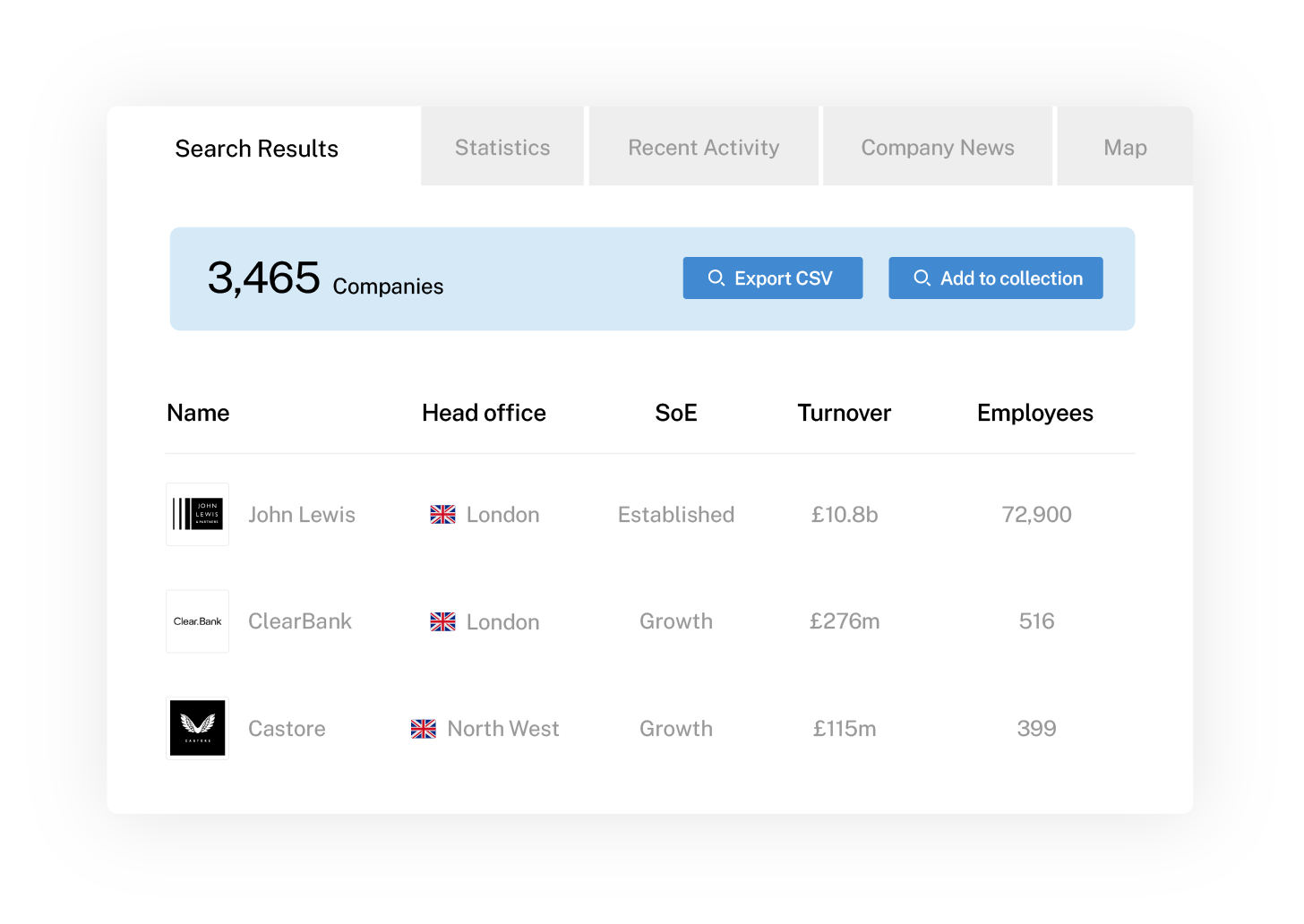
To see the platform in action, take an online tour of the platform now, or book a demo below to speak to one of our team.