
Blog featured image

How Beauhurst helps you assess startup risk and performance

 25 June 2026
Table of contents

Startups represent attractive opportunities for the discernible early-stage investor. With a relatively low buy-in cost, they offer the allure of high returns compared to more established businesses. 

But with these opportunities come risks. Publicly verifiable records are limited and early-stage startups are exempt from financial audits, making it a challenge for investors to fully assess how sound the investment is.

Data is often fragmented across company registers, financial filings, intellectual property submissions, and news sources. The information is there, but it’s disparate and hard to find.

In this article, we’ll explore how Beauhurst clients use the platform to bring all of these data sources together into one place, making it simple for angel investors, funds, and corporate finance teams to assess the potential risks, as well as the rewards.

How to find the right startups

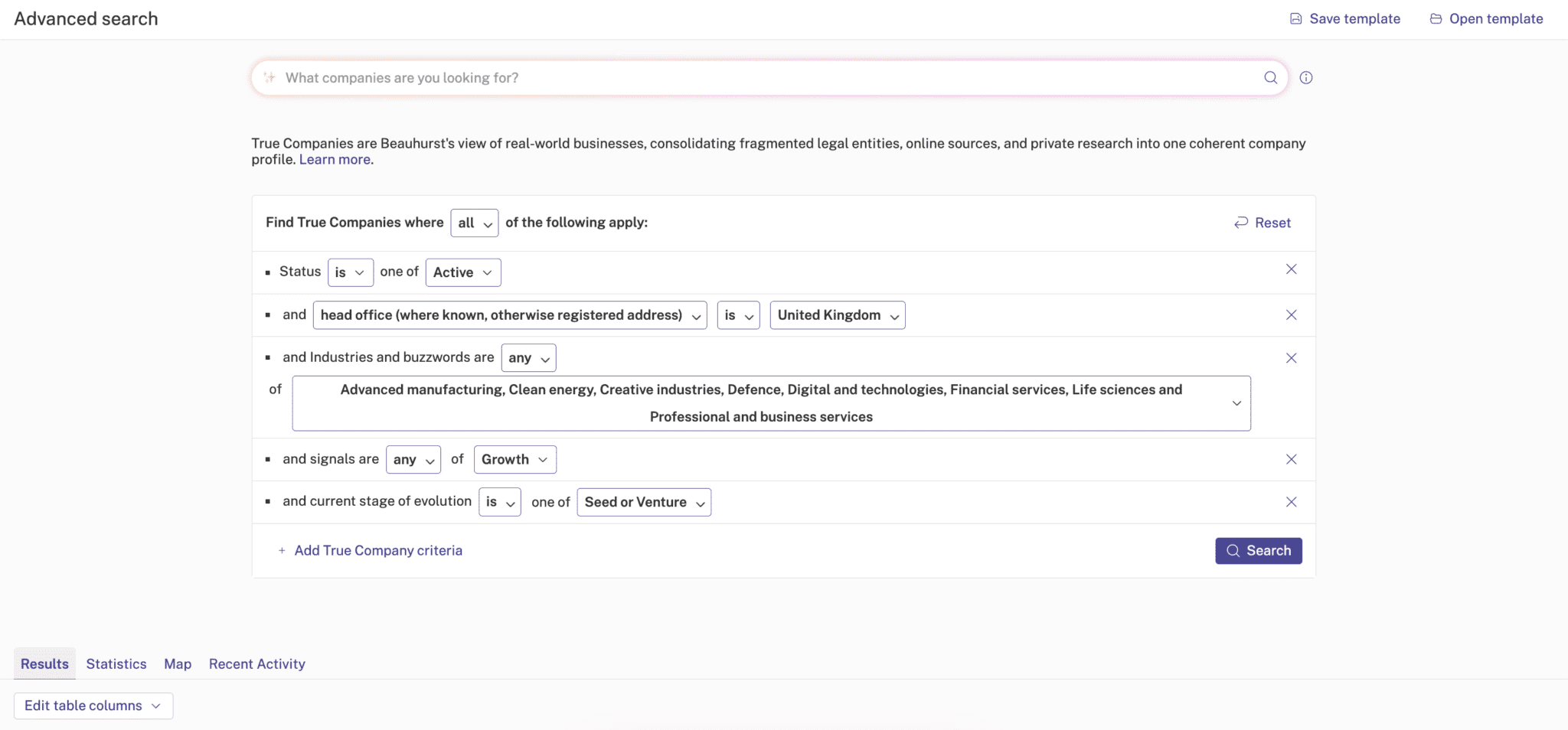
The first job is finding the companies worth assessing, and the Beauhurst Advanced Search is where that happens. You can query across more than 500 data points to build a list that matches your investment profile. This might include industry and business description, stage of growth, size by turnover and headcount, funding history, and location.

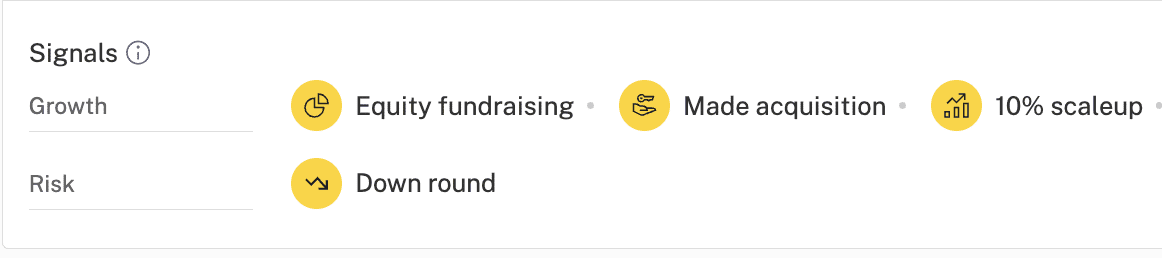
From there, you can fine tune results with Signals, a feature unique to Beauhurst. Growth Signals like scaleup status, accelerator attendance, and fundraising surface companies with genuine momentum. On the flip side, Risk Signals like CCJs, charges, and down rounds enable you to screen out companies with unfavourable attributes before you dedicate any research time towards them.
Screenshot image

These results can then be saved to a Collection – a list of companies that meet your investment profile, before reviewing them. By the time you reach an individual profile, you’re always looking at a company that meets your first handful of criteria.

Assessing a startup’s potential

Once you’re on a company’s profile, performance comes down to trajectory rather than any single figure. For example, financials show turnover, pre-tax profit, and EBITDA across multiple years, so you can see whether the numbers are trending in a favourable direction. A single strong year tells you little, but analysing trends over time can be highly instructive.

Funding history sits alongside the financials: round sizes, valuations, and the cadence of raises. A company raising larger rounds at rising valuations on a steady schedule reads very differently from one that hasn’t raised in three years. Of course, if you’re looking for early-stage investment opportunities then you may want to filter out companies with fundraisings. 

Headcount trends add another read on scaling, showing whether the team is growing in line with the story that the company is telling to the press.

For a faster route through all of this, Insight lenses (our AI-powered research tool) can summarise all the key information on a profile, for an initial first glance. These can be saved as ‘custom lenses’ and applied at scale across each company you’re profiling, for a consistent baseline.

Assessing a startup’s potential

The strength of company profiles on Beauhurst is that risk and performance sit side-by-side. Beauhurst tracks Risk Signals, including County Court Judgments (CCJs), charges, and down rounds. 

A new charge or a CCJ against a company that otherwise looks healthy is exactly the kind of detail worth applying some scrutiny to before you consider investing, And because these signals exist next to the growth figures, you’re getting a complete picture of a company’s true identity. 

Corporate structure and shareholder data show how the company is owned and who controls it, which matters as much for a minority stake as for an acquisition. Filing history and SME status help build a regulatory picture, and the associated people and funds tell you who’s behind the company and who’s already backing it.

Benchmarking startup risk and performance

A company’s figures only mean something against a comparative set. For example, a 30% revenue increase may appear strong or unremarkable depending entirely on what comparable companies did over the same period. Other factors such as industry and the company’s stage of growth can also play a part.

You can build this benchmark by returning to Advanced Search and analysing companies in the same sector, at the same stage of maturity, and at a similar size at the time of the deal you’re assessing. These statistics aggregate the cohort, giving you deal averages and valuation benchmarks to position the company against. 

When you need to go further, Export CSV and the Beauhurst API enables you to pull the data into your own models for deeper analysis, such as working through EBITDA multiples on your own terms. The result is a valuation view grounded in the context of the broader market.

Tracking startup performance

Startups are invariably fast moving, so it’s worth noting assessment dates the moment you finish your benchmarking. A company you screened last quarter may have since filed new accounts, changed its headcount, or raised again since. The value is in monitoring the movement, rather than gaining a short-term snapshot.

Collection Alerts in Beauhurst handle this by notifying you the minute that a company in your Collection raises new funding, shifts headcount, files updated financials, appears in the news, changes key people, or picks up a risk Signal like a new charge. These can be tailored according to your needs.

For teams running their pipeline elsewhere, the API and Integrations can push these changes straight into your CRM, so the deal record is always current without needing to re-run these assessments.

Rich business data, right where you need it

Try Beauhurst

Making the right investment isn’t an exact science; there are a number of moving parts, including market forces. But by getting all of the available facts in one place, you’re able to make a far more informed decision. 

Beauhurst enables you to interpret performance and risk on the same profile, benchmark those numbers against comparable companies, and catch the changes as they land rather than at the next quarter’s review.

To see how it works on the companies you’re assessing, book a demo now to try Beauhurst.