How Foreign Capital Scales UK Companies

Words Callum Newton

How Foreign Capital Scales UK Companies

In July 2024 Labour swept to power on a promise to deliver a renewed period of economic growth. But after two years and regime change at the top of government, growth remains broadly similar to pre-election levels. It’s not for a lack of trying, and crucially the focus of the Government’s efforts to spur growth may be about to change.

Last week on the banks of the Mersey, John Healey may have broken ranks with his predecessor by stating “it’s businesses that will create this country’s jobs, and wealth, and growth”. A claim like this would have been anathema within the Labour Party not long ago, and probably still makes many of the Chancellor’s backbench colleagues uncomfortable. But Healey was right to say he wants his policies to “bring new levels of confidence, investment and yes, profits in British businesses”.

In many ways it was good timing, as the Beauhurst Insights team also launched our ‘Financing the Future’ report with Barclays at the Labour Party Conference. Our analysis focused primarily on a question that sits beneath much of the debate about growth: when a UK company is ready to scale, where does the money come from?

Where UK scale-up capital comes from

The answer, increasingly, is overseas. As Abdul Qureshi (Head of Business Banking, Barclays UK) noted in our report “deals involving at least one foreign investor account for less than 10% of UK equity transactions over the last decade, but more than half of the total value raised”. Although fallen from a peak in 2022 (Figure 1), the total value of foreign backed deals over the last decade equates to around £127bn, or roughly the same amount the UK Government spent on R&D over the same period.

The difference between foreign and domestic investment is partly about deal size. In 2025, the median foreign-only deal was £5.77m. For UK-only deals, it was £490,000. Foreign-only deals are also more likely to involve larger companies: 15.8% were in businesses with 250 or more employees, against 4.85% of UK-only deals.
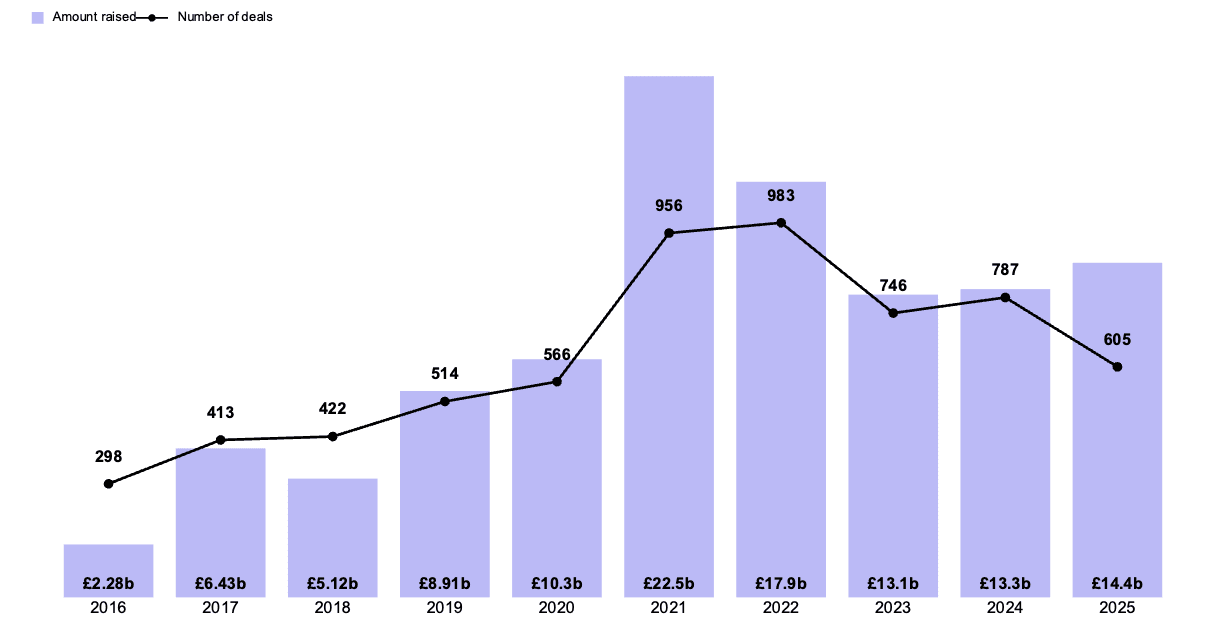
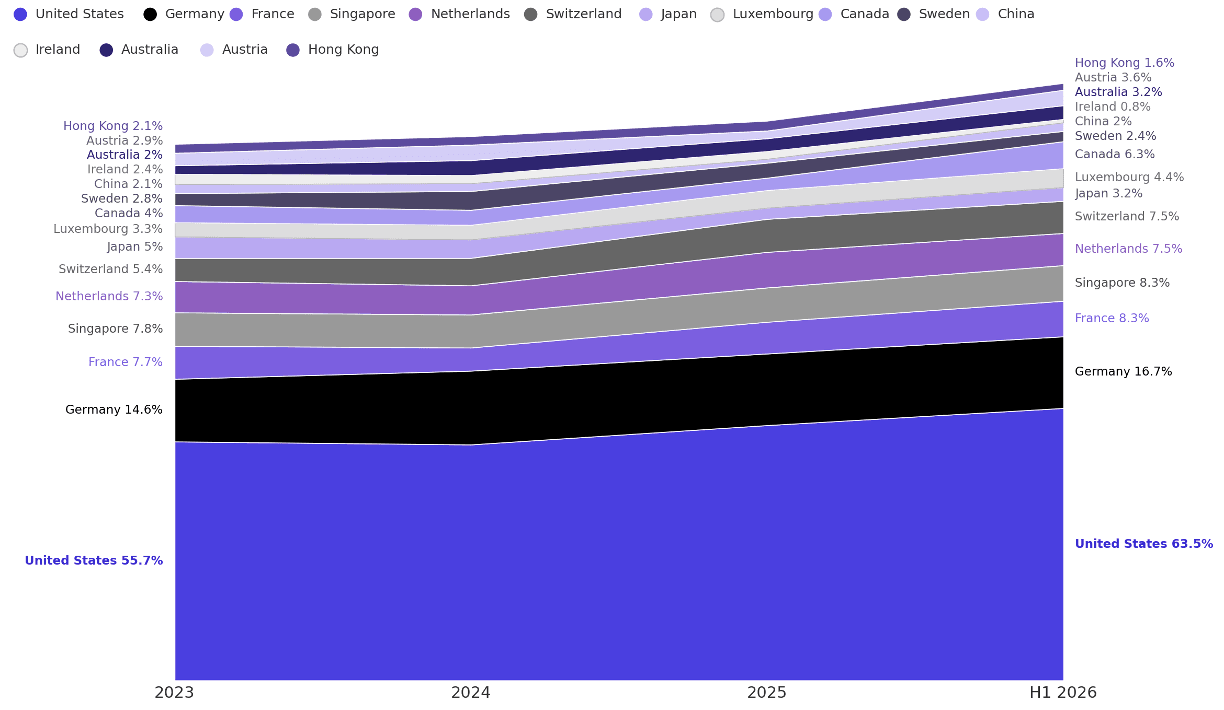
Figure 1: Foreign-backed equity investment into UK companies (2016 – H1 2026)

bar line chart 1

This checks out as UK-only investment appears to be concentrated earlier in the funding journey. Seed and venture deals made up 80.6% of UK-only transactions, compared with 67.7% of foreign-only deals. Overseas investors are more likely to appear in larger rounds and at later stages. That distinction matters for companies moving from venture to growth. They may need far more capital than domestic investors are able to provide, but still lack the commercial traction that overseas investors want to see. Founders interviewed for our report described a gap between strong early-stage support and the capital available later on.

There is a possible route through that gap. Evidence suggests overseas investors rarely act alone as 58.3% of foreign-backed deals since 2016 also included a UK investor. In 2025, the median deal involving both UK and overseas investors was £6.30m, higher than the median for either foreign-only or UK-only deals.

Domestic investment can help companies prove their business model and show that they are ready to grow. That makes it easier to meet the higher bar many overseas investors set before backing a company. In this sense, UK capital can act as a force multiplier, helping firms secure larger foreign-backed rounds. The fact that over half of foreign-backed deals also involved a UK investor suggests domestic investors remain important as companies scale.

Why US investors dominate UK growth capital

The UK’s overseas investor base is broad, but it is heavily weighted towards the US. American investors participated in 6,189 deals between 2016 and H1 2026, almost six times as many as investors from Germany, the next largest source. That concentration has increased. As shown in Figure 2 the US share of foreign-backed deals rose from 55.7% in 2023 to 63.5% in the first half of 2026. For UK companies, the depth of the US market is a major source of growth capital. But it also leaves the UK reliant on a relatively small number of investor markets.

This isn’t necessarily a problem per se, as our analysis suggests American capital is some of the most efficient on the market. As outlined in Barclays Policy Group’s recent Substack, UK companies backed by US investors recorded median turnover growth of 90.9% in the two years following investment, compared with 46.7% for those backed by other foreign investors and 46.2% for those backed by UK investors alone. Although American funds typically have deeper pockets, they also bring a wealth of experience and networks which help spur company growth.

Yet there is still a case for widening the UK’s investor base. France, Singapore and the Netherlands also feature among the leading sources of foreign investment, while Canada and Australia gained share in recent years. Building on these existing connections could help UK firms access more much needed scaling capital. But the challenge for policymakers remains how to build those connections without weakening the UK’s established links with US investors.

Figure 2: Share of total foreign-backed deals involving each country (2023 – H1 2026)

line chart 1

How foreign capital reaches UK regions

For anyone familiar with the economic geography of the UK, it will not come as a surprise that London accounts for the lion’s share of foreign capital. London-based companies received £84.6bn of foreign-backed investment over the last decade, accounting for around 66.9% of the UK total. But overseas capital reaches other regions too. Scotland recorded 291 foreign-backed deals, the most outside the Greater South East. The North West also raised £7.31bn, the largest English regional total outside the Home Counties.

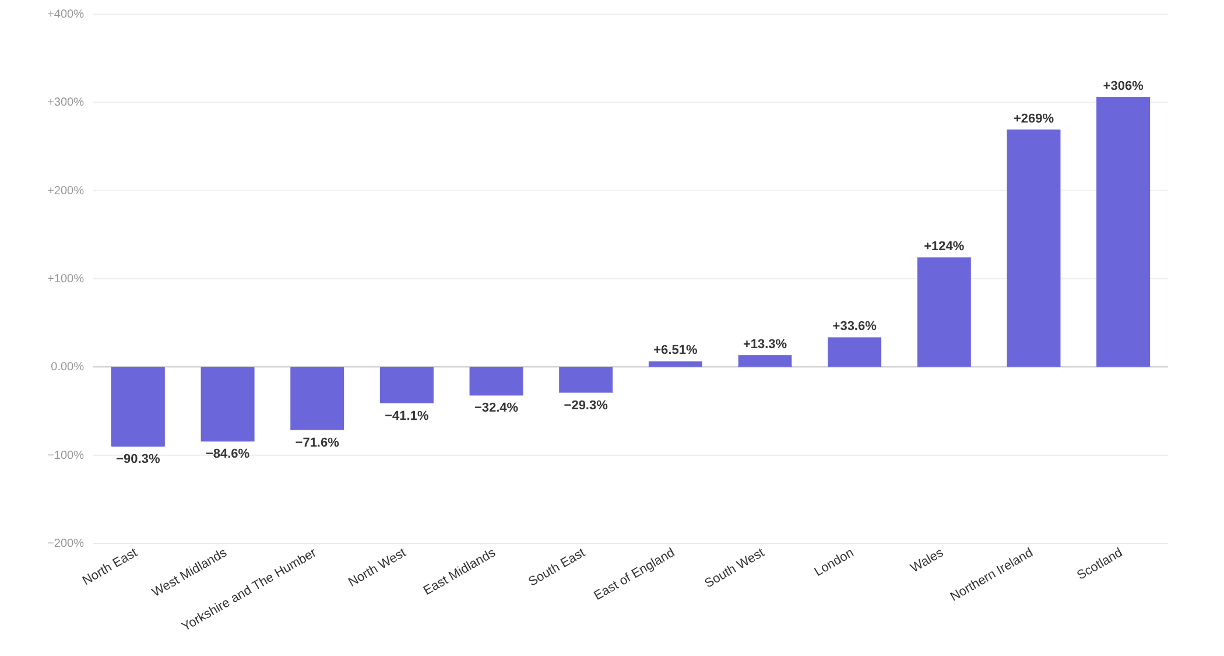
The recent picture varies sharply. Between 2023 and 2025, foreign-backed investment grew in Scotland, Northern Ireland and Wales, while it fell in several other regions. These growth rates start from very different levels, so they tell us more about momentum than scale. But they do show that there is no single regional pattern for attracting overseas capital.

That matters for the Government’s growth agenda. A policy built around the assumption that investment will spread out from London on its own is unlikely to be enough. Regions need to connect their existing strengths and high-potential companies with investors who can finance their next stage of growth. Regional mayors will likely have an important role to play.

Figure 3: Foreign-backed amount raised growth rate by region (2023 – 2025)

bar chart 2

What foreign capital means for the UK growth agenda

John Healey was right to put businesses at the centre of the UK’s growth story at Labour Party Conference. But ambition alone will not help a company move from a promising idea to a business ready to scale. That takes capital at each stage of evolution.

Together Beauhurst and Barclays’ findings show how domestic and overseas investors can contribute to that journey. UK investors help companies prove their model and build commercial traction. Overseas investors provide much of the capital behind larger rounds, often alongside UK backers. Domestic investment can therefore help unlock international capital, rather than attempt to compete with it.

And this is not necessarily a bad thing for British business. There is a concerted effort to increase domestic capital supply due to concerns an over reliance on foreign capital makes us vulnerable to geopolitical shocks or risks turning the UK into an “incubator economy”.

The latter point is especially topical. However, our report found that 75.8% of foreign-backed companies subsequently acquired by overseas buyers remain active in the UK, compared with 64.8% of domestically acquired companies with no prior foreign investment. Among those still active, headcount increased by 9.58% and turnover by 43.5% relative to their pre-acquisition baselines. This suggests that foreign investment and acquisition do not necessarily result in companies being hollowed out or stripped of their UK economic footprint.

The policy challenge therefore should be to strengthen our connections: help more companies become ready for growth investment, widen the pool of overseas investors and make sure businesses beyond London can reach them. If the Government wants confidence, investment and profits in British business, it needs to help build the routes that turn those words into companies scaling across the UK.

Subscribe to the Beauhurst Insights Substack

Data-led analysis of the UK’s private companies, straight to your inbox.

Subscribe
Discover our data

Get access to unrivalled data on all the companies you need to know about, so you can approach the right leads, at the right time.

Book a demo today to see all of the key features of the Beauhurst platform, as well as the depth and breadth of data available.

An associate will work with you to build a sophisticated search, returning a dynamic list of organisations that match your ideal customer profile.