What the headline leaves out: hardware hasn’t gone anywhere
It would be easy to swap one myth for another and call infratech a software sector. That would be wrong too.
Physical sectors still attract serious capital. Energy companies within Greentech raised £382m between 2020 and 2025, not far behind Greentech’s Digital & AI total, and Energy companies in Supply Chain raised a further £196m.
Some of 2025’s most notable regional deals were hardware-led: stratosphere platform company AALTO raised £79.2m in the South East, and LIDAR sensor developer Phlux Technology was one of two companies behind £17.2m of investment in Yorkshire and the Humber. Yet both are also tagged with Beauhurst’s IS8 digital & technologies classifier, because their hardware is only as valuable as the data and software that sit on top of it. Even infratech’s most physical deals, in other words, carry a digital layer. For more on the physical end of the market, see our top UK drone companies and top greentech companies.
Then there’s the tagging itself. A sensor company that sells a data platform alongside its hardware, or a robotics firm with its own control software, can reasonably count as both Digital & AI and a physical sector. So the most accurate version of the finding isn’t that software is replacing infrastructure hardware. It’s that almost every part of infrastructure now has a software layer, and that layer is where most of the venture capital goes.
What this means if you’re backing, building or buying infratech
For investors: if your fund filters out infratech as capital-heavy and slow, you may be screening out a software market. The better question to ask is whether a company’s route to revenue runs through infrastructure procurement, not whether it builds hardware. That’s where infratech’s real friction sits. Corporate venture arms such as Murphy Capital are betting that access to live projects shortens that route. For corporates weighing a similar model, see how Beauhurst supports corporate venturing and strategy teams.
For founders: being a software company doesn’t exempt you from infrastructure’s timelines. The report’s view is that AI’s commercial value in the sector will increasingly be judged on measurable outcomes, such as project delivery, asset performance and workflow automation, rather than technical capability alone. Position around deployment evidence, not the model.
For infrastructure clients and policymakers: if most infratech innovation is digital, then digital procurement is infrastructure policy. Technologies aimed at productivity, resilience, cost certainty and sustainability are becoming central to programme delivery rather than an add-on. Programmes such as Ofwat’s £600m Water Innovation Fund matter because sectors like Water and Civil Engineering show comparatively low patenting and spinout activity, partly because long procurement cycles make it hard for small companies to trial new technology.
For anyone writing about infratech: be specific about which infratech you mean. A headline about “Infratech investment” is, most of the time, a headline about software sold to infrastructure. That’s not the same thing as a story about construction.
The myth, busted
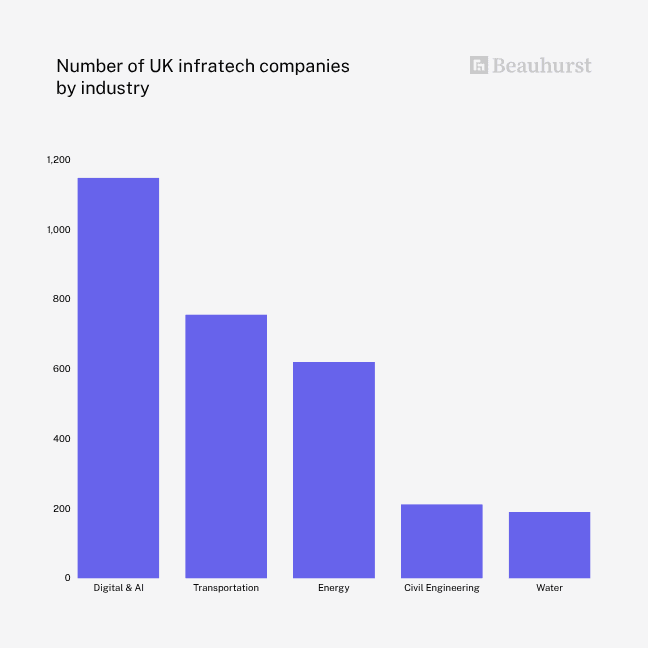
Infratech isn’t a hard-hat sector. Of the 2.11k UK infratech companies we identified, 1.41k are digital & AI, and digital & AI is the highest-funded sector in every vertical. That’s around 92% of equity in Future of Construction, the vertical most associated with physical work.
But the fix isn’t to rebrand infratech as software. Energy companies raised £382m within Greentech alone, most patent filers sit outside digital & AI, and many of the sector’s digital companies are also tagged with a physical sector. The accurate picture is software layered onto physical assets, and capital flowing mostly to that software layer.
Next time a headline describes infratech, the useful first question isn’t how big it is. It’s what the sector’s companies actually build, and whether the categories behind the number overlap.
See past the headline yourself
No single classification could show this picture. SIC codes alone would scatter infratech across construction, software, engineering and utilities, and would miss the overlap between them. Surfacing the sector’s digital core took company-level tagging across sectors and verticals, validated by hand, and linked to deal-by-deal investment, grant, patent and spinout records.
That’s the level Beauhurst data operates at. Whether you’re defining an emerging sector, sizing a market that official data doesn’t recognise, or building a thesis around an industry that sits between categories, that’s the difference between quoting a headline and understanding what’s behind it.
Explore Beauhurst Insights to commission sector research of your own, or book a demo to see how our data maps your market.