Is UK Tech Really Slowing — Or Are We Measuring It Wrong?
How to spot growth in the tech sector when VC funding is slowing
Venture capital funding into UK tech has slowed sharply. Since 2021, annual PE and VC rounds have fallen from 1,250 worth £22.0b to 485 worth £2.96b in 2025 — declines of 61% and 87% respectively. But that does not necessarily mean the tech sector itself is slowing.
Funding is one of the most visible signs of innovation in any ecosystem — but in isolation, it can be misleading. Investment levels are influenced by a wide number of things, including macroeconomic conditions, investor sentiment, and capital availability.
At Beauhurst, we analyse the UK’s private company ecosystem across multiple dimensions: company formation, investment, innovation activity, and growth progression. These broader indicators suggest a more nuanced reality.
While capital deployment has slowed from its peak, the structural drivers of UK tech growth remain intact.
“There’s a tendency to treat venture capital as the scoreboard for the tech sector. In reality, it’s just one signal. As private capital matures (and exits take longer), other signals become just as useful for taking the temperature of the sector.” Henry Whorwood
The problem: Assuming VC funding equals a healthy ecosystem
Funding cycles and innovation cycles do not move in tandem
Venture capital is inherently cyclical. Periods of rapid investment are typically followed by phases of consolidation, as investors rebalance portfolios and reassess valuations.
These cycles are often driven by external financial conditions, such as changes in interest rates, inflation expectations, and liquidity.
Innovation cycles operate differently. They are shaped by technical progress, talent flows, , and the wider innovation ecosystem — from university spinouts, to corporate R&D, and early-stage ventures. These dynamics tend to evolve over much longer timescales than capital markets.
Investment levels can fall even while innovation activity remains strong. Treating funding as the only signal of ecosystem health risks creating the impression that technological progress has stalled when, in reality, the foundations of the next wave of growth may still be actively forming.
“Relying on funding alone creates a distorted picture.”
The Solution: Looking at more signals to indicate the state of the UK’s tech ecosystem
A broader view shows continued ecosystem expansion
When viewed across multiple indicators, rather than just PE and VC funding, the UK tech ecosystem continues to show signs of strength.
For example, company formation remains active. New businesses continue to emerge across industries, from artificial intelligence and climate technology to advanced manufacturing and life sciences. In 2025, the UK recorded a record 72.5k new tech company formations — a 7.3% increase on the previous year and 61% higher than in 2015.
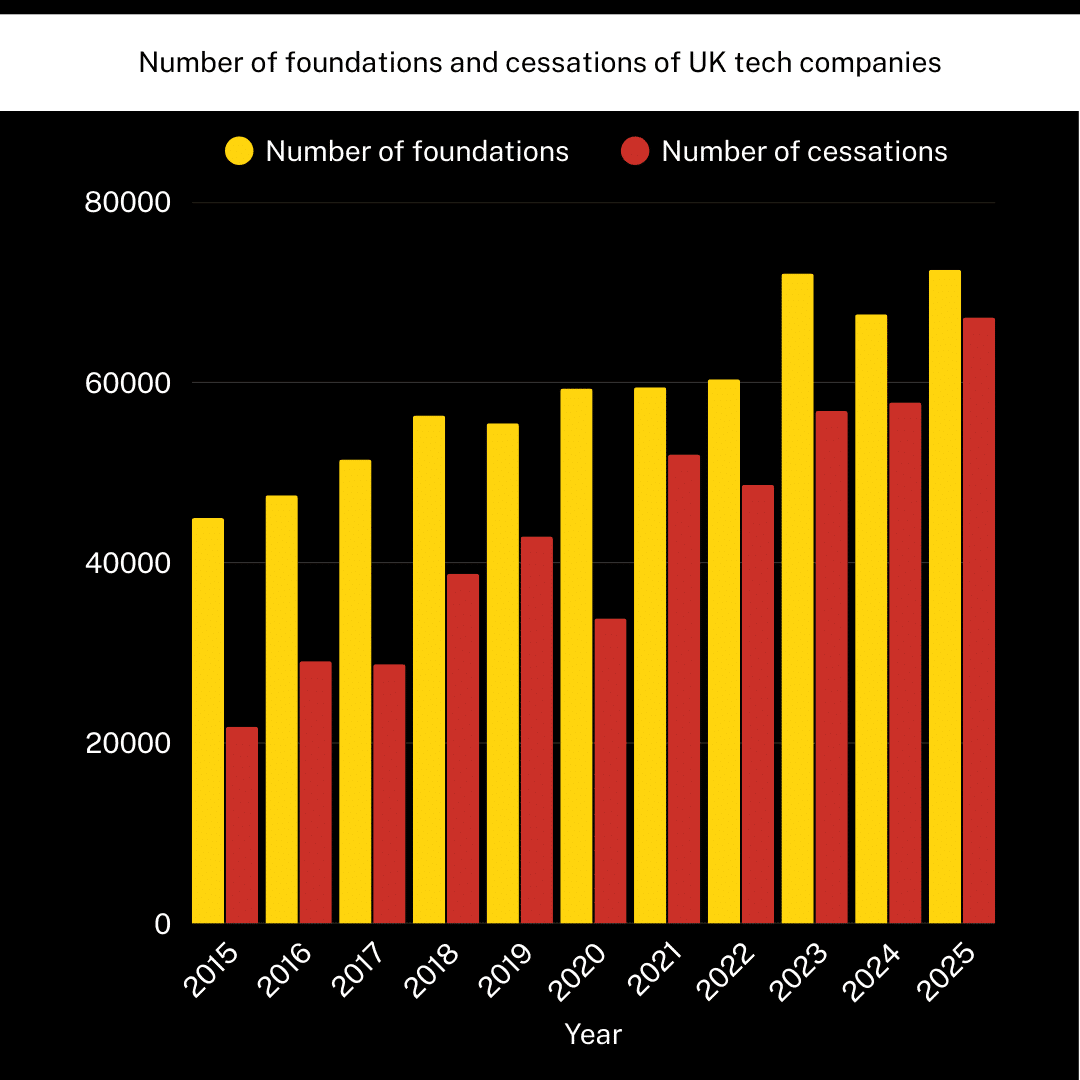
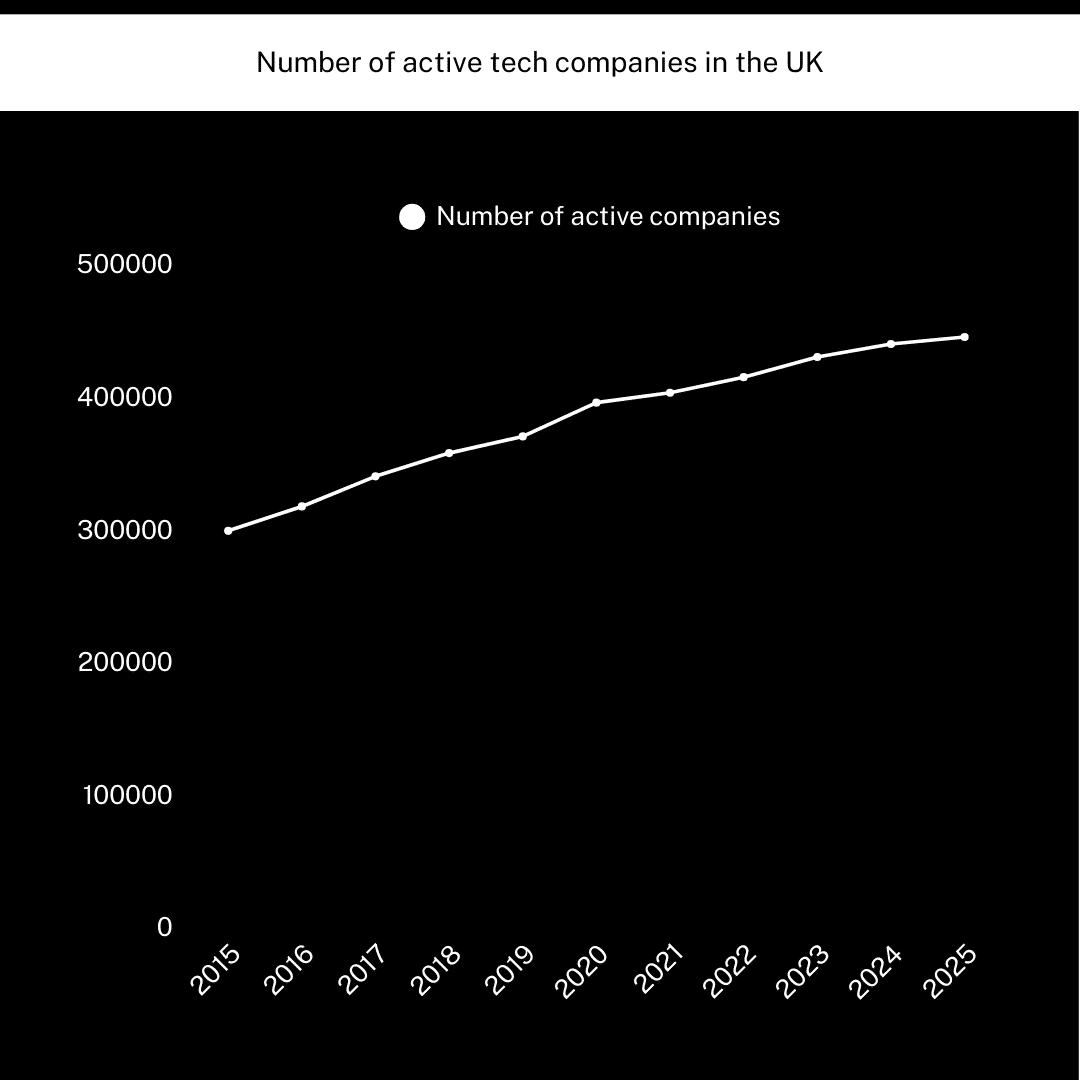
Looking more broadly, the number of active technology-focused companies in the UK has steadily grown over the past decade. In 2025, there were a record 370k tech companies active in the UK.
If we layer on our Growth and Innovation Signals to this search, we can explore how high-growth tech companies are performing in the UK. There are 40.9k UK tech companies that have hit one or more of our Growth or Innovation Signals – just over 10% of all active tech companies. This group has also grown steadily since 2015, with only a marginal dip between 2024 and 2026.
It’s evident also that funding into these innovative companies remains stable, with a yearly increase in amount raised since 2023 (£18.1b raised in 2023 up to £20.1b in 2025).
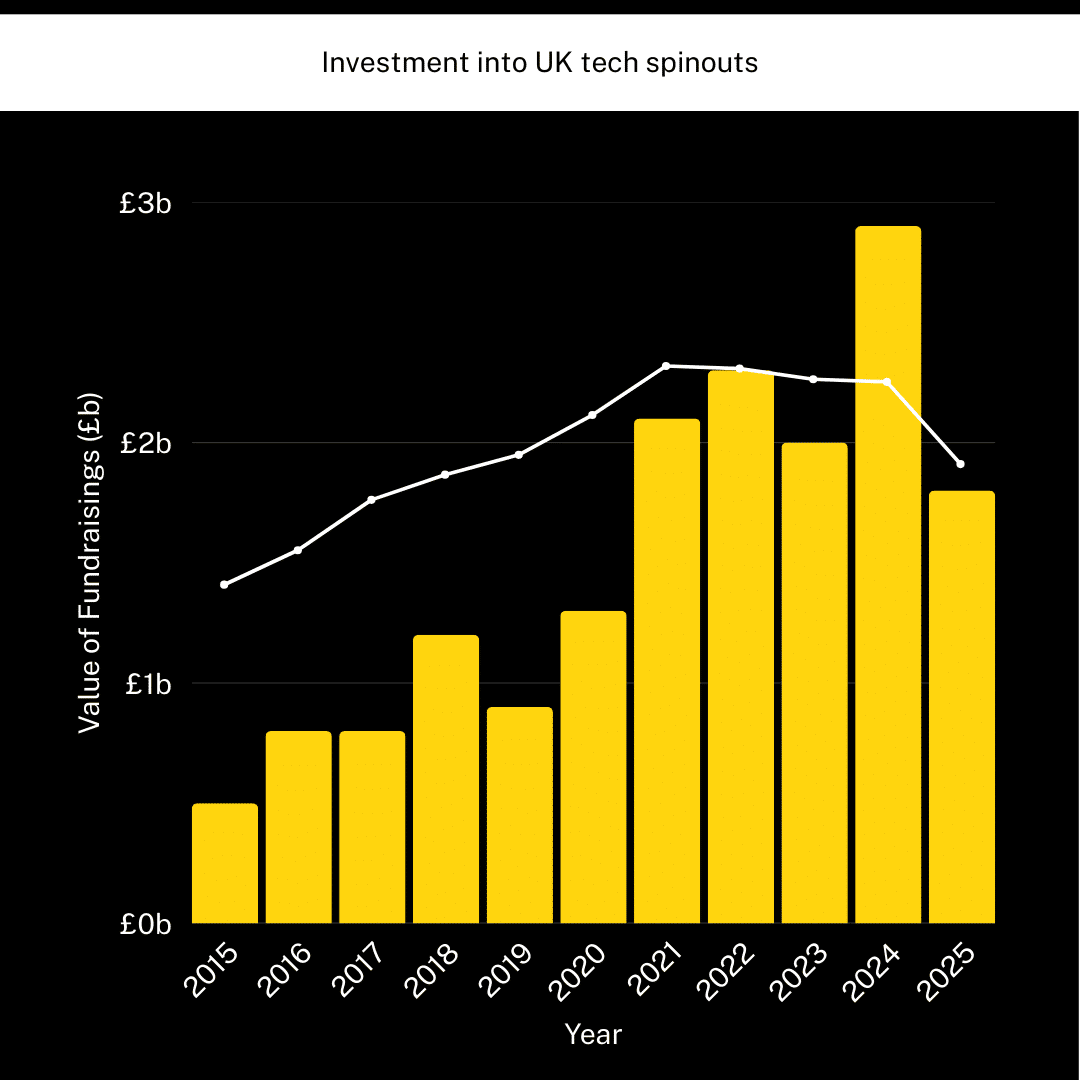
Similarly, university spinout formation — a key indicator of deep innovation — has remained resilient in the tech field. The number of UK tech spinouts hit an all-time high in 2024, with 1,793 active companies. Since then, it has declined but only very marginally, to 1,720 companies. Overall, the number has remained broadly stable since 2022, when there were 1,726 active tech spinouts.
Tech spinouts in the UK also had their strongest funding year in 2024, with £2.85b raised across 410 funding rounds. While there was a dip in funding again in 2025, it shows us that funding into UK tech spinouts doesn’t always correlate with the downwards trend of funding we’ve seen since 2021, and that funding into these tech companies remains resilient despite a decline of funding overall.
If innovation were truly slowing, we would expect to see consistent declines across these early-stage indicators. That is not currently evident.
Innovation activity continues beneath the surface
R&D funding
Patent data
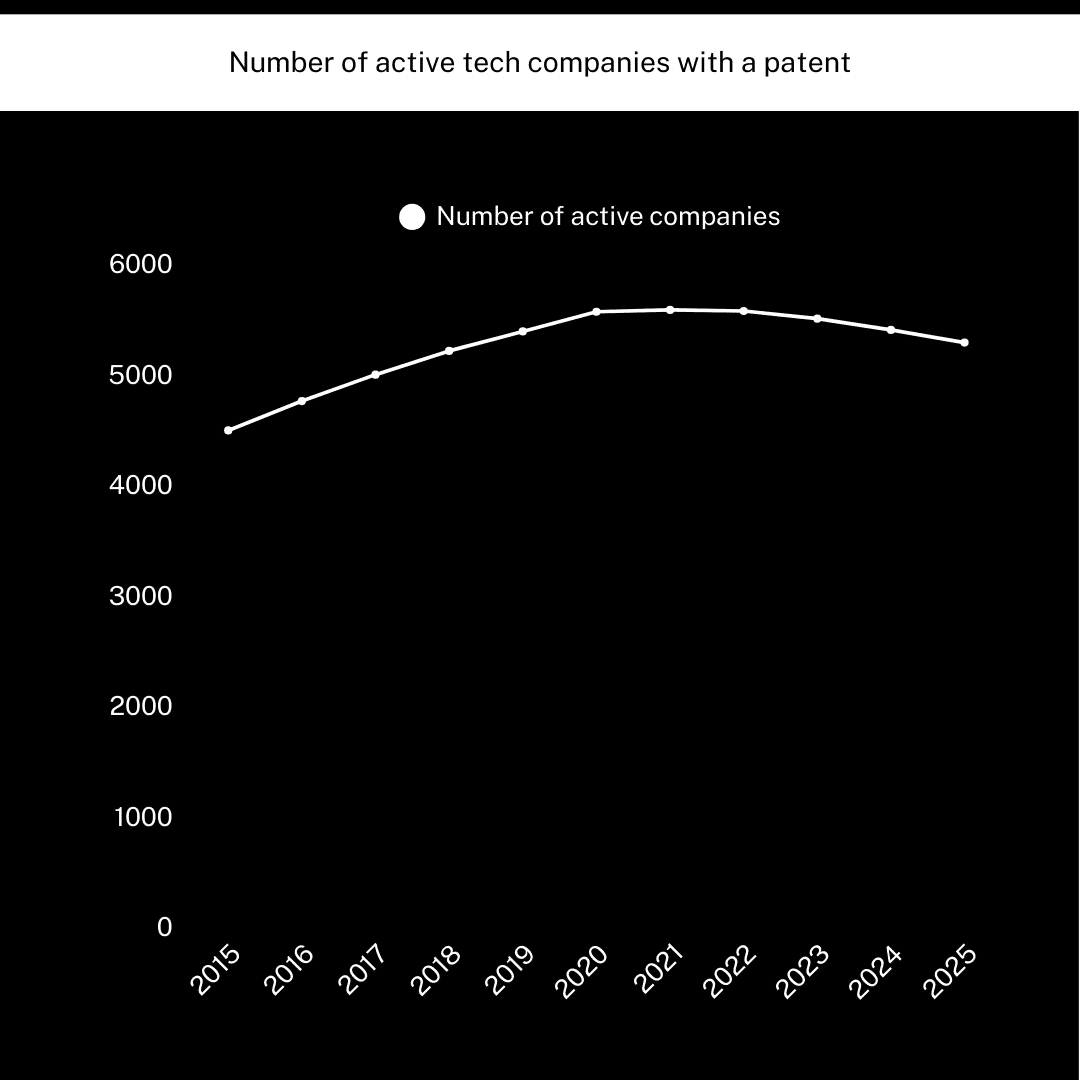
Patent data offers a longer-term lens on innovation, reflecting research that may take years to progress from discovery to approval.
While the number of companies holding patents has remained relatively flat since 2020, this stability is encouraging. It suggests businesses have continued to invest in protecting new ideas despite a challenging economic backdrop. And when viewed over the past decade, the sustained level of patent activity points to a more established and resilient innovation ecosystem — one that continues to lay the groundwork for future breakthroughs.
Grants
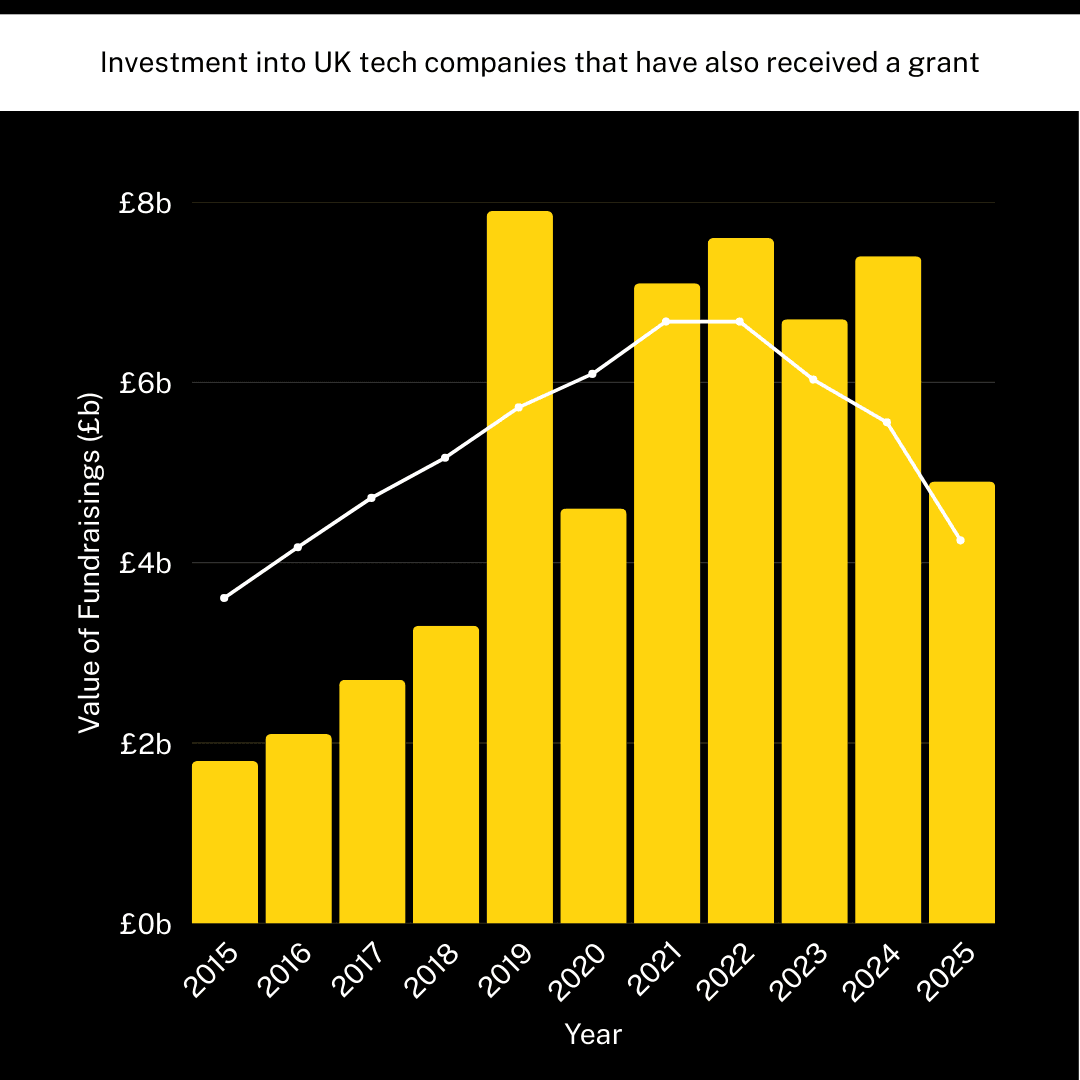
When we look at innovation grant data, it paints a similarly steady picture to the patent landscape. The number of UK tech companies receiving grants has remained relatively consistent in recent years, following stronger growth over the past decade.
An encouraging signal emerges when examining fundraisings among grant-backed tech companies. Within this group, investment levels have remained noticeably more stable, with fewer sharp fluctuations than the wider tech funding market. This suggests that grant-backed companies may be more resilient, benefiting from early support that helps them build stronger foundations and navigate changing market conditions.
Combining this data
By combining these three data points, we find a unique view of tech innovation in the UK.
A more complete view of the UK’s tech ecosystem includes tech companies that have:
- Been awarded a patent
- Received R&D equity funding
- Received an innovation grant
Combining these signals provides a different view of innovation across the UK tech sector.
Looking specifically at UK tech companies that have been awarded a patent, received R&D equity funding, and secured grant support, we can identify businesses that are not only raising capital but actively developing defensible technology.
Using this approach, 530 companies in the UK currently meet all three criteria. While the overall number of tech companies has broadly plateaued since 2020, the number combining these deeper innovation signals has steadily increased since 2015, reaching a record high in 2025.
These indicators point to a more resilient innovation ecosystem than headline funding figures suggest. Headline investment figures may fluctuate, but the signals associated with meaningful technical progress remain resilient.
The steady rise in businesses combining patents, R&D funding, and grant backing is particularly significant. It suggests that a growing share of the ecosystem is focused on developing proprietary technologies rather than pursuing short-term growth alone. In other words, while the number of companies may not be expanding rapidly, the innovation intensity within the ecosystem is increasing.
“A growing share of the ecosystem is focused on developing proprietary technologies rather than pursuing short-term growth alone.”
UK tech is not defined by a single metric
The tech sector is shaped by a combination of capital, talent, innovation, and company formation. No single metric can capture its full trajectory.
Funding has slowed from recent highs. But other indicators suggest continued underlying momentum.
- Overall tech company formations are at a record high
- Funding into innovative tech companies remains stable
- And the number of these innovative tech companies is slowly but steadily increasing
This distinction matters. Funding cycles come and go. Innovation cycles are longer, and more consequential. Periods of reduced capital deployment are not unusual. They are part of the normal evolution of a mature innovation ecosystem. The key question is not whether funding has slowed, but whether innovation itself has. The data suggests it has not.
Discover our data.
Get access to unrivalled data on the companies you need to know about, so you can approach the right leads, at the right time.
Schedule a conversation today to see all of the key features of the Beauhurst platform, as well as the depth and breadth of data available.
We’ll work with you to build a sophisticated search, returning a dynamic list of organisations that match your ideal customer profile.
Beauhurst Privacy Policy