Replacing WZ Codes: Find German Industry Data
Key takeaways
- The WZ classification system hasn’t been revised since 2008, meaning it fails to accurately reflect new industries.
- Because companies can only select one primary code and self-reporting can lead to inaccuracies, it's poorly suited for commercial analysis.
- Beauhurst Industries is a smarter, up-to-date alternatives, combining expert tagging with machine learning to map the modern business economy.
WZ Codes have a problem — they don’t represent the modern German business economy as it is right now.
The last time that WZ Codes were revised was in 2008. That means any German company operating in a high-growth industry that has emerged since 2008, like AI or fintech, won’t be accurately represented by the WZ Codes system. The same is true of SIC codes in the UK, last revised in 2007. These outdated methods of categorising industries just don’t represent Europe’s fast-moving industries.
Likewise, the European Union’s NACE classification system, though updated more frequently, has a similar challenge. And whilst a 2025 update is currently in the works, it’s an imperfect system that does not scale well with the level of innovation in Europe.
At Beauhurst, we have a better solution: Beauhurst Industries. Read on to understand the (im)practicality of using WZ codes in the modern economy, and why our clients use Beauhurst Industries instead.
What are WZ codes?
WZ Codes is a classification system designed to define what a company in Germany does. Rather than being a simple descriptive label, a WZ code is a statistical and regulatory identifier that locates a business within a clearly defined branch of the economy.
Each WZ code is part of a hierarchical framework maintained by Destatis, Germany’s Federal Statistical Office. The framework consists of:
- 21 broad sections (identified by letters A–U), such as Manufacturing, Information and Communication, or Health and Social Work.
- More specific divisions, groups, classes, and subclasses beneath each section, narrowing down to very detailed descriptions of a company’s core activity.
At its most specific level, a WZ code is a five-digit numeric identifier that describes the primary economic activity of the business (e.g. 71.12.0 – Engineering activities and related technical consultancy)
Because of this hierarchical structure, WZ codes enable analysts, policymakers, and statisticians to compare like-for-like across companies, regions, and even internationally, with the WZ system aligning closely with the EU-wide NACE Rev. 2 standard.
What's the Best Database for Company Information?
Uncover the features of various databases for company information to enhance your research and business decisions.
The limitations of WZ codes
As industries emerge — particularly in tech-based disciplines—some WZ definitions have become less reflective of modern businesses, prompting ongoing efforts to update the system.
This is particularly evident when you consider that around 200k active German companies are defined vaguely as ‘activities of holding companies’ and ‘management activities of holding companies’.
01. Lagging behind emerging industries
The current standard, WZ 2008, hasn’t been fully revised in over 15 years.
This means that it’s missing modern industries, including application software, web hosting, sensors, and data centres. Other areas, including renewable energy, e-commerce niches, and cryptocurrency services often lack a dedicated code.
This means that workarounds are often required when reporting, forcing businesses to use generic or outdated categories, which can blur important distinctions for research and policymaking.
02. Rigid and hierarchical
The five-digit numeric structure works well for traditional industries but struggles to capture hybrid business models — for example, a company that is both a software platform and a logistics provider.
Unfortunately, a firm can only list one primary WZ code, even if its revenue streams span multiple sectors. This can mean that secondary activities are omitted.
03. Reliability is dependent on self-reporting
When companies register, they typically choose their own code from the list. This can result in misclassifications, either by accident or for strategic reasons. For example, some owners could theoretically assign a tangentially related WZ code for more favourable discoverability.
Ultimately, these inconsistencies can distort industry-based statistics and speaks to the challenge of performing high quality market research with legacy classification tools like the WZ system.
04. Inconsistent detail across sectors
Certain industries, especially manufacturing, are described in high granularity (e.g., “Processing and preserving of poultry meat”).
On the other hand, service and knowledge-based sectors often have broad, catch-all categories, such as “Other information technology and computer service activities” or “Other professional, scientific and technical activities,” which barely define the nature of the work.
This imbalance can hinder meaningful cross-sector comparisons.
05. Not designed with commercial insight in mind
Much like the UK’s SIC codes, the WZ system was created with statistical and regulatory purposes in mind, rather than sales targeting, investment research, or competitive analysis.
Our own clients tend to find WZ codes poorly suited for market intelligence, and instead prefer using company data providers (like us) that offer more flexible, up-to-date taxonomies.
The alternative: Beauhurst Industries
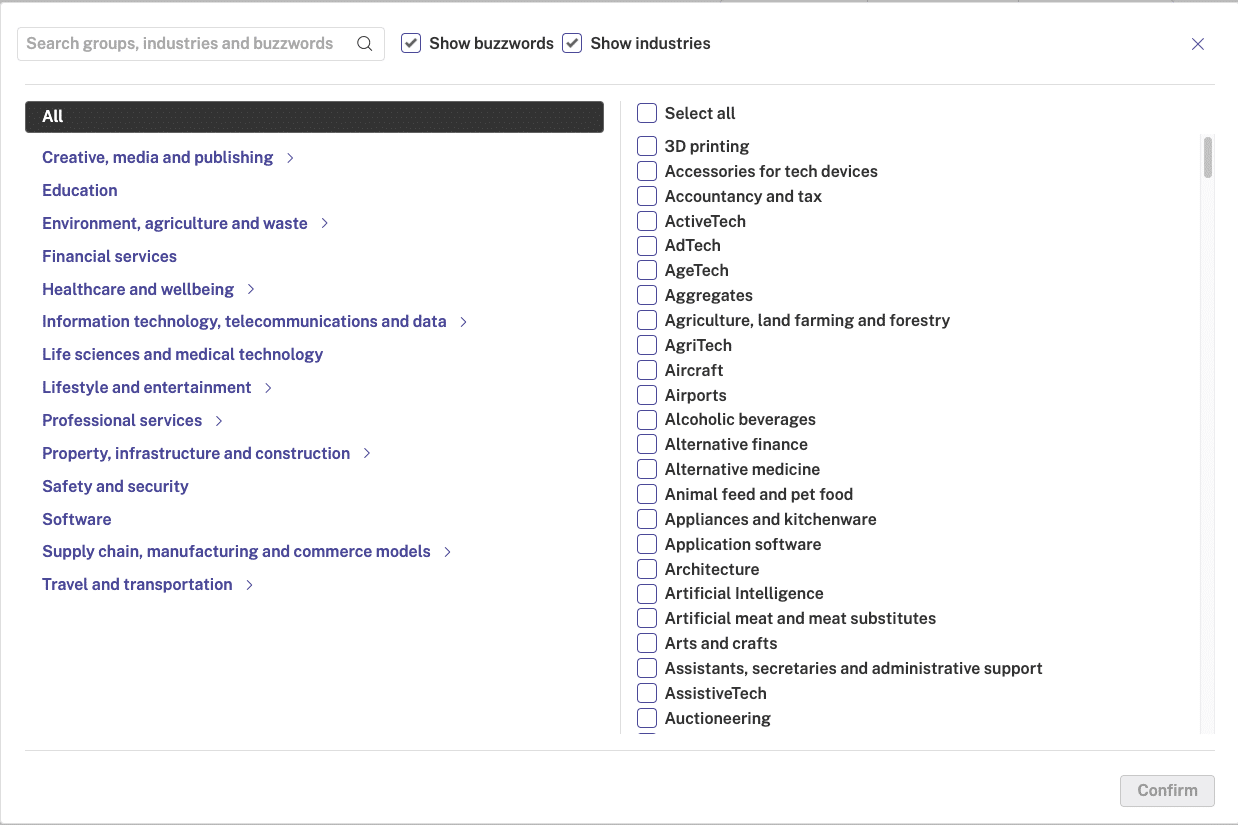
Industries is our answer to dated systems like WZ and SIC codes, featuring both traditional and emerging industries.
For example, we cover both agriculture and agritech, banking and fintech, and manufacturing and robotics. This means that subscribers to the Beauhurst platform get a more holistic view of the market, and the businesses that operate within it.
Simply put, we’re defining the complete business economy as it is now, rather than as it was then.
How we did it
For over 14 years, we’ve blended machine learning models with years of industry expertise, which means you benefit from expansive, authoritative industry coverage across Germany and the UK.
The result is a set of ever-expanding industries that streamline the complexity of WZ codes, whilst also delivering the depth necessary to analyse the modern business economy.

How it works
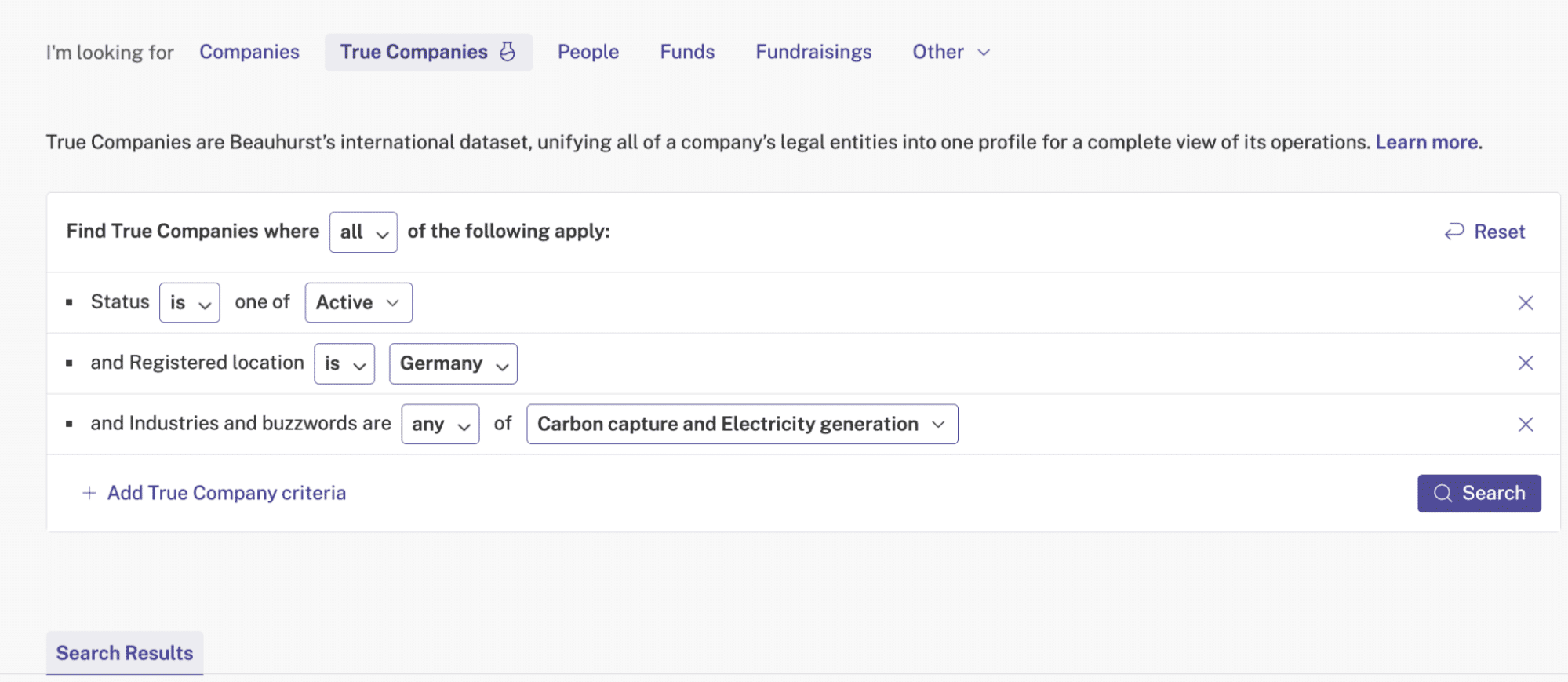
Let’s say you’re looking for German companies powering the energy transition, such as energy storage and renewables firms. Firstly, boot up Advanced Search on Beauhurst and select ‘True Companies’.
From here, you’ll want to add the Registered location as Germany— and select the status as ‘Active’ to ensure the businesses returned are still operating. Next, select the Industries and Buzzwords that describe the companies you’re interested in, such as Carbon capture and Electricity generation.
This will return a complete list of German companies working in those two specific industries of energy storage and electricity generation.
Map the German Economy with Beauhurst
Want to stay ahead of the curve and track companies in Germany? Beauhurst provides the intelligence you need to identify the companies shaping the economy of today — and the emerging industries of tomorrow.
With powerful search tools, real-time alerts, and comprehensive coverage of high-growth sectors — now expanded to include Germany’s innovation landscape — you’ll always have the insights to uncover opportunities before anyone else.
To see the data in action, why not take a tour of the Beauhurst platform? Or, to speak to a member of the team, simply fill in the form below and we’ll be in touch.
Discover our data.
Get access to unrivalled data on the companies you need to know about, so you can approach the right leads, at the right time.
Schedule a conversation today to see all of the key features of the Beauhurst platform, as well as the depth and breadth of data available.
We’ll work with you to build a sophisticated search, returning a dynamic list of organisations that match your ideal customer profile.
Beauhurst Privacy Policy