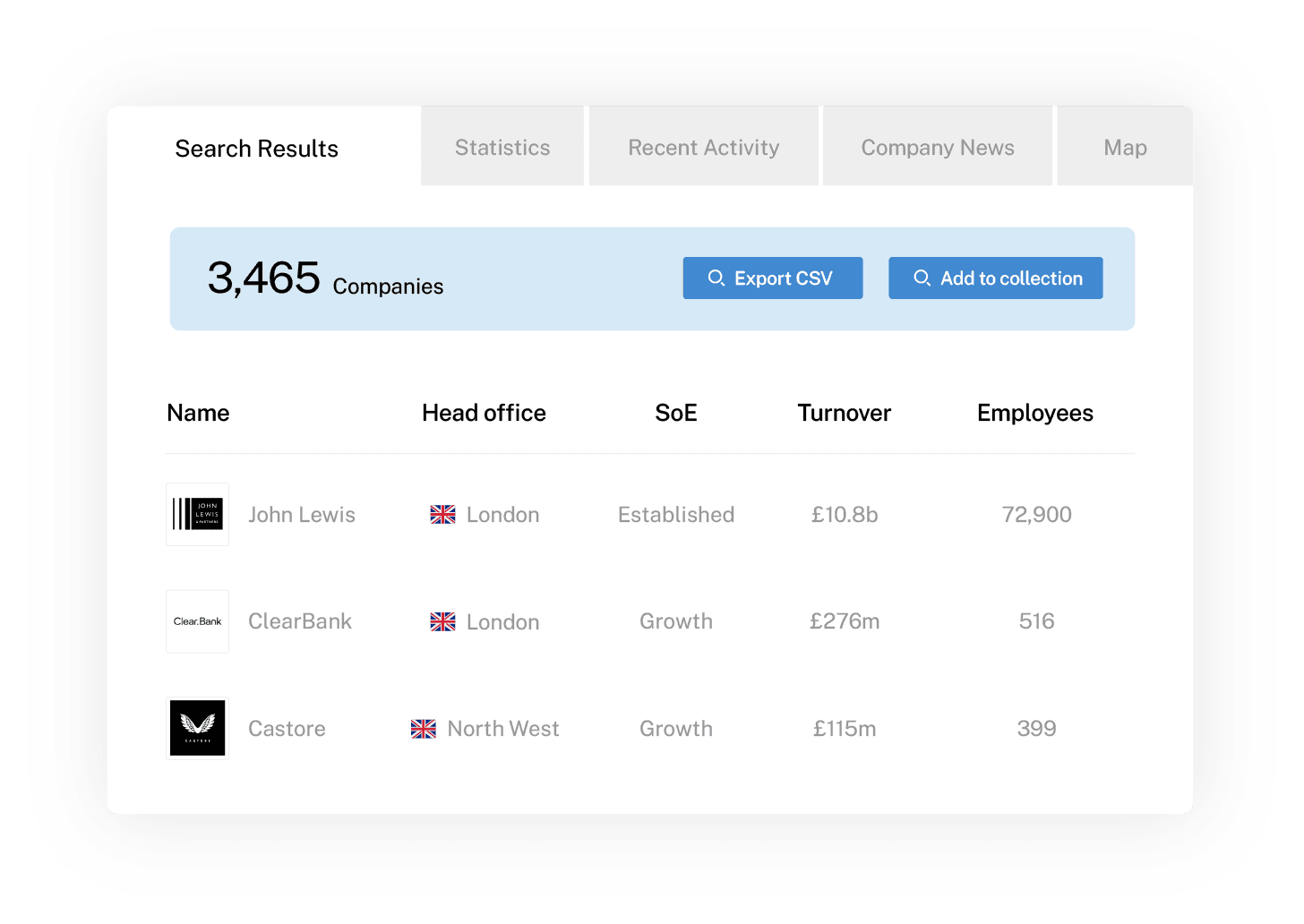
Best Tools for Qualifying Corporate Finance Prospects
The right tools should turn fragmented company data into fast, confident qualification decisions.
Finding corporate finance prospects is hard; qualifying them is even harder.
It’s challenging to find a fast, consistent way to assess fit, financial health, and deal readiness. The result of getting it wrong is wasted time and budget, inconsistent decisions, and missed opportunities.
This guide covers the best tools for qualifying corporate finance prospects in the UK and how to use them together to build a smarter, more efficient workflow.
What does it mean to “qualify a corporate finance prospect”?
Qualification is the process of determining whether a company is a good fit for your services.
It typically comes down to four questions:
- Does this company fit the target profile (size, sector, geography, etc)?
- Is it financially strong enough to transact?
- Who owns it, and how is it structured?
- Is there a reason to engage now?
These questions are what separate a long list of companies from building a meaningful pipeline of opportunities.
Why generic sales tools fall short for corporate finance
Most prospecting tools are built for SaaS sales teams. These platforms are designed to help users find contacts and automate outreach.
But corporate finance workflows are fundamentally different.
Advisers are not just looking for leads — they are looking for future transactions. That requires a deeper understanding of:
- Financial performance
- Ownership and shareholder dynamics
- Growth trajectory
- Strategic signals
The qualification criteria that actually matte
Effective corporate finance qualification tools are typically built around five key factors:
- Fit: sector, size, geography, and deal type
- Financial health: revenue, growth, and profitability
- Ownership: shareholders, PE backing, and group structure
- Deal readiness: whether the business is ready for a transaction
- Timing: trigger events that indicate a potential transaction window
How to Find Potential Clients for Corporate Finance Services
Get a detailed breakdown on how Beauhurst helps corporate finance professionals find clients.
What to look for in a corporate finance qualification tool
As with deal sourcing, the effectiveness of a qualification tool depends on the quality of its data and how easily it fits into your workflow.
1. Depth of company financial, ownership, and transaction data
For UK-focused firms, relevance matters more than scale. Platforms with strong domestic coverage and structured data provide a much clearer picture of potential clients than global databases with limited depth.
Equally, financials, ownership structures, and transaction history are essential for understanding whether a company is worth pursuing.
2. Trigger event tracking
Qualification is not just about identifying good companies — it’s also about identifying them at the right time.
Signals such as fundraisings, acquisitions, and leadership changes often indicate a window where a business may need advice. Tools that surface these signals in real time allow teams to prioritise outreach more effectively.
3. Filtering and scoring capabilities
The ability to define and apply an ideal client profile is critical.
Strong filtering allows teams to move from broad market coverage to a focused list of high-potential companies, while scoring helps prioritise where to spend time.
Good tools should help to:
4. Workflow integration
Qualification doesn’t happen in isolation. Tools that integrate directly into existing workflows ensure that prospects are tracked consistently. For example, LinkedIn connectivity supports fast engagement while CRM integration ensures prospects are tracked consistently.
This kind of seamless integration reduces manual data entry errors and ensures that no qualified lead is lost between initial contact and final follow-up stages.
The best tools for qualifying corporate finance prospects
The market for corporate finance qualification tools is fragmented. Many platforms specialise in one particular stage of a workflow, meaning teams have to rely on a combination of tools.
The key is understanding the role each one plays.
Beauhurst — UK and German private company data, signals and trigger events
Beauhurst is a comprehensive private company data platform with deep coverage of UK and German companies.
It enables teams to move beyond surface-level research and build a clear picture of every private company in these markets, allowing you to:
- Build targeted lists based on ICP criteria
- Analyse financials, ownership, transactions, and growth signals
- Get automatic updates on trigger events like fundraisings and acquisitions
- Set alerts to time outreach effectively
Crucially, Beauhurst also brings these insights into a single workflow. Features like advanced search, alerts, and Collections make it possible to move from longlisting to prioritisation without switching between tools, and CRM integrations allow you to keep data live and synced across your systems.
Discover our data.
Get access to unrivalled data on the companies you need to know about, so you can approach the right leads, at the right time.
Schedule a conversation today to see all of the key features of the Beauhurst platform, as well as the depth and breadth of data available.
We’ll work with you to build a sophisticated search, returning a dynamic list of organisations that match your ideal customer profile.
Beauhurst Privacy Policy
PitchBook —global transactions and corporates data
PitchBook is a research tool that provides global coverage of large and equity-funded companies, including deal data, private equity activity, venture capital, and financial benchmarking.
It is particularly useful for cross-border transactions and market analysis, although its focus on global coverage means it can lack the depth of UK private company insight needed for detailed qualification workflows.
Mergermarket — M&A intelligence and rumour tracking
Mergermarket focuses on M&A intelligence, providing insights into deal origination, market rumours, and transaction activity.
M&A prospect research tools, like this one, are particularly useful for tracking live deal signals and understanding broader market sentiment, but they are best used alongside deeper company data sources that can validate financial health and ownership structure.
Crunchbase —basic funding data
Crunchbase is a cheap and widely used platform for identifying startups and tracking venture funding activity.
Its low price makes it a very accessible tool. However, it offers less depth when it comes to detailed financial or ownership-based qualifications.
Companies House — free UK filings and ownership baseline
Companies House provides the foundational dataset for UK company information, including official filings, director details, and basic ownership structures.
While it is a good reference point, its raw format and lack of filtering, insights, transaction data, and alerting functionality make it difficult to use efficiently as a standalone corporate finance qualification tool.
ZoomInfo / Cognism — contact data and decision-maker discovery
ZoomInfo and Cognism are primarily contact data platforms that help teams identify decision-makers, enrich contact information, and support outreach activities.
They are useful for engagement once prospects have been qualified, but they do not provide the data required for effective corporate finance qualification.
LinkedIn Sales Navigator — relationship mapping and outreach
LinkedIn Sales Navigator supports stakeholder mapping and relationship building by helping teams identify decision-makers, track career changes, and understand organisational structures.
It is most effective as an engagement tool rather than a qualification platform, complementing deeper data sources within the wider workflow.
How to combine these tools into a corporate finance qualification workflow
As mentioned above, most teams don’t rely on a single prospect qualification software for corporate finance.
But some platforms, like Beauhurst, do more than others, combining functions to create a structured workflow.
This process typically follows four stages.
1. Source — build a long list using market data platforms
Use platforms like Beauhurst to identify relevant companies and build an initial list. The goal at this stage is breadth of coverage — capturing a wide enough universe of potential targets before narrowing down.
Strong data coverage is essential here, as incomplete or inconsistent datasets will limit the quality of everything that follows.
2. Score — apply your ICP and qualification criteria
Filter and prioritise companies based on:
- ICP fit
- Financial performance
- Ownership structure
This step turns a broad, long list into a focused set of high-potential prospects. Teams typically combine structured data with internal ICP definitions to ensure consistency across analysts and deal teams.
3. Time — use trigger events to prioritise outreach
Use trigger events such as fundraisings, acquisitions, and leadership changes to identify when companies are most likely to transact. These events often indicate a shift in strategy or capital structure that creates advisory opportunities.
Prioritising based on timing ensures teams focus their effort where the probability of engagement is highest.
4. Engage — pull contact data and personalise outreach
Layer in contact data and relationship insights, then manage outreach through your CRM. At this stage, the focus shifts from analysis to execution, ensuring the right message reaches the right decision-makers. Personalisation is key, particularly in corporate finance, where context and timing significantly impact response rates.
Many of the UK’s most active advisers follow structured, data-led approaches like this, as highlighted in Beauhurst’s Corporate Finance Advisory Power List. This consistency helps teams scale outreach without losing quality. It also ensures that qualification insights are effectively translated into real pipeline activity.

Take a tour
How Beauhurst supports corporate finance qualification
Beauhurst brings together many aspects of the corporate finance qualification workflow in one platform.
It centralises the key data points teams need to move from initial sourcing through to prioritisation and engagement.
- Filter millions of UK and German companies by your ideal client profile: quickly narrow broad markets into targeted shortlists based on sector, size, and growth.
- Score prospects using financials, signals and ownership data: combine multiple data layers to assess fit and prioritise opportunities with consistency.
- Set alerts on trigger events to time outreach perfectly: track fundraisings, acquisitions, and key signals to engage at the right moment.
- Integrate with your CRM and existing sales workflow: connect seamlessly to ensure insights flow through to pipeline management and outreach while maintaining full visibility across the business development process.
Qualify prospects with Beauhurst
Qualification is the most overlooked, and often most important, part of corporate finance business development.
While many tools focus on outreach, fewer are designed to answer the more important question: which companies are actually worth pursuing?
For UK-focused firms, this means prioritising platforms that provide both relevance and depth, and integrating them into a clear, repeatable workflow.
If you want to see how leading advisory teams are already doing this in practice, explore the Beauhurst platform and discover how better data can transform your qualification process.
People also ask
Corporate finance firms use data platforms like Beauhurst to source, analyse, and prioritise opportunities. These platforms combine company data, financials, and market signals to streamline qualification and reduce reliance on multiple tools.
Beauhurst is widely used for assessing UK private company financials, offering structured data alongside insights into growth, ownership, and market activity.
Lead qualification involves assessing a company against your ideal client profile using financial performance, sector, size, growth indicators, ownership structure, and recent activity. A strong qualification platform brings these data points together to help prioritise opportunities based on fit and timing.
Key data includes financials (revenue, EBITDA, growth), ownership and shareholder structure, sector classification, funding history, and trigger events such as acquisitions or leadership changes, all of which can be accessed in one place.
Companies House is a useful starting point, but it lacks enriched insights, filtering, and real-time signals. Additional data platforms help turn raw filings into actionable intelligence.
Indicators include consistent revenue growth, strong profitability, scalable operations, clear ownership structures, and recent strategic activity such as fundraising or acquisitions.
The best CRM depends on your team’s size and workflow, but the key is ensuring it integrates with your data source so that qualification insights carry through into pipeline management and outreach.
Discover our data.
Get access to unrivalled data on the companies you need to know about, so you can approach the right leads, at the right time.
Schedule a conversation today to see all of the key features of the Beauhurst platform, as well as the depth and breadth of data available.
We’ll work with you to build a sophisticated search, returning a dynamic list of organisations that match your ideal customer profile.
Beauhurst Privacy Policy