
How to Find Potential Clients for Corporate Finance Services
For decades, corporate finance firms have relied on the same model for winning work: build a strong network, maintain relationships, and wait for opportunities to surface.
That model still has value, but on its own it creates an unpredictable pipeline. Referrals arrive in waves, not consistently. And by the time an opportunity reaches you, it’s often already competitive.
That’s why more firms are rethinking how they find potential clients for corporate finance services. Instead of relying purely on relationships, they’re adopting a more proactive, data-led approach to corporate finance client acquisition — one built around identifying the right mandates and prospective clients at the right time, particularly business owners approaching key inflection points.
What does client acquisition look like in corporate finance?
The difference between CF prospecting and retail financial advice
Much of the advice on client acquisition in finance is designed for retail financial advisers, focusing on individuals rather than corporate transactions. It emphasises visibility such as building a personal brand, networking locally, and staying front of mind.
Corporate finance operates differently. The challenge isn’t being known; it’s being relevant at the exact moment a business needs advice.
Firms are not looking for ongoing financial guidance, they’re entering inflection points. A founder or management team begins to consider an exit. A scaleup prepares for its next funding round. A PE-backed business looks to begin a sale process.
Effective prospecting for corporate finance firms is therefore less about reach and more about timing. The firms that consistently win mandates are those that can identify these moments early, often before they become widely visible.
Buy-side vs sell-side — different prospecting approaches
This becomes even clearer when you look at the difference between buy-side and sell-side work.
Sell-side mandates tend to originate from moments of change: ownership transitions, growth milestones, or strategic shifts. Buy-side mandates, by contrast, require a continuous view of the market — a clear understanding of which companies are scaling, consolidating, or becoming attractive acquisition targets.
In both cases, success depends on the same underlying capability: the ability to track companies over time and recognise when they are likely to need corporate finance support.
Traditional methods for finding corporate finance clients
Referral networks and intermediary relationships
Relationships remain central to corporate finance business development, particularly as firms look to build relationships with intermediaries and existing clients who can introduce opportunities. Accountants, lawyers, and existing clients continue to play a key role in making that happen.
But there is a structural limitation. Referral-led pipelines are inherently reactive. They depend on external timing and often surface opportunities only once they are already in motion.
For firms trying to scale their corporate finance client acquisition, this creates a ceiling. Growth becomes tied to network size rather than market opportunity.
Industry events and professional networks
Events and organisations such as the ICAEW Corporate Finance Faculty provide valuable visibility and relationship-building opportunities.
They are effective for maintaining presence within the market. However, they rarely provide a systematic way to find potential clients for corporate finance at the point of need. Like referrals, they tend to reinforce existing networks rather than expand them in a targeted way.
LinkedIn and visibility-led approaches
LinkedIn and other social media have become a core channel for many firms, particularly for sharing deal credentials and building credibility. It plays a role in staying visible — especially in competitive mid-market segments.
But visibility alone does not equate to opportunity. Without a way to identify which companies are actively approaching a transaction moment, outreach risks becoming broad and unfocused.
How to use data to find corporate finance clients
The shift happening across the industry is subtle but important. Instead of asking “who do we know?”, firms are increasingly asking “which companies are most likely to need us right now?”
This is where data becomes critical, providing valuable insights into which companies are most likely to require corporate finance support.
A data-led approach to client acquisition allows firms to move from reactive to proactive origination. Rather than waiting for opportunities to surface, they can identify companies entering key phases — growth, transition, or pressure — and engage earlier in the process.
This has two immediate effects. First, it increases the volume of potential opportunities by expanding beyond existing networks. Second, it improves conversion rates by aligning outreach with genuine need.
Key signals that indicate a company needs corporate finance services
What distinguishes a high-quality prospect is not just who they are, but what they are going through.
Certain events consistently signal that a company may require corporate finance support. Fundraising activity is one of the clearest. When a business raises capital, it is often entering a new phase of growth, bringing with it strategic decisions around expansion, acquisitions, or eventual exit.
Changes in ownership structure can indicate similar shifts. A new investor, a management buyout, or a restructuring of shareholdings often precedes further transaction activity.
Business growth itself is another strong indicator. Rapid increases in headcount or revenue tend to introduce complexity, and with it, the need for advice around funding, strategy, or exit planning.
At the other end of the spectrum, signs of financial pressure can point towards restructuring or distressed M&A opportunities. While very different in nature, these situations are equally important within a comprehensive corporate finance deal sourcing strategy.
A more nuanced, but highly predictive, signal sits around ownership and succession. Businesses led by ageing founders or long-standing shareholders often reach a point where exit planning becomes a priority, particularly when paired with strong recent performance.
When a company shows consistent headcount growth over the past one to five years alongside increasing turnover or EBITDA, it suggests a business that has successfully scaled and may now be approaching a natural transition point. In these cases, succession planning, partial exits, or full sale processes become far more likely, making this combination of maturity and momentum a particularly compelling trigger for corporate finance engagement.
Individually, these signals are useful. But the real value lies in how they intersect. A founder approaching succession alongside sustained growth, or a recent fundraise coupled with rapid headcount expansion, are not isolated data points—they are moments of inflection.
By identifying and prioritising these overlapping signals, corporate finance teams can focus their efforts on the companies most likely to transact, at precisely the right time.
Take a tour
How to build a proactive corporate finance pipeline — and how to win mandates
Building a consistent pipeline is only part of the equation. The firms that outperform are those that understand not just how to find opportunities, but how to win mandates once those opportunities are identified.
From there, the process becomes one of filtering and prioritisation. Instead of broad lists, the goal is to create a high-quality origination approach by identifying a defined set of companies.
Research consistently shows that targeted, data-driven origination outperforms broad outreach approaches. In fact, according to Outreach, data-driven business development can outperform intuition-based approaches by up to 3x in conversion rates.
Another advantage comes from continuity. By tracking these companies over time, firms can move beyond one-off outreach and instead build informed, timely engagement strategies. Conversations become more specific, grounded in real developments rather than generic introductions.
This is where many firms see a step change in results. Origination becomes more targeted, conversations more relevant, and conversion rates higher.
How Beauhurst helps corporate finance professionals find clients
This shift towards data-led origination is exactly what platforms like Beauhurst are designed to support.
Rather than relying on fragmented sources, Beauhurst brings together detailed intelligence on UK companies, allowing firms to identify and track potential clients with far greater precision.
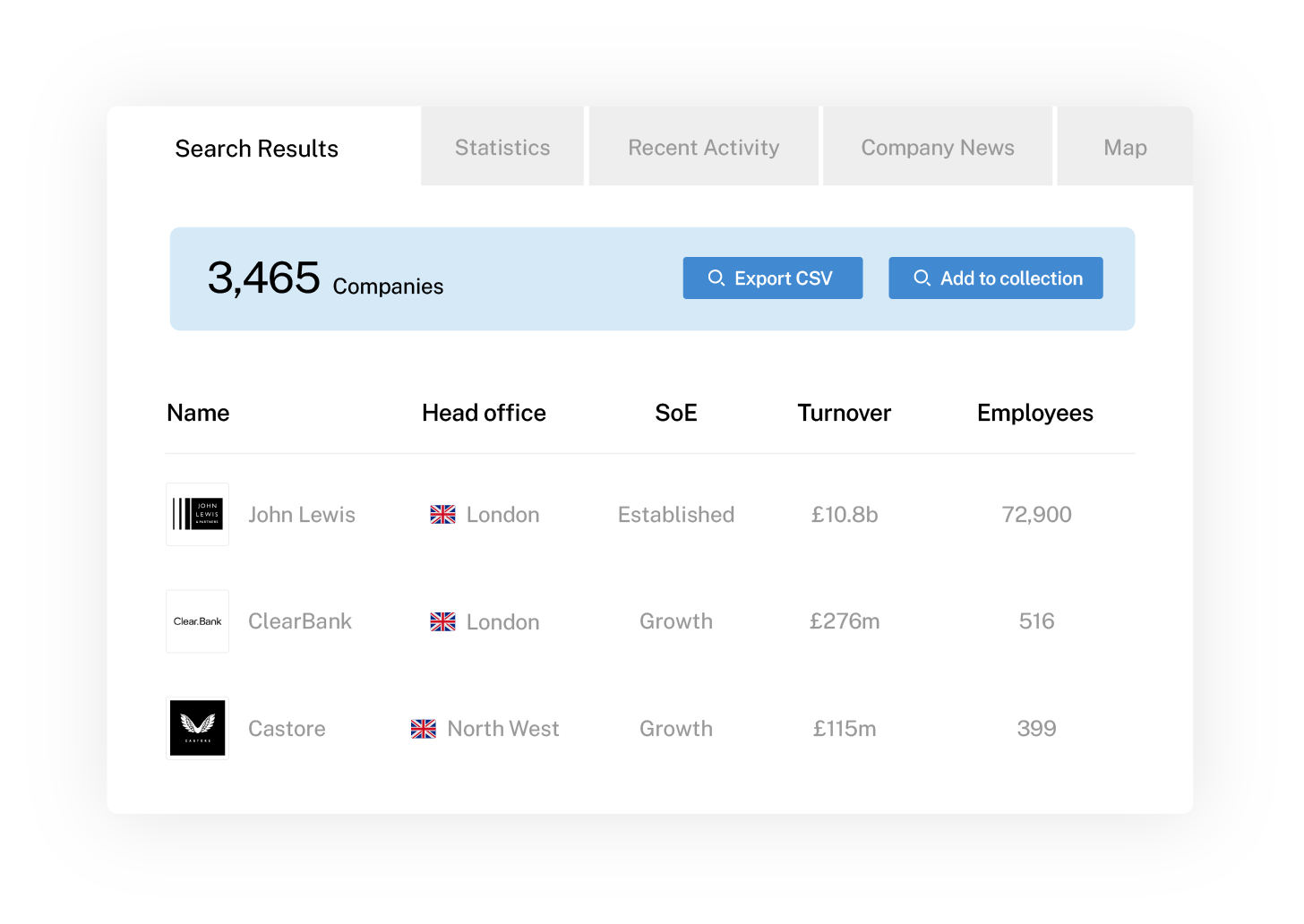
At its core, the platform enables teams to search across millions of companies using highly specific criteria. This makes it possible to move beyond broad prospecting and instead build tightly defined target lists aligned to a firm’s strategy.
More importantly, it provides visibility on the signals that matter. Fundraisings, acquisitions, and growth milestones are all tracked, helping firms understand not just who to target, but when to engage.
Over time, this creates a more structured approach to client acquisition. Instead of static lists, teams can build dynamic pipelines, monitoring companies as they evolve and responding to changes as they happen.
How Corporate Finance Teams Use Beauhurst
Get a detailed breakdown of how Beauhurst helps corporate finance professionals
Key takeaways: finding potential clients for corporate finance
- Relying solely on referrals creates inconsistent and reactive deal flow — it’s not scalable on its own
- Effective client acquisition is driven by timing and relevance, not just visibility
- The best firms focus on identifying trigger events — such as fundraisings, ownership changes, and rapid growth
- A data-led approach allows you to find potential clients for corporate finance services earlier, before opportunities become competitive
- Tracking companies over time leads to more informed origination and higher conversion rates
- Defining a clear ideal client profile is essential for focused, efficient origination
- Platforms like Beauhurst enable firms to move from reactive networking to proactive deal sourcing
- Combining relationships with data is what turns business development into a repeatable, scalable pipeline
Conclusion: from reactive networks to proactive origination
The way firms find potential clients for corporate finance services is changing.
Relationships still matter, but they are no longer enough to sustain consistent growth on their own. The firms that are pulling ahead are those that combine networks with data — using company intelligence to identify mandates earlier and engage more effectively.
In practice, that means shifting from reactive introductions to proactive identification. It means understanding not just who your ideal clients are, but when they are most likely to need you.
Get that right, and client acquisition becomes less unpredictable — and far more scalable.
Discover our data.
Get access to unrivalled data on the companies you need to know about, so you can approach the right leads, at the right time.
Schedule a conversation today to see all of the key features of the Beauhurst platform, as well as the depth and breadth of data available.
We’ll work with you to build a sophisticated search, returning a dynamic list of organisations that match your ideal customer profile.
Beauhurst Privacy Policy