
Best Tools for Finding Company Decision-Makers for Corporate Finance Teams
Data without ownership and financial context is just noise. Here’s how the right tools turn it into actionable deal intelligence.
Success for corporate finance teams depends on identifying the right individuals within an organisation, whether founders, shareholders, or finance directors, and assessing whether the business is genuinely in a position to transact.
Many tools on the market are built for outbound sales teams. They focus on volume: more contacts, more emails, and more automation. But corporate finance workflows require something different: context, ownership insight, and timing signals.
This guide compares the best tools for finding decision-makers in private companies in the UK, specifically for corporate finance, and evaluates platforms for deal origination and relationship development.
What to look for in tools that find decision-makers in private companies
1. Depth of UK private company coverage
Global databases often prioritise large, well-known firms. But corporate finance teams typically target SMEs, growth-stage businesses, and founder-led companies, where coverage gaps are common.
2. Director, shareholder, and ownership data
The real decision-maker isn’t always obvious. A CFO may run processes, but founders or investors often control outcomes. Tools should provide visibility into directors, PSCs, and full ownership structures.
3. Verified contact details for decision-makers
4. Financial and trigger event signals
Fundraising, acquisitions, leadership changes, and growth milestones all indicate when a company may be open to advisory support. Without these signals, outreach lacks timing.
5. Fit for the corporate finance and professional services workflow
The right corporate finance prospecting tool should reduce manual research, support qualification, and integrate into deal pipelines, not just generate lists.
The best tools for finding decision-makers in private companies
Beauhurst (purpose-built for UK and German private company data)
Beauhurst supports corporate finance, private equity, and advisory teams working with UK and German private companies.
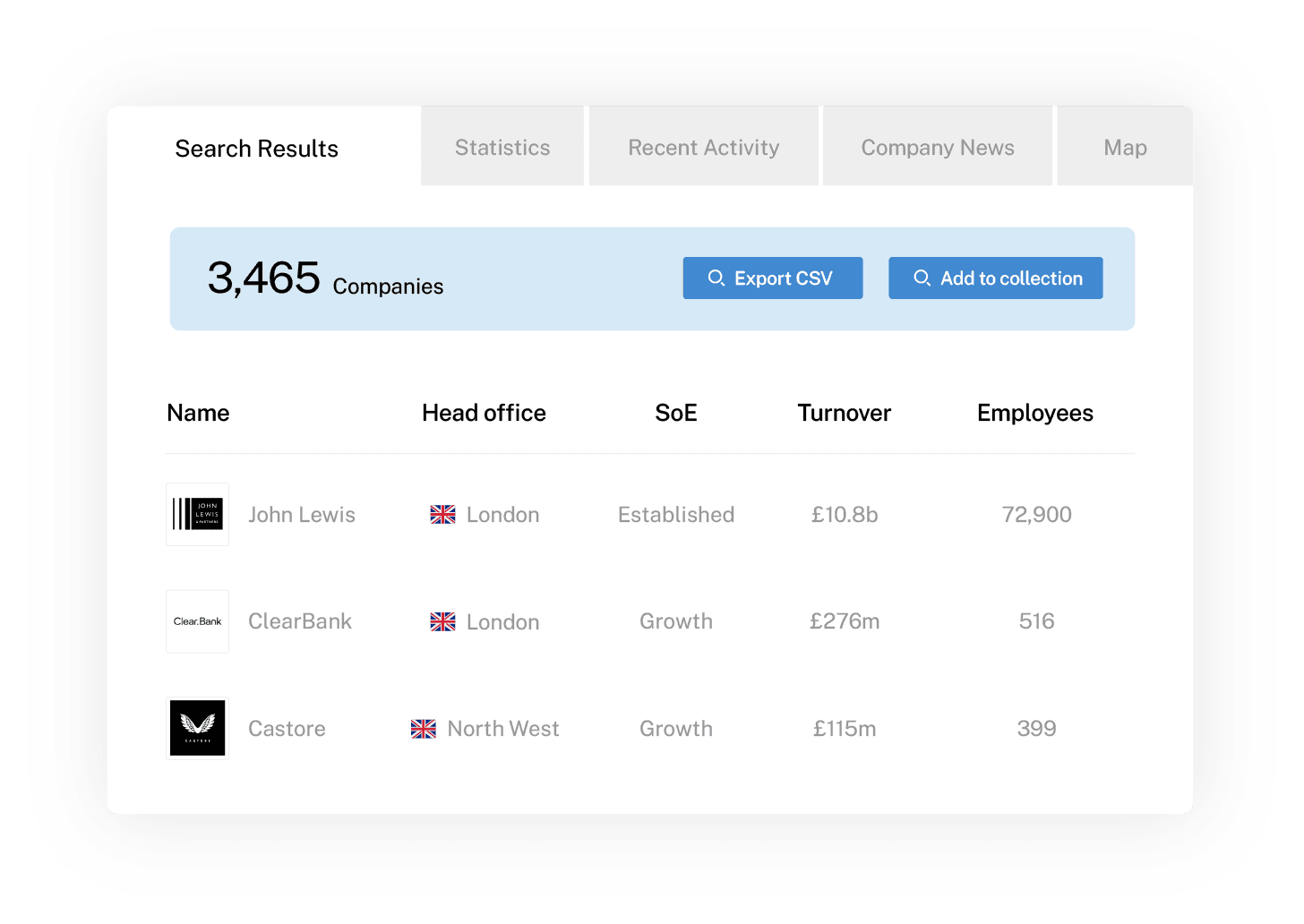
It combines decision-maker contact data with ownership structures, financials, and deal signals, allowing teams to identify not just who to contact but also whether the opportunity is viable and timely.
Users can filter companies by growth stage, funding history, sector, and financial performance — then surface founders, shareholders, and key executives, along with verified contact details.
Best for: Deal origination, mandate generation, and context-driven prospecting.
Take a tour
ZoomInfo (global contact database with mixed UK depth)
ZoomInfo is a large-scale B2B contact platform with strong US coverage and extensive contact records.
However, its UK private company depth — particularly in the SME segment — is more limited. It also lacks ownership and transaction context, meaning analysts often need to supplement it with additional research.
Best for: Global sales teams prioritising scale.
Cognism (EMEA contact data)
Cognism offers strong EMEA contact coverage and positions itself as a compliant data provider for outbound sales teams.
While it performs well on contact details, it lacks corporate structure, ownership, and deal-related insight — making it less suitable for corporate finance workflows.
Best for: Sales teams focused on compliant outreach.
Apollo.io (contact discovery with outreach tools)
Apollo combines a contact database with sequencing and outreach functionality, making it attractive for startups and SDR teams.
Its strength is automation rather than data depth. For corporate finance use cases — especially ownership and deal signals — it falls short.
Best for: Cost-effective outbound prospecting.
LinkedIn Sales Navigator (network-driven prospecting)
LinkedIn Sales Navigator is strong for identifying individuals by role and leveraging professional networks for introductions.
However, it’s less reliable for owner-managed businesses and private SMEs, where profiles may be incomplete or outdated. It also lacks structured financial and ownership data.
Best for: Relationship-led prospecting.
Companies House
Companies House is the official UK register, providing director information, filings, and PSC data.
While essential for verification, it lacks contact details, advanced filtering, and actionable insights—making it unsuitable as a standalone prospecting tool.
Best for: Basic company and director lookup.
How These Tools Compare for Corporate Finance Use Cases
So, how do these tools work in practice? These use cases highlight where generic sales tools fall short, and where more specialised UK private company data platforms provide additional value for corporate finance teams.
Deal origination and mandate generation
Sales-focused tools typically prioritise volume, generating large contact lists with limited context. In contrast, corporate finance and advisory teams benefit more from platforms that combine contact data with ownership information, financials, and deal signals, enabling more targeted and timely outreach.
This is particularly important for identifying high-value opportunities early in the engagement cycle.
Qualifying private company targets
Without ownership and financial context, teams often spend significant time manually assessing relevance. Integrated datasets reduce this effort, helping teams quickly determine whether a company fits their mandate and improving overall pipeline quality.
This becomes especially valuable in corporate finance workflows where speed and accuracy of qualification directly impact conversion rates.
Building long-term relationship maps
Understanding how companies are connected, through shareholders, investors, and directors, enables teams to map influence networks and build long-term engagement strategies, rather than relying on one-off outreach.
This is particularly useful for financial and professional services teams focused on repeat engagement and relationship-driven deal flow.
Why Beauhurst Is the Best Fit for Corporate Finance Teams
Unlike other fractured tools, Beauhurst is designed to give corporate finance teams a complete view of private markets, helping them identify, understand, and engage the right companies at the right time.
Beauhurst offers features like:
- Comprehensive UK and Germany coverage:Full visibility across all private companies, including hard-to-find SMEs and high-growth businesses.
- Ownership and financial intelligence: Clear insight into cap tables, shareholders, control structures, and key financial performance metrics.
- Live fundraising and event tracking: Real-time alerts on funding rounds, acquisitions, and other strategic changes that signal engagement opportunities.
- CRM-ready workflow integration: Seamlessly connects with existing tools to support efficient research, outreach, and pipeline management.
Together, these capabilities enable teams to move from research to targeted engagement faster and with greater confidence.
The data platform for leading law firms
Discover how BeauhurstImpact can help you make a real difference.
How to Choose the Right Tool for Your Team
Selecting the right platform comes down to how well it supports your targeting, research, and outreach workflow, not just how much data it provides.
To make sure you’re choosing the right tool, think about the questions below.
Questions to ask during a demo or trial
- Does the platform provide full coverage of the UK companies we target?
- Can we reliably identify true decision-makers, including shareholders and influential stakeholders?
- Are there clear signals that indicate when a company is ready to engage?
- How much manual research is still required to validate or enrich the data?
- Does it integrate smoothly with our CRM and existing workflows?
Evaluation checklist
Once you’ve seen the demo, think about the tool in the context of your team, and evaluate the following capabilities.
- Comprehensive coverage of UK and German private companies
- Clear visibility into ownership and shareholder structures
- Are there clear signals that indicate when a company is ready to engage?
- Actionable financial, funding, and deal-related insights
- Strong compatibility with corporate finance workflows and tools
How to Choose the Right Tool for Your Team
Most “decision-maker” tools are built for sales teams, and it shows. They prioritise volume over relevance and contacts over context.
For corporate finance teams in the UK, the requirement is fundamentally different. The best tool for finding UK private company contacts needs to identify the right people and understand the business behind them, its ownership, performance, and readiness for a transaction.
That’s why platforms like Beauhurst stand out: they don’t just help you find decision-makers, they help you find the right opportunities.
People also ask
The most effective tools combine decision-maker identification with ownership data, financial context, and growth signals. This is especially important in UK private markets, where key decision-makers are often not immediately visible through standard contact databases.
General contact databases can be useful for basic outreach, but they often lack the depth needed for corporate finance and advisory use cases. Understanding ownership, control, and company performance is critical when identifying true decision-makers in private companies.
A strong platform should combine verified company data with ownership structures, shareholder information, financial performance, funding activity, and growth indicators. This allows teams to move beyond surface-level contacts and focus on real decision-making influence.
The best tools for deal origination combine real-time company intelligence with ownership and financial context. This enables teams to identify off-market opportunities, track relevant triggers, and engage decision-makers at the right moment.
Basic director information is available via the UK company registry. However, for a complete view of control and influence, you typically need enriched datasets that map ownership structures, shareholders, and related entities.
Professional networking platforms can help identify individuals by role and company, but they often lack visibility into ownership, financial performance, and investment activity. For SME targeting in corporate finance, additional company-level intelligence is usually required.
Official filings provide foundational company data, but they are limited in scope. More advanced platforms enrich this information with ownership mapping, funding history, and growth signals to support deal origination and advisory work.
The most effective tools are those that combine ownership, investment history, and organisational structure. This allows teams to identify both operational leaders and underlying investor influence, which is critical for PE-backed environments.