The Quantum Leap: Is Quantum The UK’s Next Big Sector?

 6 November 2025
Table of contents

The UK’s quantum industry had a standout year in 2024 with record-breaking investment. As breakthroughs in quantum computing, sensing, and communication move from research labs to real-world applications, the sector is evolving from a niche area of physics into a cornerstone of the UK’s innovation economy.

Over £337m was invested into quantum companies last year — the highest annual total to date — signalling growing confidence from both private investors and government programmes. And with the UK committing £500m in new funding to strengthen its national quantum capabilities, momentum is only set to build.

But as we move through 2025, questions remain: which quantum subsectors are closest to commercialisation? Where are investors placing their bets? And how can professional advisors, from law firms to strategy consultants, use this data to identify emerging opportunities?

In this article, we’ll explore the state of the UK’s quantum industry, the companies leading the charge, and how Beauhurst’s data can help you uncover insight in one of the UK’s fastest-developing deep tech sectors.

What is quantum technology?

Quantum tech applies the science of how particles behave at the smallest scale to build faster computers, smarter sensors, and ultra-secure communications.

For the UK, it represents a strategic growth area, supported by billions in government investment, with the potential to transform industries from healthcare to defence and cement the country’s position as a global innovation leader.

Record breaking investment into quantum technology: the UK’s quantum sector at a glance

Last year the quantum industry saw record breaking investment — £337m was invested into quantum companies in 2024, and this amount has been growing every year since 2021. There was also a record number of company foundations in 2024, with 32 quantum companies set up.
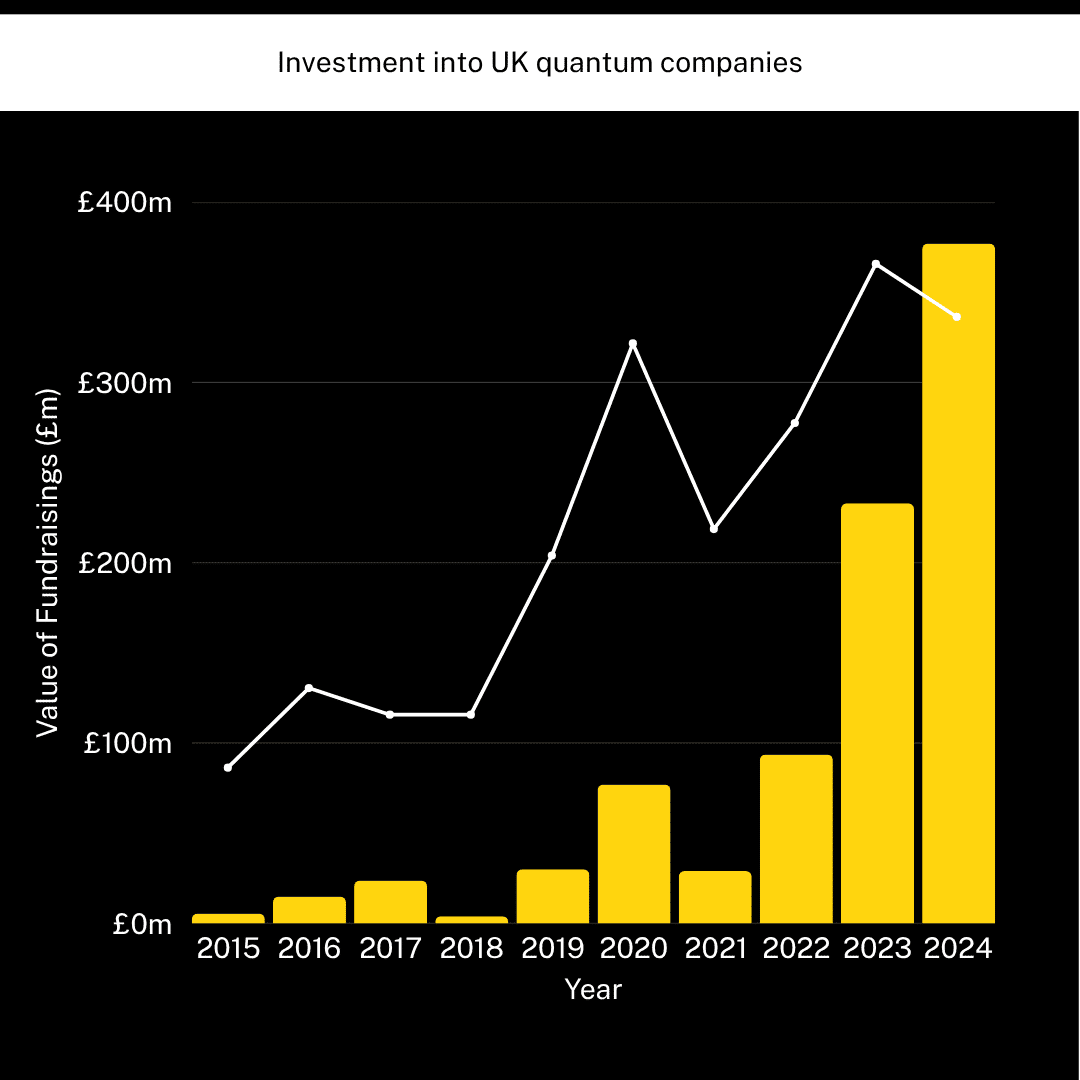

However, since the beginning of 2025, things may have started to decline. There’s only been £55.5m invested in quantum companies so far this year, which means by the end of the year, we could see funding for these companies sink to its lowest since 2021.

That being said, with the government’s commitment to invest £500m into quantum computing companies over the next four years, we’re still likely to see a lot more growth in this sector.

Overall, there are 207 active quantum companies in the UK, over 10% of which are university spinouts (24). This is reflected in the top funders for UK quantum companies, with Oxford Science Enterprises both investing the most and contributing to the highest number of fundraisings.

If you’re a Beauhurst subscriber, you can explore more of the UK’s quantum industry here.

Equity investment into spinouts 2025

In collaboration with Parkwalk, we explore how UK spinouts are powering the future economy — from record-breaking biotech raises to the growing role of AI and digital technologies.

Which quantum subsectors are breaking out?

Quantum sensing

According to our data, there has been £35.1m invested into the UK-based quantum sensor companies since 2018, with companies like Delta-g, Aquark Technologies, and Quantum Science at the receiving end of that investment.

These firms are using quantum effects to develop ultra-precise sensors, from navigation systems that don’t rely on GPS to medical imaging tools that can detect disease earlier. Because these technologies are already moving out of the lab and into pilot projects, quantum sensing is likely to be the first area to reach widespread commercial adoption.

Quantum sensing

As data privacy and cybersecurity become national priorities, quantum communication is gaining ground. UK companies such as Arqit and Nu Quantum are pioneering encryption systems that use quantum principles to secure information transfer, making them virtually immune to hacking.

This subsector has benefited from strong government and defence interest, with projects supported by Innovate UK and the National Quantum Technologies Programme. While the technology is still early in deployment, its strategic importance for both national security and financial services means demand is expected to grow quickly over the next few years.

Quantum computing

We can’t speak about quantum subsectors without speaking about quantum computing — the most high-profile, but also the most technically challenging field.

The UK government has committed to invest £500m into quantum computing over four years to strengthen national security and economic resilience. The UK’s £500 million quantum funding package aims to accelerate hardware development, research, and real-world testing across academia and industry. It follows earlier measures such as £100 million for five regional quantum hubs and the creation of the National Quantum Computing Centre (NQCC), the cornerstone of the UK’s quantum infrastructure.

Some of the UK’s big players include Oxford Quantum Circuits, Riverlane, and ORCA Computing. These companies are building the hardware and software needed to perform calculations that are impossible for today’s classical computers, from simulating new materials to optimising supply chains.

While full commercial applications are still a few years away, the UK’s investment ecosystem for quantum is maturing fast. In short, quantum computing remains a long-term bet, but one that’s drawing serious backing.

NPL Quantum Ecosystem Mapping

Our latest report, in collaboration with NPL, maps the UK’s quantum company landscape and provides insight into the businesses driving innovation.

How advisors can use Beauhurst to find quantum companies and what to do with that data

Why should professional advisors care about the growth of quantum technology in the UK?

Quantum technology is no longer just an academic pursuit — it’s on its way to becoming a commercial reality. As quantum startups attract funding and partnerships, they’ll increasingly need legal, financial, and strategic support. For advisors, understanding this space early creates opportunities to build relationships with some of the UK’s most innovative future clients.

Which types of advisory firms are best placed to support quantum companies?

Law firms can assist with IP protection, licensing, and collaboration agreements.

Accountants and corporate finance teams can help structure grants, R&D tax claims, and investment rounds.

Consultancies and strategy advisors can guide commercialisation and market entry.
Quantum startups often begin as spinouts with complex funding and ownership structures — meaning trusted advisors play a critical role early on.

Using Beauhurst to find quantum companies

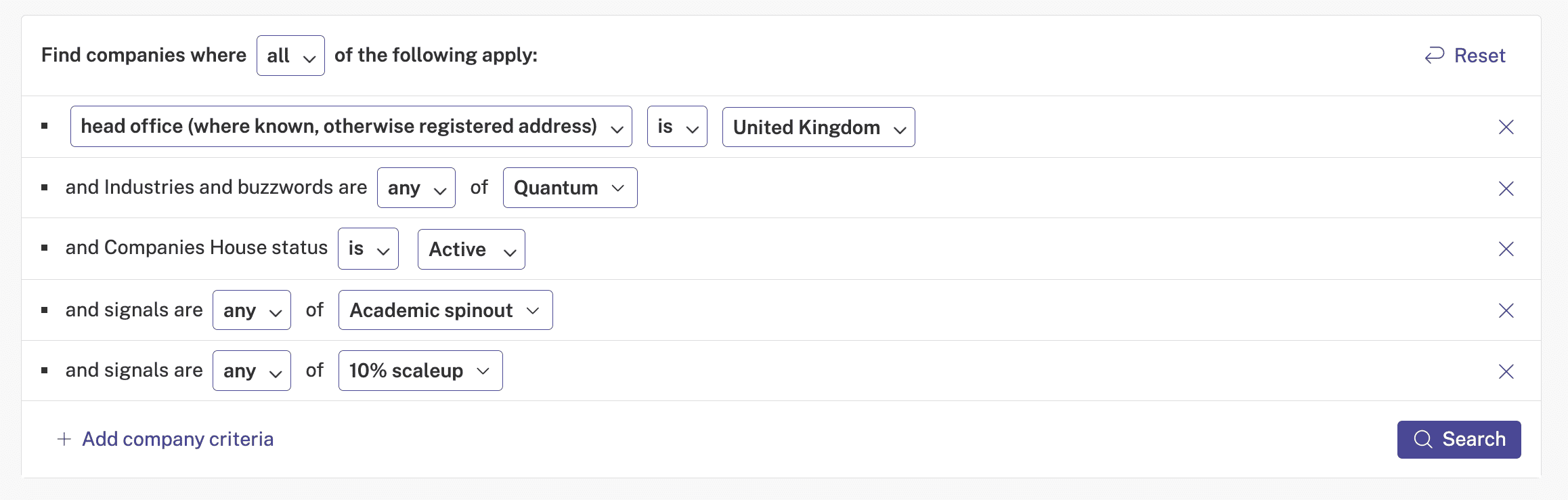
With Beauhurst’s industry data, finding niche companies such as those in the quantum sector is easy. Simply navigate to the Advanced Search, and select:

Screenshot of Beauhurst platform looking for Quantum companies

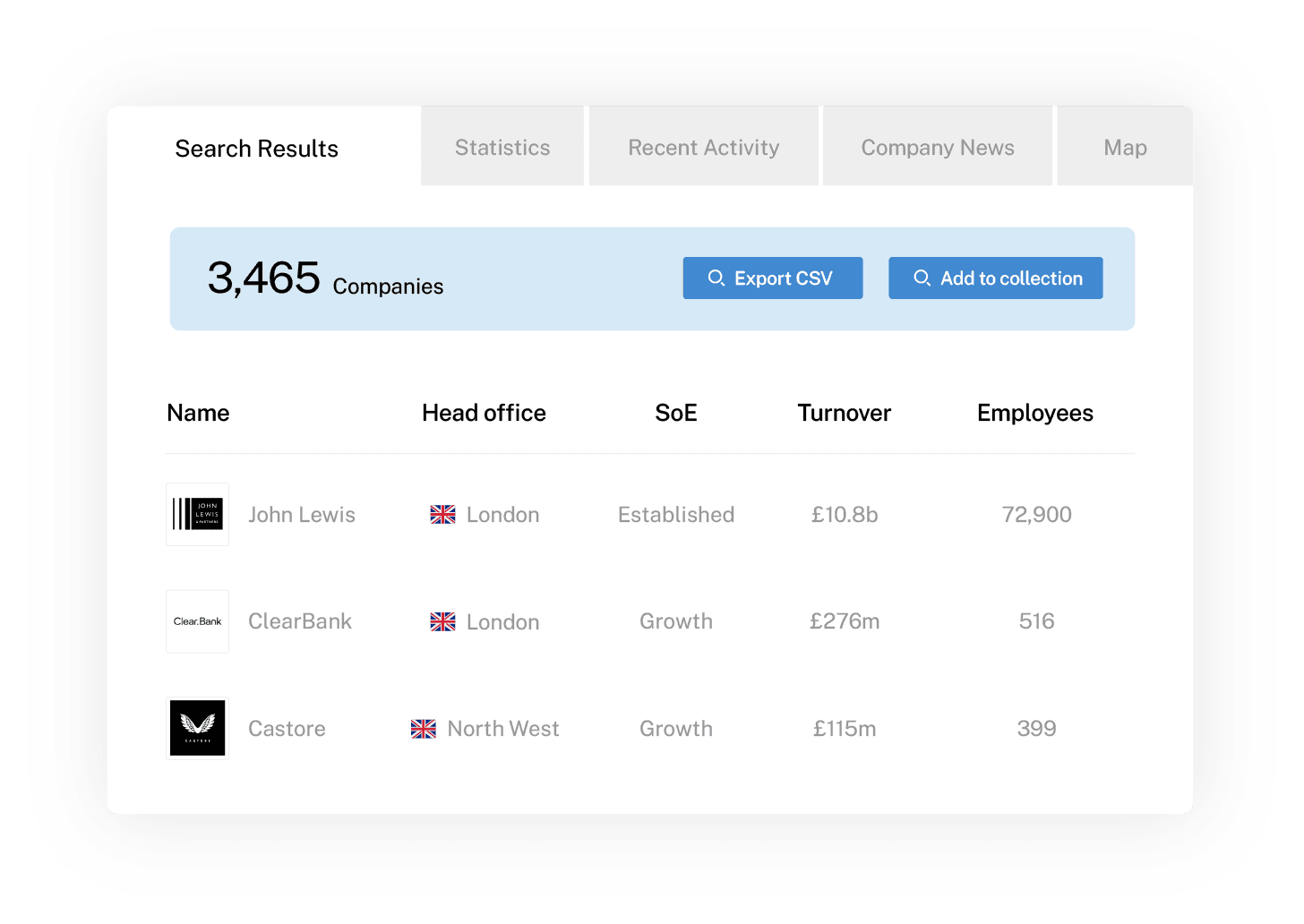
From here, you’ll get a list of 207 companies. But you might want to narrow down that list even further.

For example, if you’re a consultancy or strategic advisor, you might want to find quantum companies that are both academic spinouts and showing signs of rapid growth. That’s because these are often the businesses beginning to commercialise and seek external expertise.

Here you can use the Beauhurst Signals.

What to do with quantum company data

Once you’ve got your data, what can you do with it? Beauhurst makes it easy to turn those insights into action. Here are a handful of commercial applications.

Spot potential clients early
Identify startups that are scaling, raising funding, or have spun out of universities. These companies are often looking for support around structuring investment, managing IP, or accessing grants.

Understand their growth journey
Review a company’s funding history, key people, and partnerships to tailor your outreach. You’ll know exactly where they are in their commercial journey and which services they’re likely to need next.

Track emerging clusters
Use regional and industry filters to see where quantum innovation is concentrating — ideal for regional offices or firms targeting local innovation hubs like Oxford, Cambridge, and Bristol.

Strengthen your sector expertise
By monitoring news and trends across all 200+ quantum companies, you can build internal knowledge, benchmark activity, and position your firm as the go-to advisor in the UK’s growing deep tech landscape.

In short, Beauhurst helps advisors move from reactive to proactive — using live data to identify opportunities, start smarter conversations, and win work in one of the UK’s most exciting emerging industries.

Take a tour

Want to see Beauhurst action? You’re in luck. Take a virtual tour of the platform and discover how we get our unbeatable data insights.

Company spotlight: The quantum companies in the UK gaining investment

Methodology
To be included in our company spotlight, a company must:

Companies have been ranked by amount raised in 2025.
05.

Quantum Blockchain Technologies

Amount raised in 2025: £2.00m
Total amount raised: £4.00m
Subsector: Server software

Quantum Blockchain Technologies is an R&D company combining AI, quantum computing techniques, and cryptography aimed at disruptive applications in blockchain and Bitcoin-mining hardware and software systems.

The company has been through two funding rounds, raising a total of £4.00m. Most recently, it raised £2.00m in January 2025.

04.

SCI Semiconductor

Amount raised in 2025: £2.50m
Total amount raised: £2.50m
Subsector: Chips and processors

SCI Semiconductor is a hardware company aiming to develop memory-safe semiconductor chips, designed for security-critical applications (e.g., defence, infrastructure) and leveraging advanced chip design to reduce system vulnerabilities.

The Sheffield-based company went through its first-ever funding round in February 2025, raising £2.50m. Alongside this, it also received a grant for £400k from InnovateUK. This was the company’s second grant, having also received £825k from Digital in 2023.

03.

Delta-g

Amount raised in 2025: £4.60m
Total amount raised: £6.10m
Subsector: Sensors

Delta-g is a spinout from the University of Birmingham that has developed quantum gravity-sensor technology, which detects minute variations in the gravitational field to provide subsurface and spatial intelligence (e.g. underground structures, navigation in GPS-denied environments).

In total, the company has raised £6.10m in equity. It most recently secured £4.60m in September 2025, from British-based funds National Security Strategic Investment Fund (NSSIF) and Science Creates Ventures, and Singapore-based fund Serendipity Capital.

02.

Nu Quantum

Amount raised in 2025: £18.0m
Total amount raised: £30.7m
Subsector: Electronics Hardware

Nu Quantum is a Cambridge-based spinout from the University of Cambridge’s Cavendish Laboratory focused on building quantum-networking hardware, specifically a “Quantum Networking Unit” which links quantum processors and enables scalable quantum computing networks.

The company attended the Seraphim Space Camp and the QTEC (Quantum Technology Enterprise Centre) accelerator programmes. And it featured on the 21toWatch high-growth list in 2020. Overall, the company has raised £30.8m, and raised £18.0m in June 2025.

01.

Phasecraft

Amount raised in 2025: £25.2m
Total amount raised: £42.7m
Subsector: Application software

Phasecraft is a quantum-software startup developing algorithms that help scientists simulate chemical reactions and other complex quantum-enabled problems. The firm works closely with major quantum hardware providers such as Google, IBM and Rigetti Computing.

The company is an academic spinout of the University of Bristol and University College London, and has been through four funding rounds, raising a total of £42.7m in equity. It’s also received 10 grants totalling £3.06m.

The UK’s quantum moment

The UK’s quantum sector is gaining traction, and moving from theory to practice. Record-breaking investment in 2024, combined with strong government backing and a growing network of university spinouts, is laying the foundations for a globally competitive industry.

While 2025 has started more slowly in terms of funding, the long-term outlook remains strong. With applications across computing, sensing, and security, quantum technology could underpin the next wave of innovation, and create major opportunities for investors, corporates, and advisors who engage early.

For professional advisors, Beauhurst provides the visibility needed to track these emerging companies, understand their growth journeys, and build relationships before the rest of the market catches up.

FAQs

Growth in the UK quantum sector is being fuelled by government funding, including the £500m quantum package and regional innovation hubs, alongside increasing private investment into spinouts and startups developing commercial applications in sensing, computing, and security.
Quantum startups are reaching a stage where they need specialist legal, financial, and strategic advice to move from R&D to revenue. Advisors who understand the landscape can identify new clients early and position themselves as trusted partners in a high-growth, government-backed sector.
As of October 2025, there are 207 active quantum companies in the UK — with 24 identified as university spinouts. This highlights the sector’s strong academic roots and the growing role of innovation hubs such as Oxford, Cambridge, and Bristol.
Advisors can use Beauhurst’s Advanced Search to filter companies by sector, location, or growth signals — for example, to identify active quantum spinouts showing scaleup activity. From there, Beauhurst’s detailed profiles allow you to review funding history, key people, news, and partnerships to inform outreach or sector strategy.

Discover our data.

Get access to unrivalled data on the companies you need to know about, so you can approach the right leads, at the right time.

Schedule a conversation today to see all of the key features of the Beauhurst platform, as well as the depth and breadth of data available.

We’ll work with you to build a sophisticated search, returning a dynamic list of organisations that match your ideal customer profile.

Beauhurst Privacy Policy