The UK has a well deserved reputation as a global leader in research and innovation. With world class universities and a strong technical talent pool, Britain consistently produces ideas that shape the global economy.
However turning those ideas into successful, scalable business ventures remains a persistent challenge for founders and policy wonks alike. While the UK excels at generating intellectual property, many of its most promising companies struggle to translate this into long-term commercial success.
This is particularly true amongst university spinouts. The UK is a great place to start a business, but this advantage quickly fades once a founder wants to scale-up activity as domestic capital becomes both increasingly important and scarce. Many firms ultimately look overseas for funding, often leading to foreign acquisitions or listings. As the House of Lords Communications and Digital Committee has warned, the UK risks becoming “an incubator economy for other nations” if this issue is left unaddressed.
Access to finance is often cited as the key constraint. But how much does it actually shape outcomes? To better understand this relationship, the Beauhurst Insights team analysed the long-term performance of UK spinouts, comparing those that secured equity investment with those that did not.
How equity investment shapes spinout survival
It goes without saying that not every business goes on to become the next Apple or Meta (regardless of their founder’s ambitions). In fact around a fifth of UK companies fail within the first 12 months, and only half make it to the five year mark. Survival rates for spinouts are better, but follow a similar trend. There are many drivers of business survival – from product-market fit to macroeconomic conditions. But one factor stands out in the data: access to equity investment.
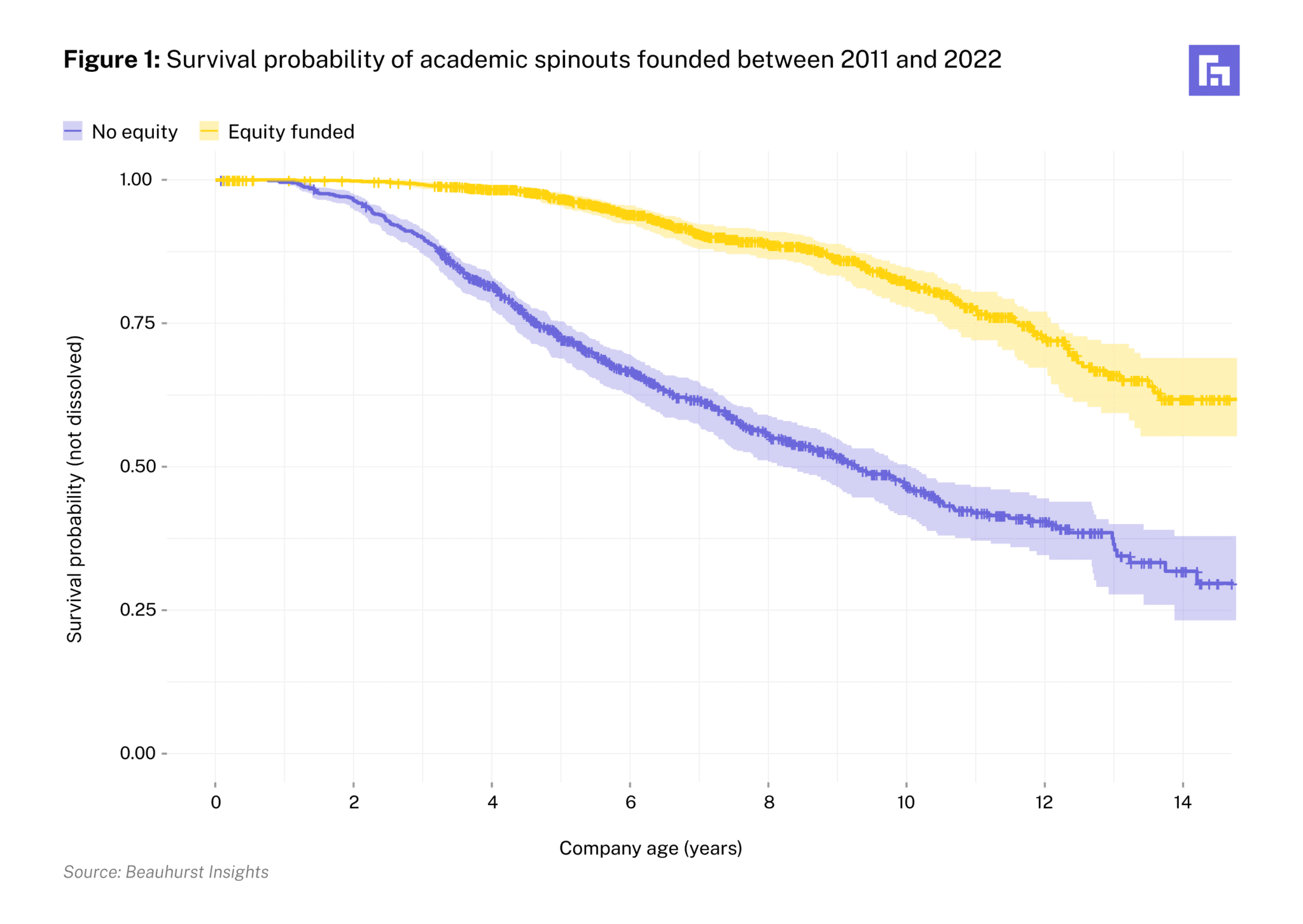
The Beauhurst Insights team has analysed the data and found that UK spinouts which raise equity investment are significantly more likely to outlive their non-funded peers. As shown in Figure 1, spinouts which secured equity had a 95% chance of survival through to the five year mark, compared to a 75% survival likelihood among firms without investment.
The probability gap widens over time. Equity-backed firms have over an 80% probability of surviving for at least a decade, and nearly two-thirds likelihood of surviving fourteen years. In contrast, for non-equity-backed spinouts below the probability of survival to ten years is below 50% and only 32% to reach fourteen years.