The UK's Defence Tech Funding Gap

Words Callum Newton

The UK's Defence Tech Funding Gap

The UK’s real defence funding gap

There are moments in history which sharply expose the difference between political rhetoric and reality. For the Soviet Union it was the fall of the Berlin Wall, for the Americans the fall of Kabul. The 1956 Suez Crisis is regarded as a watershed moment for the UK, marking the end of empire and imperial hegemony. ‘Suez’ has become a byword for failure in British political discourse and a reminder of our reliance on American hard power. However recent events may have exposed an even deeper rift.

The US and Israeli bombing campaign against Iran has dominated global headlines, created unprecedented regional instability and unwanted market volatility. Although the UK is not directly involved, the crisis has exposed Britain’s inability to defend its bases and allies across the region – caused by decades of underinvestment in our armed forces and industrial base. Prime Minister Keir Starmer’s initial refusal to allow US aircraft to use British bases for strikes against Iran reportedly angered Donald Trump and raised questions about the durability of the “Special Relationship”.

Despite government promises to increase defence spending, rhetoric is once again outpacing reality. Investment into UK defence firms is falling rapidly, even as warnings grow that Britain risks losing influence within NATO. Today the Beauhurst Insights team examines what is happening across the UK’s defence innovation ecosystem and what it means for our security in the years ahead.

How decades of underinvestment shaped UK defence

First, the context. Funding gaps are nothing new in defence. UK defence spending fell from roughly 7% of GDP in the 1950s to around 2% by the early 2020s as governments sought to capitalise on the post-Cold War ‘peace dividend’. Over time this reshaped the industrial base: subsidies declined, supply chains consolidated and private capital became more hesitant to back defence innovation – reinforced by ESG constraints and long procurement cycles.

Russia’s invasion of Ukraine marked a turning point. Defence returned to the political agenda, with the UK committing to increase spending over the coming decade. Yet rebuilding capability takes longer than announcing budgets. Years of underinvestment have left structural gaps across production, supply chains and crucial innovation pipelines.

Parliamentary scrutiny has highlighted the scale of the challenge. Some assessments suggest the British Army could run out of munitions within days of a high-intensity conflict, while only two of the Ministry of Defence’s 49 major defence projects are currently running on time and within budget. The shift in rhetoric is clear. The question is whether investment and delivery are keeping pace.

Why defence tech investment is falling as spending rises

Against this backdrop, commitments from the Prime Minister to increase defence spending to 5% of GDP by 2035 are certainly welcome. Yet research conducted by the Beauhurst Insights team suggests they do not fully address the underlying constraint: bottlenecked capital for innovative defence firms. Spending may be rising at the top of the system, but the flow of funding into the companies responsible for future capability remains limited – namely within defence tech.

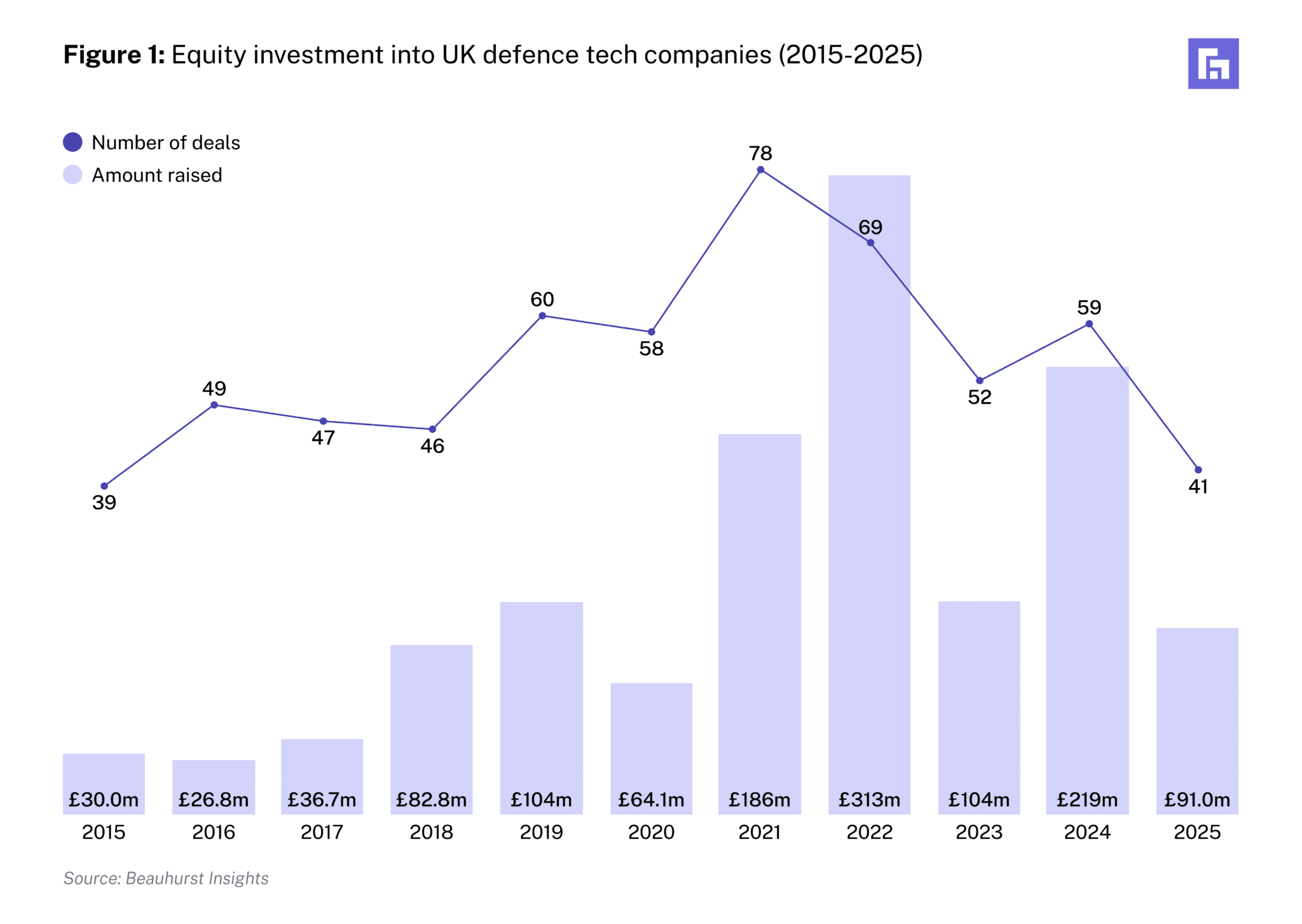
Earlier this year we published research alongside defence-VC MD One, which found that while defence spending has steadily risen since the war in Ukraine, equity investment into UK defence tech companies has fallen. As shown in Figure 1, there was a spike in investment in immediate response to the war followed by a clear drop in both the total amount raised and number of deals. For context, UK defence tech firms raised £313m through 69 deals in 2022. This figure had dropped to only £91m through 41 deals in 2025.
bar-line chart 1

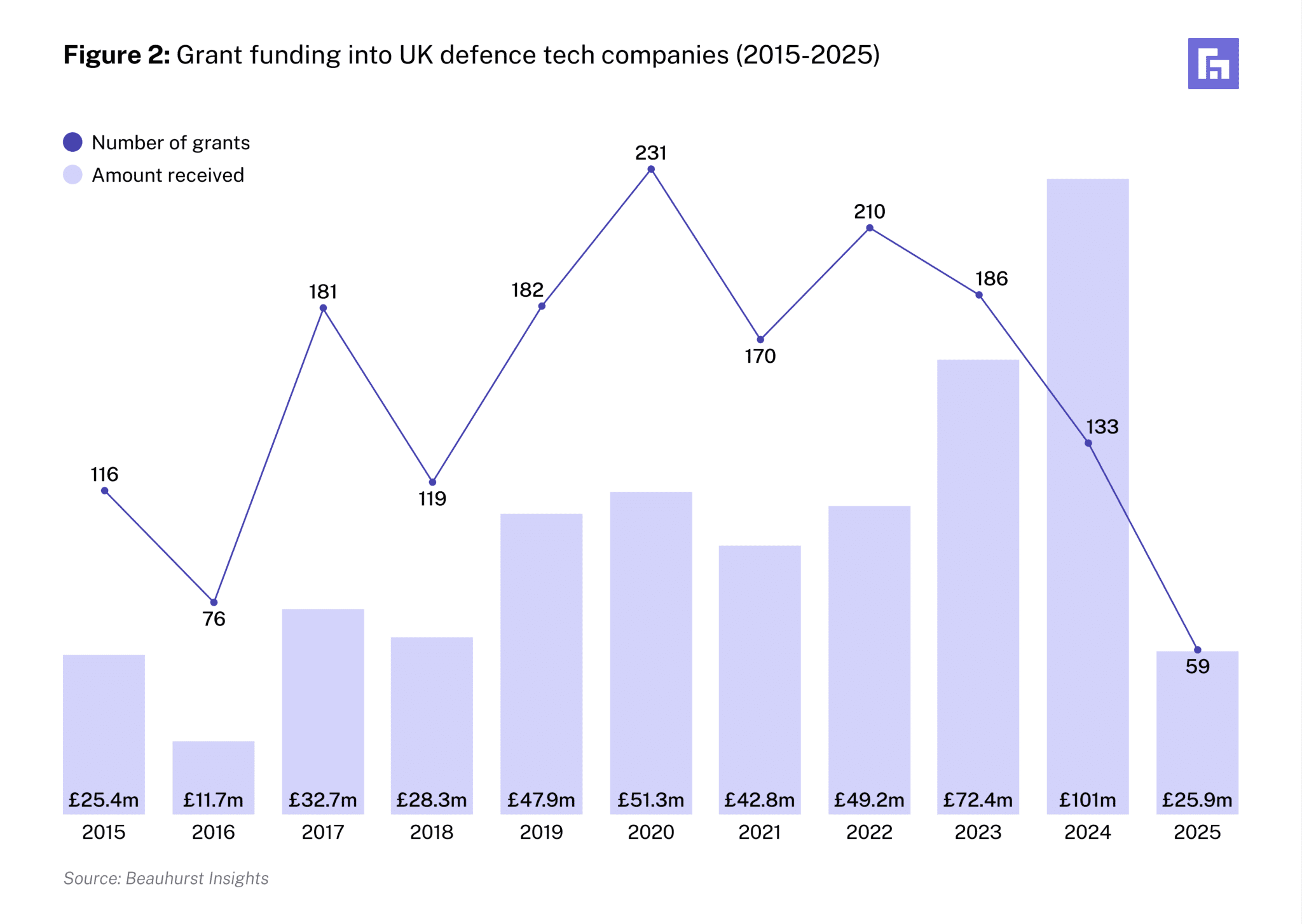
But this isn’t only a private sector problem. The amount of public sector grant funding into British defence tech firms also cooled substantially last year. Figure 2 shows that total grant funding steadily increased between 2021 and 2024 from £42.8m to £101m, broadly in line with the overall rise in defence spending. This represents a 70% increase in funding in just three years. However in 2025 when the Government was ramping up plans to increase spending, grant funding dropped substantially to only £25.9m – the lowest level since 2016.

bar-line chart 2

This approach clearly appears to be out of kilter with national plans, and both elements (public and private funding) matter. Private sector investment is crucial to unlocking growth, scaling businesses and ultimately securing Britain’s industrial base in an increasingly uncertain geopolitical climate. But public sector support is also important. Grant funding is more stable and less cyclical than venture capital, making it essential for early-stage experimentation and capability development. When both public and private funding soften simultaneously, the risk is not slower growth but a thinning of the future capability pipeline.

Part of the problem lies in structural barriers to defence investment, including slow procurement cycles, ESG restrictions on institutional investors and limited late-stage capital within Europe. However, spending is only part of the story – the provenance of capital matters too, especially American capital. Since the end of the Second World War, US foreign policy has often been underpinned by the principle of maintaining overwhelming military superiority over potential rivals. America alone accounts for 37% of global defence spending, with US funds and companies also large investors in NATO-member state defence industries.

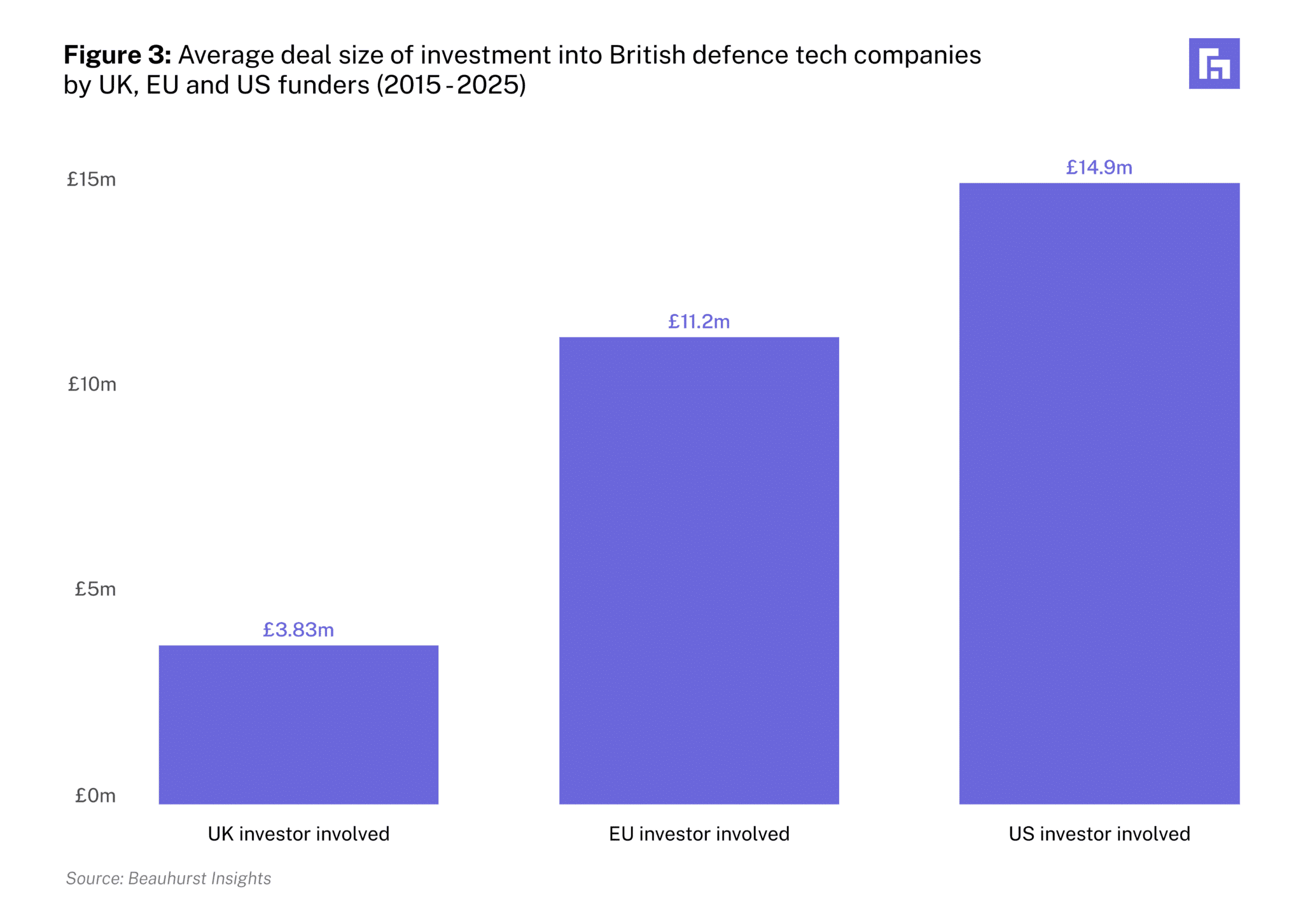
The UK is no exception. Although the US isn’t the largest or most active investor in British defence tech, when it spends it spends big. As shown in Figure 3, the average deal size when US funders invest into British defence tech is significantly larger than when EU funders invest, and almost four times larger than domestic capital formation. Turning our back on America would be a mistake, now more so than ever.

bar chart 1

The UK’s defence funding gap: what the data shows

Defence is a complex and politically charged topic. While there is no silver bullet for fixing defence procurement and repairing Britain’s industrial base, it is clear the status quo is unsustainable.

Recent events in the Middle East have reinforced that point. Although the UK has avoided direct involvement in the US-Israeli strikes against Iran, the crisis has nonetheless exposed the limits of Britain’s ability to project power and defend its interests after decades of underinvestment in its armed forces and industrial base.

At the same time, the gap between political ambition and industrial capability is becoming harder to ignore. The UK has signalled higher spending and renewed strategic ambition, yet recent delays to the Defence Investment Plan – alongside claims the Strategic Defence Review remains largely uncosted – illustrate how unsettled the path from rhetoric to delivery still is and have even got the unions up in arms.

Beauhurst’s data suggests this uncertainty is already feeding through the system. Private investment into defence innovators has cooled, public grant funding is falling and a growing share of scale capital is coming from overseas. The risk is that Britain is marking time: signalling intent and increasing headline budgets without materially accelerating capability.

Suez exposed the limits of Britain’s power once before. The danger now is that the gap between ambition and capability is opening again.

Want to discuss the data? Drop me a message: callum.newton@beauhurst.com


Subscribe to the Beauhurst Insights Substack

Data-led analysis of the UK’s private companies, straight to your inbox.

Subscribe
Discover our data

Get access to unrivalled data on all the companies you need to know about, so you can approach the right leads, at the right time.

Book a demo today to see all of the key features of the Beauhurst platform, as well as the depth and breadth of data available.

An associate will work with you to build a sophisticated search, returning a dynamic list of organisations that match your ideal customer profile.