The Robotics–AI Convergence: The UK’s top ten robotics companies
Robotics and artificial intelligence in the UK have long been closely linked, with machine learning powering existing robotics technology for some time now. However, the relationship between the two technologies has become more entwined in recent years, both in application and in investment trends. So much so, thatMorgan Stanley estimates the ‘humanoid’ industry — where robotics and AI converge — could be worth $5t by 2050.
In the UK, robotics companies are developing technologies for applications including logistics automation, autonomous vehicles, industrial manufacturing, and infrastructure inspection. Many of these systems rely on AI technologies (machine learning, computer vision, and sensor fusion, for example) to operate effectively. AI is not just enhancing robotics — it is fundamentally reshaping how robotics companies are built, funded, and scaled.
Using Beauhurst data, we examine the growing convergence between robotics and artificial intelligence in the UK — digging into how many robotics companies are developing AI capabilities, which subsectors are attracting the most activity, and the UK’s top ten robotics-AI companies.
The UK’s robotics and AI ecosystem
According to Beauhurst data, there are currently 3,036 active robotics companies in the UK. Of these, 105 companies also have artificial intelligence capabilities, representing approximately 3.5% of the robotics ecosystem.
At just 3.5%, AI adoption within robotics may appear low — but this likely reflects a classification gap rather than reality. Many robotics companies embed AI at a functional level without positioning themselves as ‘AI companies’, suggesting the true level of convergence is significantly higher.
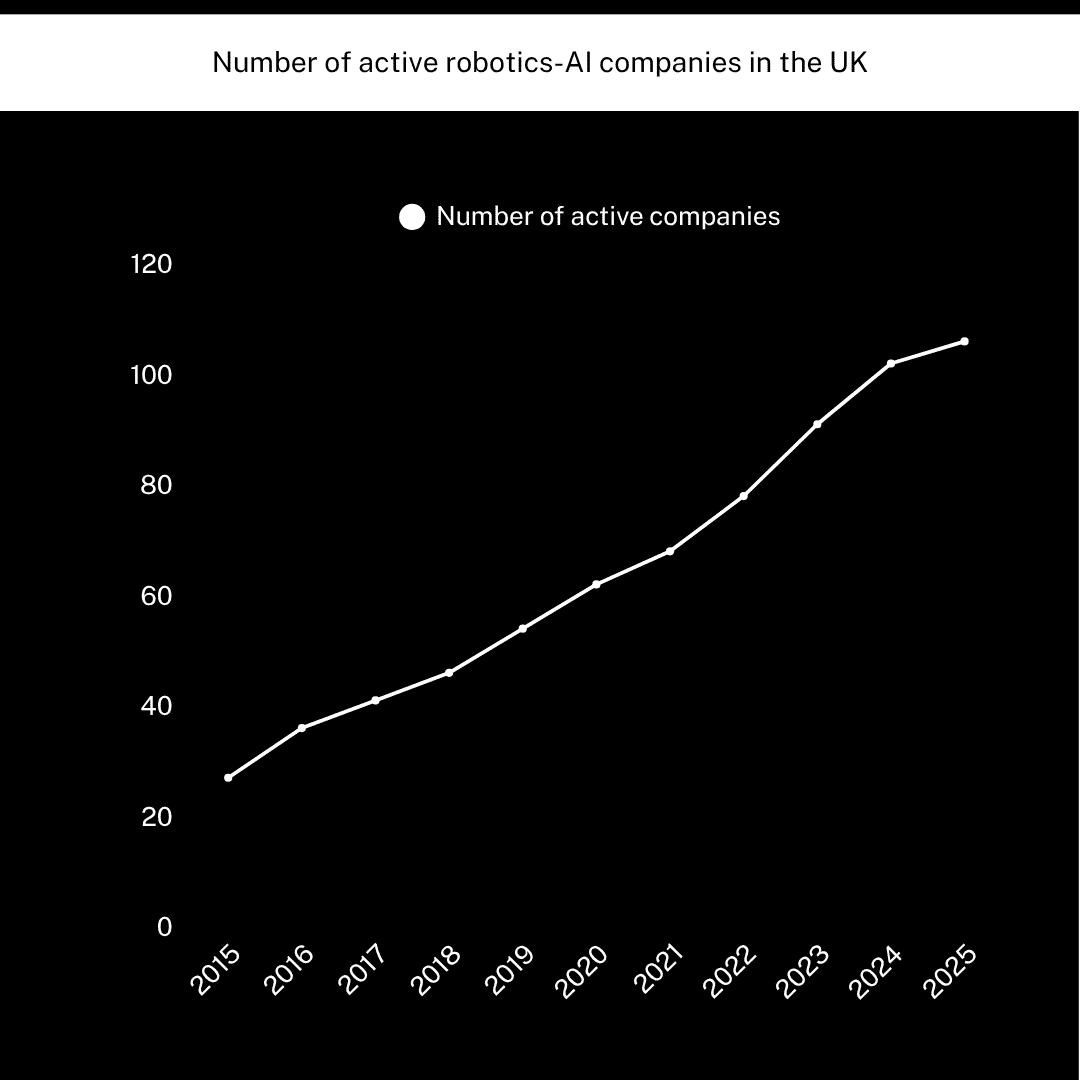
When we examine the number of active robotics companies using AI, we see it has grown rapidly over the past ten years. In 2015, there were just 27 AI robotics companies in the UK, compared with 105 in 2025, representing a growth rate of 289% over the period.
The UK’s robotics and AI ecosystem
Investment trends provide further evidence of the increasing importance of artificial intelligence within the robotics sector.
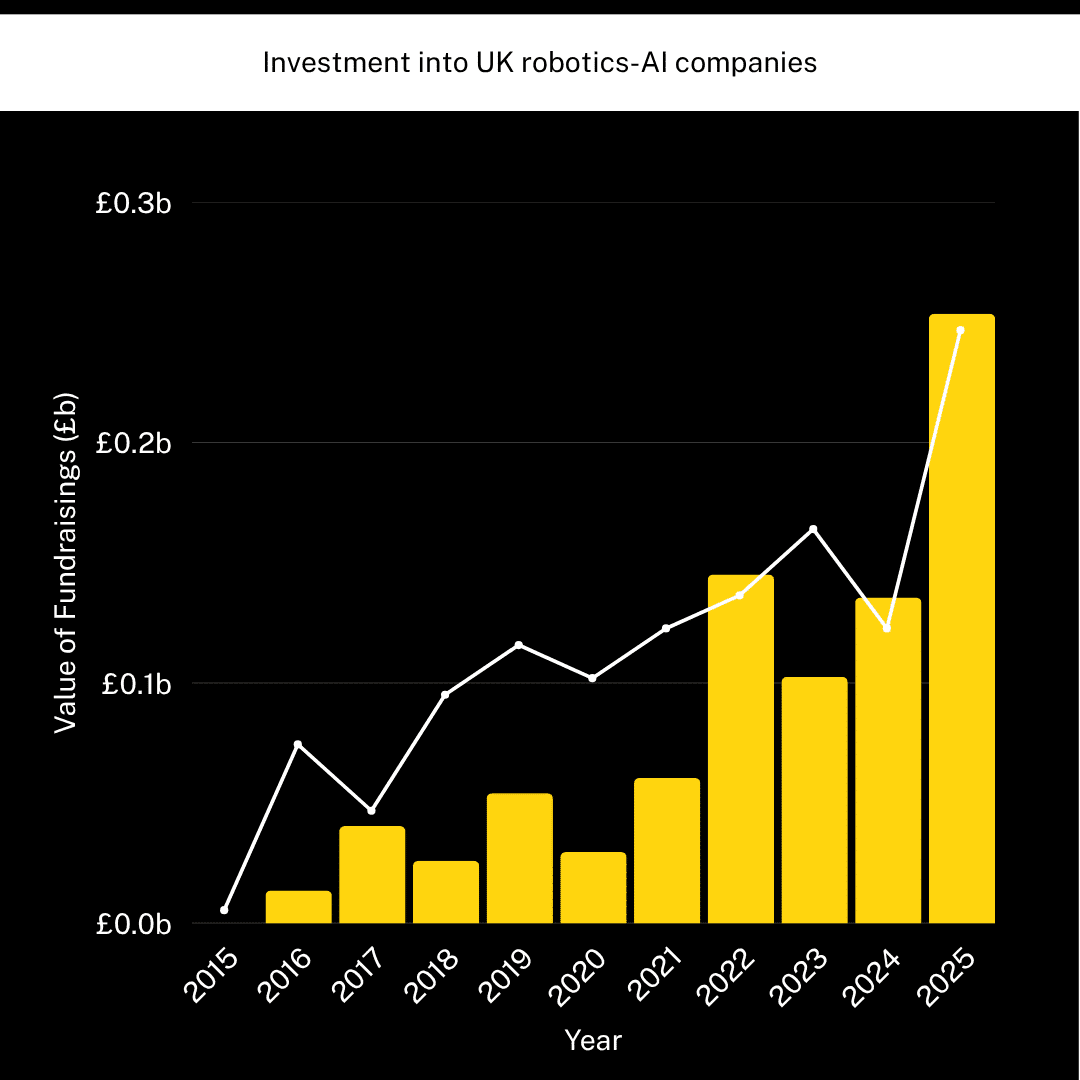
UK robotics companies that incorporate artificial intelligence have collectively raised £869m in equity investment since 2015, across 186 funding rounds. And in 2025, these companies had a record-high year for investment, raising £254m across 36 fundraising events. This is a 3403% increase in amount raised and a 3500% increase in the number of fundraisings since 2015.
This marks a shift in how robotics is perceived by investors, from capital-intensive hardware to scalable, software-driven platforms. AI is effectively ‘softening’ robotics, making it behave more like a software category in terms of margins and scalability.
And it’s also not just a few big deals driving the numbers. The rise in both funding and deal count points to a wider group of companies successfully raising money, showing growing confidence across the market.
Funding stage distribution across Robotics-AI companies
Another way to understand the sector is by examining where companies sit in the funding lifecycle.
Among UK AI robotics companies:
- 46% are Seed-stage companies
- 23% are Venture-stage
- 9% have reached Growth-stage funding
These figures signal that much of the AI robotics ecosystem remains relatively early-stage, with many companies still developing core technologies or bringing products to market.
The high proportion of Seed-stage companies suggests the sector is still in an experimental phase, where technical feasibility is proven, but commercial models are still being tested. If even a small share of these early-stage companies successfully scale, the shape of the market could change quickly over the next few years.
The subsectors driving AI robotics development
AI robotics companies in the UK operate across a wide range of industries. However, several subsectors account for a large share of activity.
Advanced manufacturing robotics
Manufacturing remains one of the most established areas for robotics adoption. However, artificial intelligence is enabling new capabilities such as automated quality inspection, predictive maintenance systems, and adaptive robotic assembly.
In total, 32.1% of the UK’s robotics-AI companies are developing solutions for manufacturing and industrial automation, with £105m raised in equity funding in 2025 alone.
And with Advanced Manufacturing forming a key part of the UK’s Modern Industrial Strategy, we should expect to see greater investment arrive in the form of both grants and equity in the next decade.
Drones and aerial robotics
Aerial robotics represents another significant area of development. Across the UK, 12.3% of the UK’s robotics-AI companies are building drones or aerial robotic systems, with many incorporating artificial intelligence for tasks such as: automated flight control, object detection, image and video analysis, and environmental monitoring.
Together, these companies have raised £12.3m in equity in 2025, which is a huge spike from the previous year, when drone companies using robotics and AI didn’t go through a single funding round.
Autonomous mobility and vehicles
Autonomous mobility is one of the most prominent areas where robotics and artificial intelligence intersect.
UK companies are developing technologies for applications including self-driving vehicles, delivery robots, industrial autonomous vehicles, and robotic transport platforms.
According to Beauhurst data, 8.5% of the UK’s robotics-AI companies are currently developing robotics technologies for autonomous mobility, collectively raising £80.9m in equity investment in 2025 — the subsector’s second most successful year for investment.
The UK’s top 10 AI robotics companies
To identify the most prominent businesses operating at the intersection of robotics and artificial intelligence, we ranked companies by total equity fundraising to date.
Below are the top 10 AI robotics companies in the UK today, according to our data.
Arctoris
Founded: 2016
Location: Vale of White Horse
Total amount raised: £14.0m
Arctoris is a biotech platform company developing automated laboratories for drug discovery. Its robotics-driven “Ulysses” platform runs biochemical and cellular experiments remotely, generating highly reproducible datasets for biotech and pharmaceutical partners. By combining automation, machine learning and biological expertise, the company aims to accelerate the discovery of new medicines.
A University of Oxford spinout, Arctoris has attended four accelerator programmes. Overall, the company has secured £13.97m across four fundraising rounds, including a £8.1m venture round in August 2023, and most recently £2.03m in December 2025. Alongside this, it’s also received £855k in grants primarily from Innovate UK for R&D projects.
Emotech
Founded: 2014
Location: Camden
Total amount raised: £16.3m
Emotech is a multimodal AI technologies company focused on speech, language, and digital avatars. Its software helps businesses to build conversational interfaces, AI-powered virtual assistants, and animated digital humans for applications in sectors such as customer service, education and entertainment. The company’s tools combine speech recognition, natural language processing and computer vision to create more human-like interactions with technology.
Alongside its enterprise software, Emotech is also known for developing Olly, an AI-powered social robot designed to interpret and respond to human emotions in real time.
Emotech has demonstrated significant growth since its 2014 incorporation, transitioning from Seed to Venture-stage in July 2020. In total, the company secured £16.34m across two major fundraising rounds. The company also featured in Deloitte’s Technology Fast 50 UK in 2023.
Q-Bot
Founded: 2012
Location: Lambeth
Total amount raised: £16.6m
Q-Bot develops robotics and AI systems designed to improve building retrofit and energy efficiency. Its autonomous robots navigate underfloor voids in homes to survey spaces and install spray-foam insulation with minimal disruption. The technology helps landlords and housing providers upgrade older buildings while reducing heat loss and carbon emissions.
The company has raised over £16.6m across 14 funding rounds, with significant investments including £3.5m in September 2023 and £1.6m in June 2022. Alongside this, Q-Bot has secured £5.39m from 26 grants.
Dogtooth Technologies
Founded: 2014
Location: South Cambridgeshire
Total amount raised: £174m
Dogtooth Technologies builds autonomous robots for harvesting soft fruits such as strawberries and raspberries. Using computer vision and machine learning, the robots identify ripe fruit, pick it delicately, and grade it automatically for quality. The technology is designed to help growers address labour shortages while improving yield monitoring and harvest efficiency.
Overall, the company has raised £17.4m across 8 funding rounds and secured £4.9m in grants, with notable backing from Octopus Ventures, LocalGlobe, and the FII Institute. It’s also progressed through multiple evolution stages from Seed to Growth-stage since 2014.
SLAMcore
Founded: 2016
Location: Rutland
Total amount raised: £29.5m
SLAMcore develops spatial intelligence software that enables robots and autonomous machines to understand and navigate their surroundings. Its technology is based on visual SLAM (simultaneous localisation and mapping), allowing devices to build real-time 3D maps using cameras and sensors. The platform is used in robotics, autonomous vehicles and consumer devices requiring accurate positioning and perception.
The company has attracted major investors including Toyota Ventures, Samsung NEXT, Octopus Ventures, and Amadeus Capital Partners. Overall SLAMcore, has raised £29.45m across five rounds including a recent £7.85m raise in March 2025 at a £28.54m valuation.
Secondmind
Founded: 2016
Location: Cambridge
Total amount raised: £51.4m
Secondmind is a machine learning software company created to help engineers design complex physical systems. Its platform applies advanced AI techniques—such as probabilistic modelling and optimisation—to problems in areas like automotive engineering and manufacturing.
The company has been through multiple funding rounds, raising over £51m across six fundraising events since 2016, with the most recent £12.6m round in November 2023 involving Mazda and existing investors. It transitioned from Seed to Venture-stage in 2017 and reached Growth-stage by May 2019. It recently expanded into the US in July 2025.
Amity Corporation
Founded: 2019
Location: Dover
Total amount raised: £64.2m
Amity Corporation is a tech company developing AI-driven software platforms and digital experience tools for enterprises.
Its products include customer engagement systems, social and messaging infrastructure, and AI-powered digital human technologies used in sectors such as retail, healthcare and hospitality. Through subsidiaries and platforms, the company focuses on enabling interactive, AI-enhanced customer experiences.
The company has grown rapidly since its 2019 incorporation, growing from 7 employees in 2020-2022 to 250 by December 2024. In total, it has raised £64.16m across three equity fundraisings, including a £46.34m round in July 2024 for international expansion and acquisitions, and transitioned from Venture to Growth-stage in November 2025.
Chemify
Founded: 2019
Location: Glasgow
Total amount raised: £78.9m
Chemify is a digital chemistry company combining robotics, AI and a proprietary programming language to automate the design and synthesis of molecules. Its “Chemputation” platform translates digital chemical instructions into real-world compounds using robotic laboratories. The technology aims to accelerate the discovery of medicines, materials and industrial chemicals.
The company has expanded significantly from 15 employees in 2022 to 79 by December 2024. It’s also secured substantial funding — £78.93m across four equity rounds and £13.93m in grants.
Dexory
Founded: 2015
Location: South Oxfordshire
Total amount raised: £167m
Dexory creates autonomous robots that scan and map warehouse environments in real time. Its systems capture data on stock levels, shelf locations and operational activity, feeding it into a digital twin of the facility. This enables logistics operators to monitor inventory accuracy and optimise warehouse performance without manual checks.
At number two on our list, Dexory stands out as a rapidly scaling warehouse automation company. It has raised over £167m in funding, including a major £123.8m Series C round in October 2025 led by Atomico. Dexory holds two patents filed in 2019 and 2023, and has received £1.77m in R&D grants
Oxa
Founded: 2014
Location: Oxford
Total amount raised: £254m
Oxa develops software for autonomous vehicles and robotic mobility systems. Its platform provides the perception, decision-making and control capabilities needed for vehicles to operate without human drivers across environments such as logistics yards, industrial sites and public roads. The company partners with automotive and transport organisations to deploy autonomous mobility at scale.
University of Oxford spinout Oxa secures top spot on our list, having demonstrated substantial growth since its 2014 founding, transitioning from Seed to Growth-stage by 2019, and expanding from 157 employees in 2020 to 390 by 2024.
The company has secured £253m across six equity fundraisings, including a £105m round in 2022 and £76.6m in 2025, alongside this it’s also received £16.7m in grants from 17 Innovate UK projects focused on autonomous vehicle technology.
Where AI is changing robotics the most
The impact of AI on robotics is most evident in how widely it’s being applied across industries — not just in a single core use case.
In manufacturing, which accounts for 32.1% of AI robotics companies, AI is improving precision and efficiency through applications like automated inspection and adaptive assembly. In logistics, companies like Dexory are using AI to turn physical environments into real-time data systems, while in mobility, businesses like Oxa are building full autonomy stacks for vehicles operating in complex, real-world settings.
Elsewhere, AI is enabling entirely new types of robotic applications. Q-Bot’s systems navigate confined spaces to retrofit homes, Dogtooth Technologies applies computer vision to delicate agricultural harvesting, and SLAMcore provides the spatial intelligence that allows robots to understand and move through their environments.
What connects these use cases is not the hardware itself, but the intelligence layer that sits above it, transforming robots from fixed tools to adaptive systems. AI is shifting robotics from fixed, task-based machines to systems that can perceive, decide, and adapt — opening up a much broader range of commercial applications.
The robotics-AI subsector: From emerging trend to established market
The UK’s AI robotics sector is still relatively small, with just 105 companies, but it is growing quickly and attracting increasing levels of investment. With £254m raised in 2025 alone and a large share of companies still at Seed stage, the market is clearly still in its early phases.
What stands out is the breadth of applications. From autonomous vehicles and warehouse robotics to drug discovery platforms like Arctoris and digital chemistry systems like Chemify, AI is enabling robotics to move into more complex, data-driven environments.
If this trend continues, the next phase of growth will be defined less by how many robotics companies adopt AI and more by which of these companies can scale successfully. The foundations are in place, but the long-term shape of the market will depend on how many of today’s early-stage businesses turn technical capability into commercial traction.
Want to know more about specific niche industries across the UK? Take a tour of the Beauhurst platform and see what you can discover.