The State of UK Investment
H1 2025
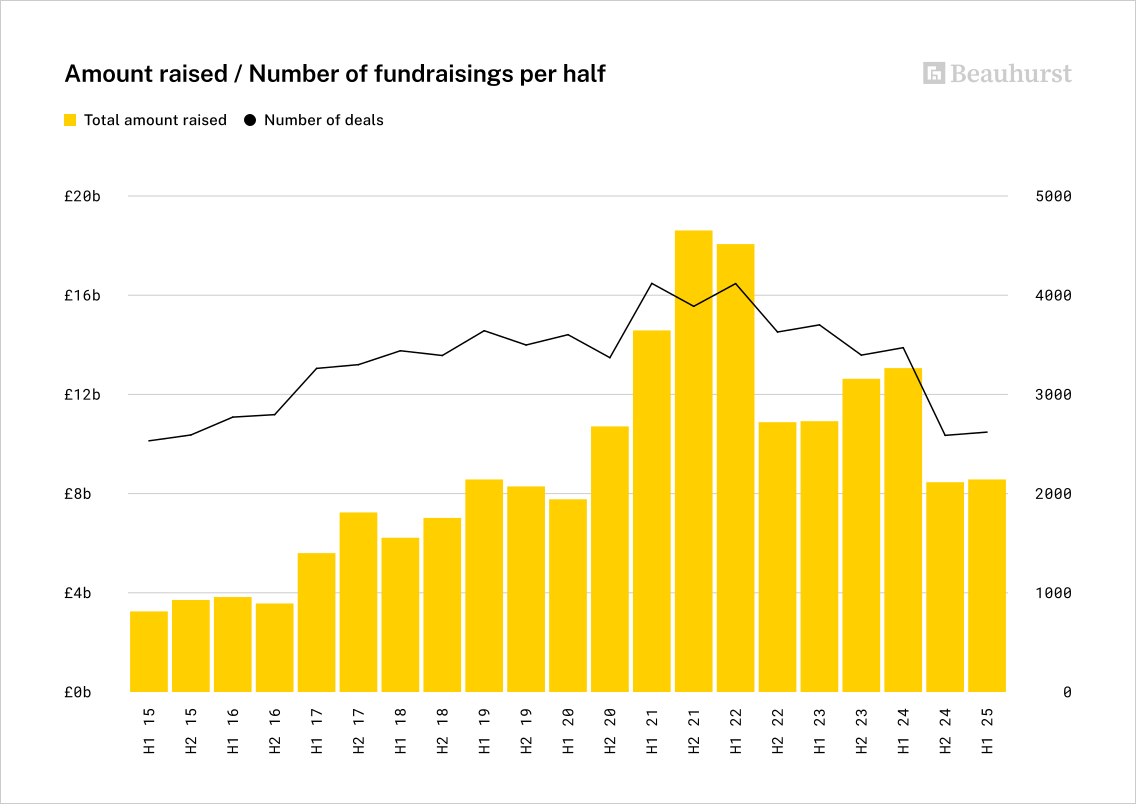
It’s increasingly clear we may be settling into a lower baseline for investment activity. The sharp peaks of previous years, including the post COVID-19 investment boom in 2021 and 2022, have given way to a flatter, more cautious landscape.
Half comparison
At first glance, the picture doesn’t look too bleak. Investment into UK companies ticked up slightly from H2 2024 to H1 2025, with a 1.3% increase in both the number of deals and total amount raised. While that suggests some stability, the gains are marginal and they don’t hold up when we look year-on-year.
Comparing H1 2025 to H1 2024, the market has clearly contracted: deal count is down 25%, and the total amount raised has fallen by 34%. This points to a meaningful decline in overall market appetite and not just a temporary dip.
Quarterly review
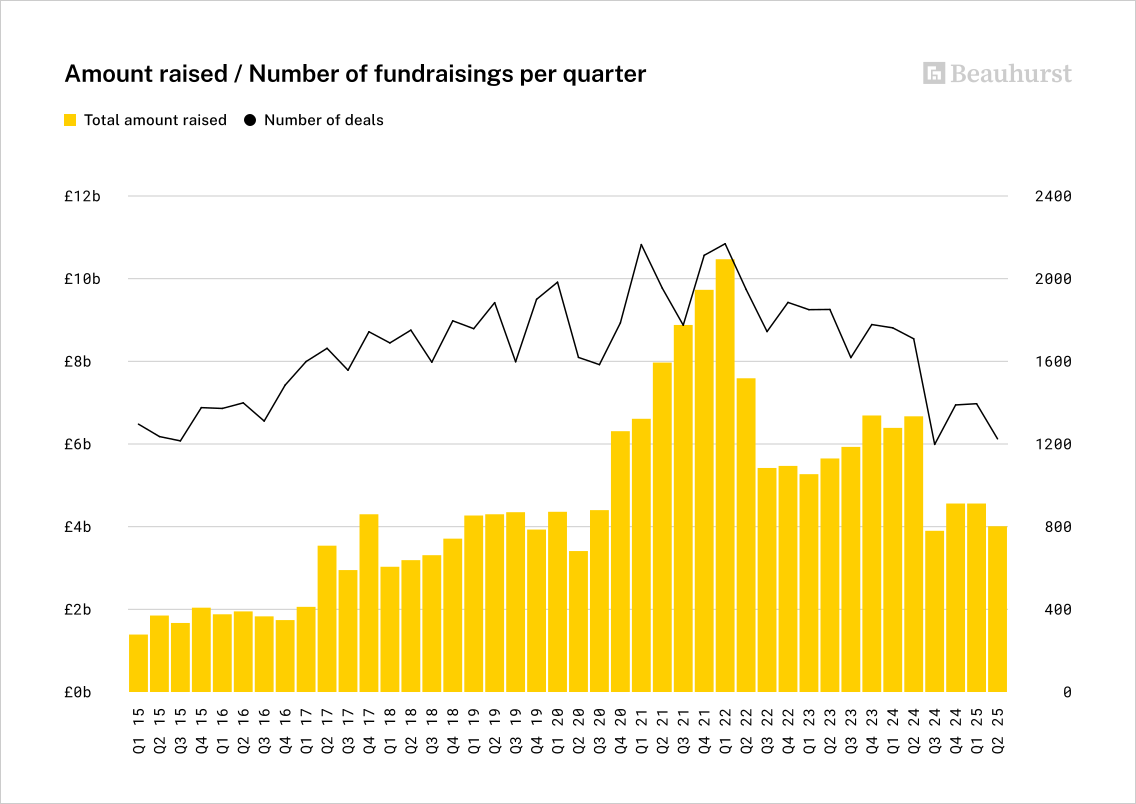
Similarly, when we compare to the previous quarter, numbers are declining — both the number of deals and the amount raised dropped by 12%.
If deal volume continues to decline at the same pace — say, another 12% drop in Q3 2025 — we could be looking at just 1,078 deals that quarter. A further 12% drop in Q4 would bring the total number of deals for the year down to just 4,647, which would mark the lowest annual deal count since 2014.
Using the same projection for the amount raised — a 12% decline each quarter until the end of 2025 — we would see £15.2b invested in 2025. That would be the lowest since 2018, and a 29% decrease from 2024.
“2025 could mark the lowest deal volume since 2014.”
In our previous report covering UK equity investment in Q1 2025, where we also saw fewer deals and less investment across the UK overall, we asked: is this the new normal? With the latest data in hand, it’s now clear that we may need to get used to lower investment volumes and cautious investor appetite.
To unlock the rest of the report, enter your details below.
Don’t worry — it won’t cost you anything and we’re not signing you up to an account (promise).
Where is investment being made in the UK?
Half comparison
London always secures the top spot for the region bringing in the most investment, and H1 2025 was no different. The capital made up 50% of all deals made, and a huge 65% of the total amount raised — a 22% increase in amount raised from H2 2024.
The South East ranked second for the number of deals (11%) and third for total funds raised (6%). Meanwhile, the East of England accounted for 7% of all deals, placing it third in that category, and contributed 10% of the total amount raised, earning it second place for funding.
There was exciting news for the South West, which experienced a 75% increase in funds raised and contributed 5% of the UK total. A large portion of this can be attributed to a large investment into The Openwork Partnership, which secured £120m in May 2025.
Investment into Scotland continued to increase after we saw a 108% increase in amount raised in our Q1 2025 review. Scottish companies secured 7% of all deals made in H1 2025, and 4% of the amount raised — this is an increase on H2 2024 of 24% and 9% respectively.
Wales saw a drop in investment in H1 2025. The number of deals in Wales declined by 34% and, even more significantly, the amount invested into Welsh companies declined by 80%.
Northern Ireland also saw a drop in the amount raised (by 25%), but had a 7% increase in the number of deals made.
80%
Quarterly review
While London again secured the top spot when looking at activity in Q2 2024, there is a slightly different story in our quarterly review than in our half-year analysis. London-based companies secured 51% of deals and 64% of the total amount raised in Q2, but this is a 10% and 16% decrease from the previous quarter. Despite this, London continues to make up over half of total UK investment.
Compared to the previous quarter, we are still seeing good news for the South West, which had a 10% increase in the total number of deals and a 266% increase in the amount raised.
There was also encouraging investment for the North East in terms of the amount raised, which increased by 188%. However, this wasn’t reflected in the total number of deals, which dropped by 15%.
Scotland tells a mixed story in Q2 2025. Although the number of deals increased by 10% in the previous quarter, the nation’s companies saw a 49% dip in the amount raised. And there continued to be less positive news for Wales, which had a 58% decrease in the number of deals and an 84% decrease in the amount raised.
Which industries are seeing the most investment?
Half comparison
As we’ve seen in the past couple of years, software companies dominate the investment market in the UK, and H1 2025 was the same. Software companies secured 49% of deals and 64% of the total amount raised, which, interestingly, was the same number of deals but a 28% increase in the amount raised compared to H2 2024. Under Software sit the subsectors of SaaS and AI — let’s take a closer look at how they did.
“There was an increase of investment into SaaS and AI companies.”
SaaS companies saw a 12% increase in the number of deals made, with 657 deals in H1 2025, and a 60% increase in the amount raised (totalling £3.4b) over the previous half. AI also saw an increase across both the number of deals and amount raised —by 11% and 21% respectively.
Fintech companies had an increase in investment, with deals rising by 12% (496) and the total amount invested (£2.7b) rising by 40%. Overall, tech companies performed well this half, with investment also rising in adtech, lawtech, and martech.
But these weren’t the only industries to gain more investment. Another standout is digital security, which had a 12% increase in the number of deals made and a huge 422% increase in the amount raised, rising to a total of £535m invested in H1 2025.
This may come as a reaction to the number of cyber security attacks the UK has experienced recently, such as the wave of attacks on supermarkets M&S and Co-op, which happened earlier this year. In fact, according to The Cyber Security Breaches Survey 2025, 43% businesses and 30% charities reported having experienced some kind of cyber security breach or attack in the last 12 months.
Quarterly review
Despite a 26% drop in deal count, the financial services sector saw a 35% increase in funds raised, raising £1.1b in Q2 2025. Some tech subsectors, including blockchain, insurtech, edtech, and proptech, not only attracted more deals but also raised larger amounts in Q2 2025.
SaaS, AI and fintech all saw declines in both deal volume and amount raised this quarter, despite performing well half-on-half, possibly suggesting early signs of a funding slowdown for the market’s favourite sectors — we’ll only know once 2025 comes to a close.
Company stages of evolution
Half comparison
When we look at the stage of evolution data, as usual Seed-stage companies lead the way in the number of deals made (1,242). However, these businesses rank at the bottom for the amount raised (£1.16b) due to their low average deal size. Venture-stage companies raised the most (£2.99b) and came in second place for number of deals (956).
Established-stage companies recorded the smallest number of deals (172) but saw the most dramatic funding growth compared to the previous half, with a 99% increase from H2 2024 to H1 2025 — raising £2.91b in the latest half.
Growth-stage companies ranked third for both deals and amount raised in this period.
Quarterly review
The quarterly trends mirrored the half-year results in several areas. Seed-stage firms continued to lead in deal volume with 579 transactions, but again saw the least investment at £540m.
Established-stage companies maintained their pattern of fewer deals (77) but topped the charts for capital raised, bringing in £1.71b. Growth-stage firms, consistent with the half-year picture, placed third in both deal count and total funding.
Overall, Established companies saw increased average deal size and total raised across both H1 and Q2 2025. This means, as we’ve seen before, investors appear to be favouring stability over risk.
Company valuations
Half comparison
Valuations continued their downward trend across the first half of 2025, reflecting the enduring cautious and value-driven investor mindset that we saw in our stage of evolution analysis.
Looking half-on-half, pre-money valuations fell at every stage of evolution. Companies at the Growth-stage saw the most pronounced decline, dropping from £68m in H2 2024 to £38m in H1 2025.
Growth-stage founders seem to be getting squeezed — they’re still raising decent amounts of money, but they’re having to give up more of their company to get it. This might be because investors are now expecting more proof that these businesses can scale, make money, or eventually exit successfully.
At earlier stages, like Seed or Venture, valuations are often based more on potential. But at the Growth-stage, investors are being more careful and focused on real results, which makes it harder for companies to hold onto the high valuations we’ve seen in the past.
Quarterly review
The picture becomes even starker when looking at quarterly data. In Q2 2025, the overall mean valuation fell to its lowest point since Q1 2019, marking a six-year low. The most dramatic shift came at the Established-stage, where the average valuation plummeted from £76m in Q1 to just £20m in Q2 — a staggering drop in a single quarter and the lowest quarterly figure for Established companies since Q3 2015.
This steep fall again reflects heightened investor scrutiny around profitability, sustainability, and deal terms, especially for mature businesses, where expectations around value are typically more rigid.
Announced Deals
H1 2025 Top five
CityFibre
Isomorphic Labs
FNZ
CMR Surgical
ElevenLabs
ElevenLabs operates a platform that uses AI to automatically translate audio and video content into different languages. In January, the company raised £145m in equity with 18 funds contributing to the investment. The money will be used to improve its AI-driven audio technology.
Unannounced Deals
H1 2025 Top five
In H1 2025, 65% of deals went unannounced — the highest proportion since H1 2020. Tracking unannounced fundraising is crucial because it reveals hidden investment activity, offering a more complete and accurate picture of the UK market.
The data for our top five unannounced fundraisings was compiled on 01 August 2025.
How does Beauhurst find unannounced fundraisings?
At Beauhurst, we track company filings daily to uncover fundraises that aren’t publicly announced, giving us a comprehensive view of the UK fundraising landscape.
However, filings can be submitted months after a deal closes, so some unannounced fundraises completed within the half may not be visible at the time of reporting.
Ultromics
Ultromics makes machine learning technology which aims to detect heart diseases through analysing ultrasound data. To enter new markets and expand within the US, the company raised £43.2m in June — the investment came from several funds including Oxford Science Enterprises and the University of Oxford.
GB Bank
Abingdon Software
Tortoise
Pulmocide
Methodology
About the authors
Lily is a Content Associate at Beauhurst, and professional writer, with over eight years of experience. She is responsible for content creation at Beauhurst and specialises in both creative and analytical writing. Prior to this, she worked in SEO and completed an MA in Creative Writing.