Growth in Every Postcode: Testing Burnham's Devolution

Words Callum Newton

Growth in Every Postcode: Testing Burnham's Devolution

Britain is now on to its ninth Prime Minister since the turn of the Millennium. To put that in perspective, the previous nine stretch back to the 1950s when Anthony Eden occupied No.10 and the Suez Crisis dominated the headlines. Yet even after so much political change, Andy Burnham’s agenda appears to be more radical than most of his predecessors as he attempts to rewire how the British state works at a local level.

Earlier this summer Andy Burnham set out his stall, calling for the wholesale devolution of power from Westminster to the English regions and devolved nations. At the centre of this agenda was a promise to deliver “growth in every postcode”. This is certainly a noble ambition. Nationally growth has stagnated over the last decade, with business and investment activity increasingly concentrated in London and regional cities.

However, while much of the debate around devolution takes place at a regional and local authority level, less attention has been paid to how growth is distributed between postcodes. The Beauhurst Insights team has therefore examined these patterns to establish a benchmark against which government and politicians can assess the success of Burnham’s “growth in every postcode” agenda.

How widely is UK business growth spread?

Beauhurst’s data suggests Burnham may have a point. While the UK’s active company population has steadily expanded over the last decade, the proportion of postcodes sharing in that growth has fallen. As Figure 1 shows, 70.3% of UK postcode districts recorded an increase in active company numbers in 2026, down from 86.3% in 2017. 

Note: We have defined “growth” as having more “active” companies than in the previous year.
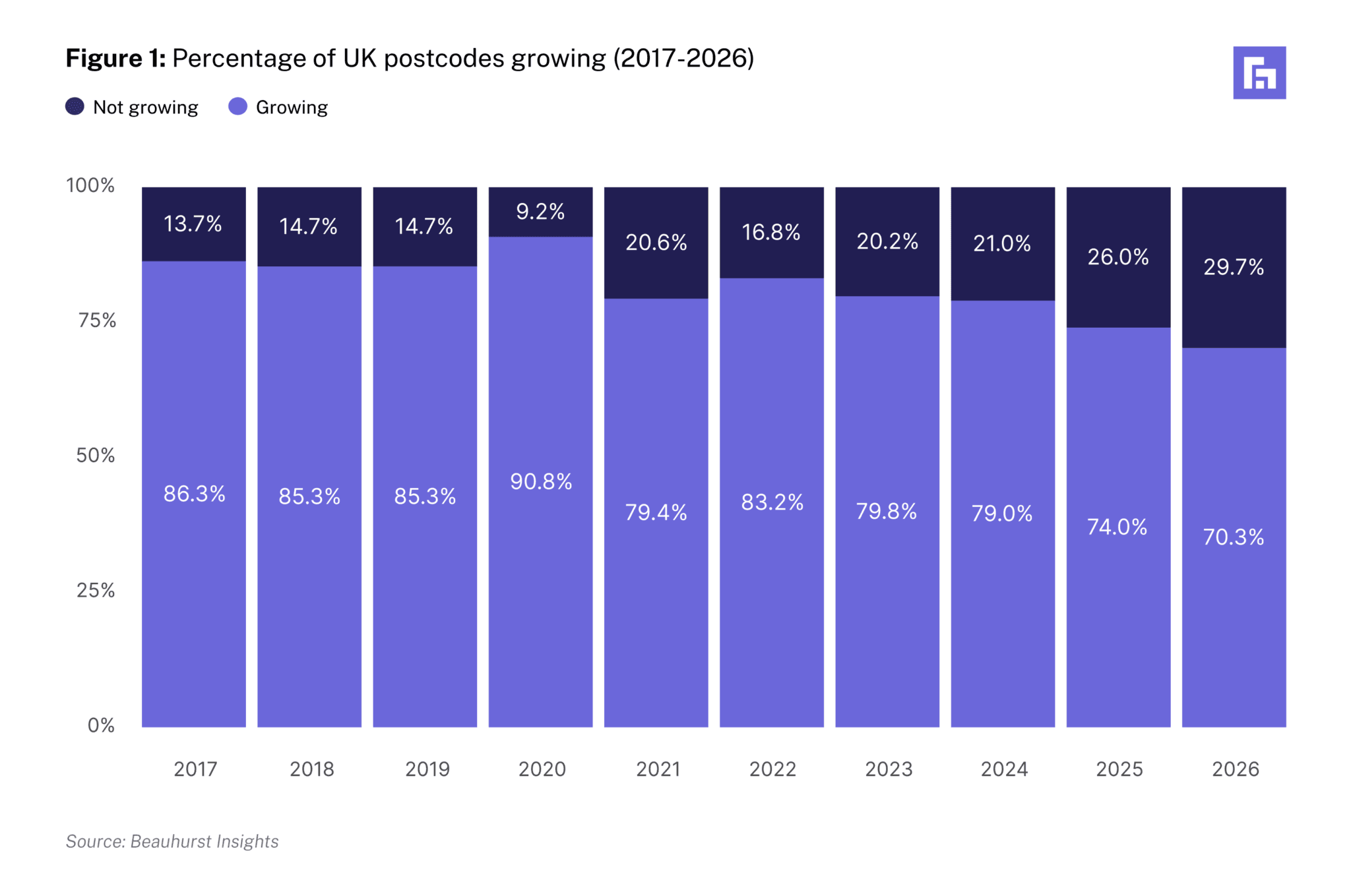
stacked bar chart 1

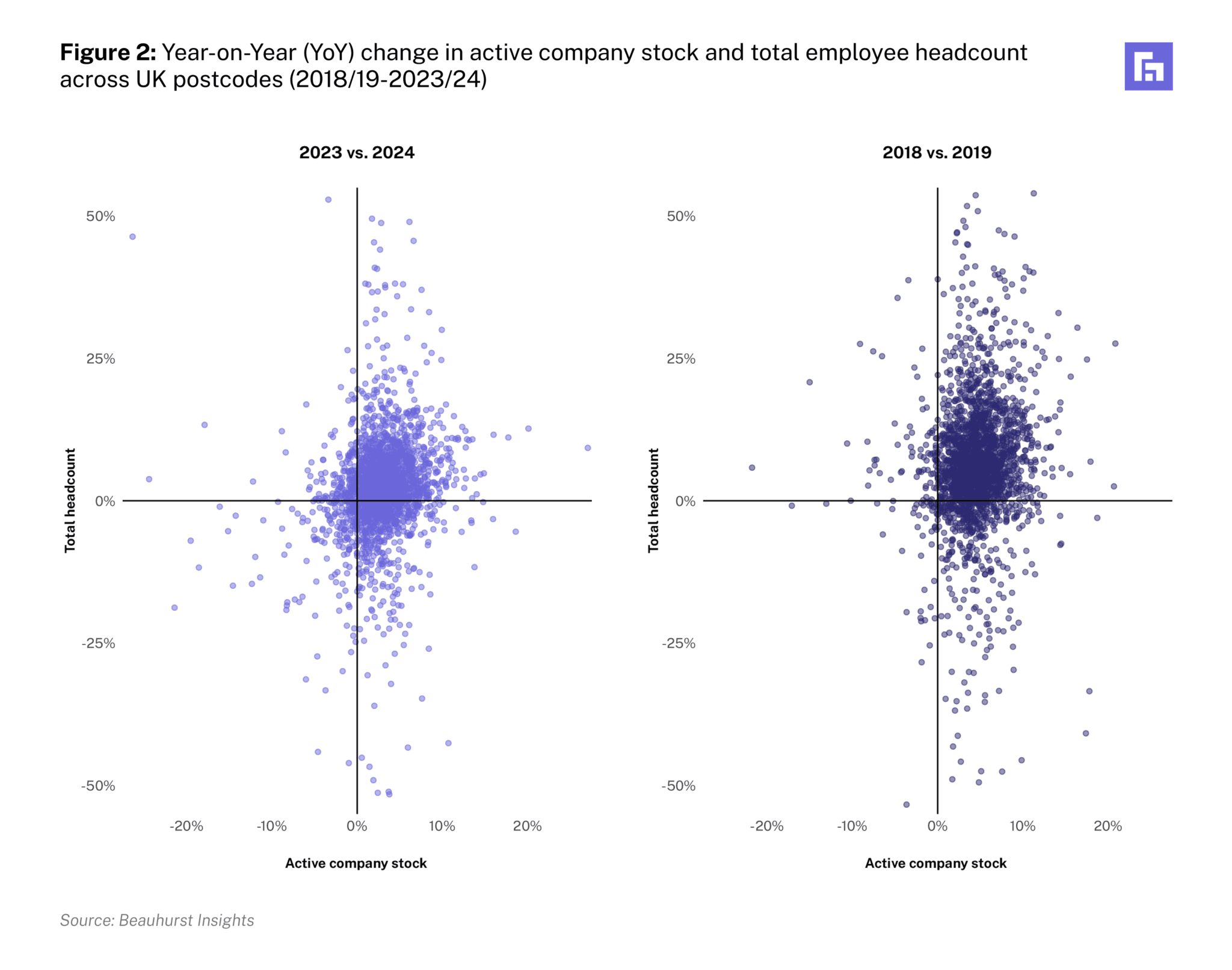
Unfortunately the picture looks more concerning when we consider whether this expanding business population is accompanied by rising levels of employment and financial activity. Between 2018 and 2019, 76.4% of postcode districts in our analysis recorded increases in both active company numbers and total employee headcount. By 2023/24, that proportion had fallen to 61.6% (Figure 2). A similar trend is recorded again when considering company turnover. Between 2018/19, 52.5% of postcode districts recorded growth in both total turnover and “active” company headcounts. Whereas between 2023/24 that figure had dropped below half to only 46.2%.

scatterplot chart 1

In short, things appear to be moving in the wrong direction across many UK postcodes. Taken together, Beauhurst’s figures suggest that business growth is becoming less geographically widespread. Most British postcodes continue to gain businesses, but a smaller proportion are seeing simultaneous increases in company numbers and employment – which poses both a significant challenge and casus belli for Burnham’s devolution agenda.

Why London is lagging on postcode growth

But there’s another piece of the puzzle. Much of the debate around devolution and “growth in every postcode” centres on moving power and decision-making away from London and South East England towards “left behind” regions. There are good reasons to address these regional inequalities, but this framing risks overlooking differences within regions – including communities across the capital which have not shared in its prosperity.

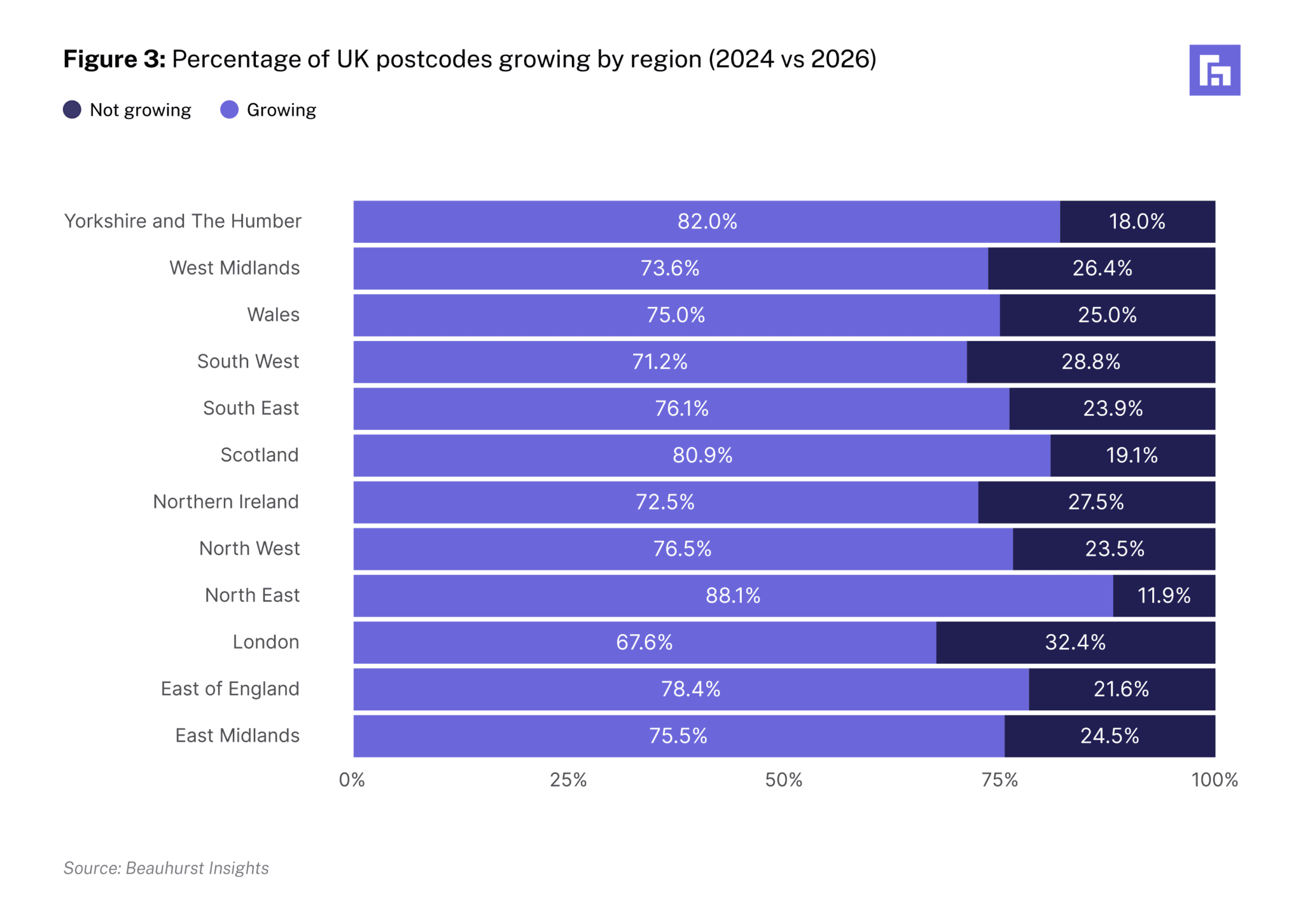
Figure 3 adds an interesting complication to this debate. Between 2024 and 2026, London recorded the lowest proportion of postcode districts with an expanding active company population of any UK region, at 67.6%. This compares with 88.1% in the North East and 82.0% in Yorkshire and the Humber. Crucially, London may have also fallen behind in how business growth translates into financial outcomes. The capital lags behind both the North East, East Midlands and Northern Ireland when it comes to YoY growth in “active” companies and employee headcount. The South East also falls behind London by the same metric, and is effectively on par with the North West and West Midlands.

What the data means for Burnham’s devolution agenda

In many ways Beauhurst’s data vindicates many of Burnham’s arguments for “devomaxxing”. Its clear growth is becoming increasingly concentrated and many postcodes are not sharing in Britain’s prosperity. Hailing from the North East, the author can attest this is the case. But while Burnham’s “growth in every postcode” promise is noble and ambitious, Beauhurst’s data also shows it is important his agenda is not based on generalisations. Not all parts of London and the South East are wealthy and prosperous. If he is serious about delivering growth in every postcode, Burnham would do well (and could be politically rewarded) for not forgetting the postcodes on No.10’s doorstep.


Subscribe to the Beauhurst Insights Substack

Data-led analysis of the UK’s private companies, straight to your inbox.

Subscribe
Discover our data

Get access to unrivalled data on all the companies you need to know about, so you can approach the right leads, at the right time.

Book a demo today to see all of the key features of the Beauhurst platform, as well as the depth and breadth of data available.

An associate will work with you to build a sophisticated search, returning a dynamic list of organisations that match your ideal customer profile.