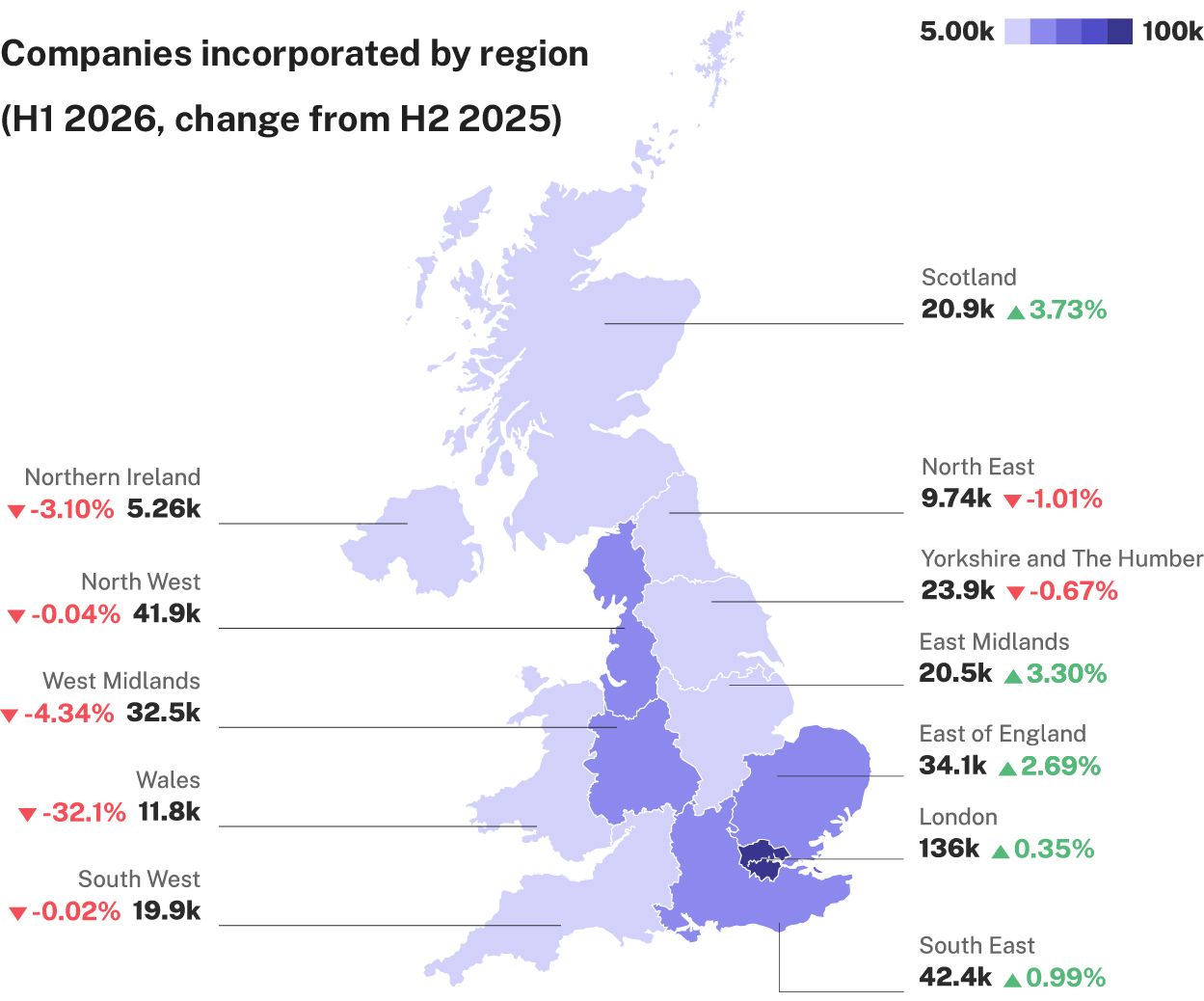
In our new series, we’re busting the myths that come from UK, German and Irish business data. The headlines say one thing, but when you dig into the data, does it hold true? This week: does a falling incorporation number mean UK entrepreneurship is weakening, or is the more interesting story about what kind of company gets started, not how many?
Where this number comes from
There were 402k new companies incorporated in the UK in H1 2026, down 5.7% on H1 2025 and the second consecutive half-year decline. It’s the lowest H1 total in five years.
Two regulatory changes impacted this window. Mandatory identity verification for directors and persons with significant control arrived in November 2025 under the Economic Crime and Corporate Transparency Act. And Companies House then doubled its incorporation fees from February 2026. Of the two, identity verification is likely to have contributed more significantly to the slowdown.
Read in isolation, a 5.7% fall in new companies looks like a straightforward story: fewer people are starting businesses. That reading misses two things.
One: a smaller flow doesn’t mean a smaller base
Identity verification exists specifically to raise the bar for incorporation, filtering out low-intent and fraudulent registrations in favour of companies with genuine longevity. A shrinking count of new filings, in other words, can mean a higher-quality register rather than a weaker pipeline of founders.
And the active company base, the actual stock of running businesses, as opposed to the flow of new filings, grew to a record 5.66m over the same period. Two numbers, same report, pointing in opposite directions: the flow of new incorporations is down, the stock of active companies is up. Most coverage of this release will lead with the flow number alone. That’s accurate on its own terms, but it leaves out half the picture.
Two: the companies still forming look different
Sector data from the same release makes the point even sharper. Application software rose 40% year-on-year to 28.1k incorporations in H1 2026, overtaking restaurants and property development to become the UK’s most common industry for new companies. The wider Digital and technologies category grew 38% to 28.9k.
Over the same period, more established, consumer-facing sectors moved the other way: clothing incorporations fell 26% year-on-year, and restaurants, pubs, cafés and takeaways fell 10%, likely reflecting cost pressures from rising business rates and employer National Insurance contributions bearing down harder on premises-based businesses than on digitally native ones.
Put those together and the overall 5.7% fall isn’t a uniform retreat. It’s software and tech pulling one way, hard, and traditional consumer-facing sectors pulling the other, with the net effect landing as a comparatively modest-looking decline. That’s a shift in the shape of UK company formation, not just its volume.
Worth holding onto some caution here too: it’s too early to say whether this is a temporary adjustment or a lasting shift, and part of the fall in raw incorporation numbers may reflect founders, including solopreneurs, choosing not to incorporate at all rather than genuinely fewer businesses being started.
Even so, a falling incorporation count doesn’t necessarily mean the UK is producing fewer entrepreneurs. It may instead point to a changing mix of companies being formed, with software and technology accounting for a growing share of startup activity.