North East Combined Authority (NECA)
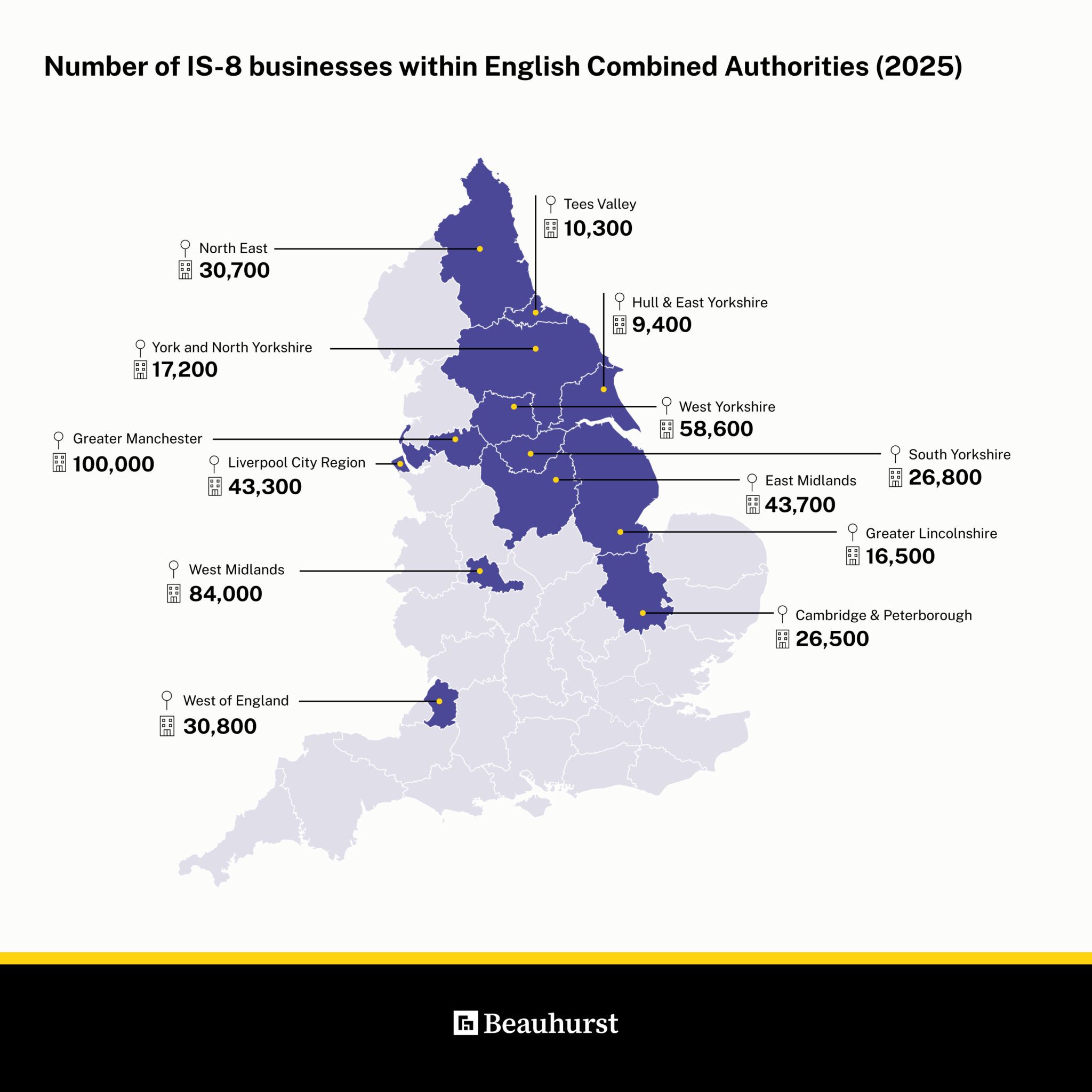
Starting in my native North East, NECA is home to over 30,700 IS-8 businesses. A sizable chunk is taken up by Advanced Manufacturing companies, such as AR Controls and Graphene Composites, which is unsurprising given the North East’s strong industrial heritage. The region also has burgeoning Clean Energy and Defence sectors, which are expected to play key roles in NECA’s upcoming Local Growth Plan.
Tees Valley Combined Authority (TVCA)
Manufacturing is also an integral part of the economy in neighbouring Tees Valley. There are currently 10,400 IS-8 companies operating across TVCA. Alongside Advanced Manufacturing, TVCA has become a major hub for businesses building Clean Energy infrastructure used across the rest of the UK and Europe. Many of these businesses — such as Catalsys and Nova Pangea Technologies — are scaling quickly and have benefited from sizable rounds of equity fundraising.
York & North Yorkshire Combined Authority (Y&NYCA)
Across the border there are 17,200 IS-8 businesses in York and North Yorkshire. Unlike peer Combined Authorities across northern England, almost half of the IS-8 businesses are Professional and Business Service firms often centred around York and Harrogate, including IDR Law and YRG Group. Many of these businesses are scaling quickly, with Professional and Business Service firms in the region securing over £5.7 billion in equity fundraising since 2011.
Hull and East Yorkshire Combined Authority (HEYCA)
There are currently 9,400 IS-8 businesses operating within HEYCA’s remit. Despite covering a smaller population, HEYCA has more IS-8 firms per capita than many other neighbouring Combined Authorities. Some of the largest firms are Hudson Contract and Phoenix Software Ltd., which specialise in providing Digital Technology and Professional Services to clients across the UK.
Greater Lincolnshire Combined County Authority (GLCCA)
A similar picture is apparent in their neighbours across the Humber. There are 16,000 IS-8 companies in Greater Lincolnshire, including over 8,000 Professional and Business services firms which are driving innovation and supporting thousands of jobs. Much of the groundwork for this burgeoning sector was laid by the former Greater Lincolnshire LEP. However, the newly established GLCCA is expected to build on their work and further integrate Lincolnshire’s economy with Britain’s wider industrial strategy.
West Yorkshire Combined Authority (WYCA)
Often considered the ‘powerhouse’ of post-industrial Britain, WYCA is home to one of the largest concentrations of IS-8 businesses in England with 58,600 companies. Over half of measured companies are engaged in Professional & Business Services, such as Plexus Law and Parklane Properties. West Yorkshire also has a rapidly growing Creative Industries sector anchored around Leeds, which accounts for a fifth of WECA’s IS-8 companies.
Greater Manchester Combined Authority (GMCA)
A similar story is playing out across the Pennines. To date, there are over 21,000 Creative Industries companies operating across Greater Manchester. This sector is growing quickly, spurred on by the presence of Media City in Salford and GMCA’s dedicated Creative Industries Plan. Greater Manchester also has almost 40,000 Digital Technology businesses — such as The Hut Group and Matillion — which have secured over £5.4 billion in equity fundraising since 2011.
Liverpool City Region (LCRCA)
LCR has the largest concentration of Advanced Manufacturing businesses in Northern England. Although not the largest in terms of headcount, LCRCA’s 22 Advanced Manufacturing firms — such as 2M Holdings and Joloda Hydraroll — are at the forefront of global innovation. The Manufacturing Technology Centre (MTC) and Materials Innovation Factory (MIF) also play a crucial role in enabling LCRCA to leverage its strong industrial heritage to attract investment and global talent.
South Yorkshire Mayoral Combined Authority (SYMCA)
SYMCA has a comparatively smaller profile of IS-8 businesses than other Combined Authorities, but it is growing quickly. Much of the growth is spurred by support from accelerators which are spotting growth potential and coaching business leaders through the formative early stages of development. There are currently 40 companies operating within SYMCA which have attended an accelerator programme within the last five years and have gone on to receive equity funding, such as Tribosonics and FourJaw.
West Midlands Combined Authority (WMCA)
Once Britain’s industrial heartland, the West Midlands is now undergoing a cultural revolution. With over 15,000 businesses — including Centresoft and Arthouse — WMCA is home to the second largest cluster of Creative Industries businesses in England which has succeeded in raising £253m in equity investment since 2011. The rapid growth of the sector suggests WMCA’s dedicated Creative Industries and Culture strategies are having a tangible impact on spurring innovation and attracting investment.
East Midlands Combined County Authority (EMCCA)
In Beauhurst’s second home, there are almost 44,000 IS-8 companies operating across the East Midlands Combined County Authority. The largest cohort is Professional and Business Services, which accounts for 47% of EMCCA’s IS-8 businesses and includes key drivers of innovation, such as Ideagen and Huddle. Professional services are followed closely by Digital Technology firms which have succeeded in drawing £635m in equity investment into the region.
West of England Combined Authority (WECA)
The West of England Combined Authority has one of the highest rates of IS-8 companies per capita amongst England’s Combined Authorities — second only to Greater Manchester. WECA is currently home to 30,800 IS-8 businesses, over 40% of which are Digital Technology firms which support over 47,000 jobs across the region.
WECA’s key comparative advantage appears to be Defence. The combined authority is home to the largest number of defence companies, many of which are clustered around Bristol’s major Rolls-Royce site. Although small compared to WECA’s wider IS-8 cohort, the region’s defence companies have secured over £14.8m in equity funding since 2011 and have a combined turnover of over £190m.
Cambridgeshire & Peterborough Combined Authority (CPCA)
There are currently almost 27,000 IS-8 companies operating within the Cambridge & Peterborough Combined Authority. Although CPCA has a comparatively lower number of IS-8 businesses compared to other combined authorities, its clear comparative advantage is Life Sciences, which accounts for almost half of the region’s total equity funding since 2011.
CPCA is home to almost 800 Life Sciences companies which are at the cutting edge of global innovation. Much of the activity is concentrated around Cambridge — including over 100 Life Science spinouts — solidifying the city’s prominence within the UK’s ‘Golden Triangle’.
For more information on Beauhurst’s data, please contact our specialist Research & Consultancy team: callum.newton@beauhurst.com