How to Find Local Businesses in Germany

 27 August 2025
Table of contents

Germany’s business landscape is decentralised; its economy is distributed amongst several centres and regions, meaning there are clusters of companies, of all sizes, spread across the country. This makes the process of finding the right local business location more complicated than in more centralised markets, like the UK.

Finding these companies isn’t always as simple as running a search, in English, on Google. Many German SMEs still rely on regional networks, trade associations, and local reputation rather than global directories. Add in GDPR-driven privacy practices, and you have a market where online visibility can be patchy, even for successful, established firms.

In this article, we’ll look at traditional methods, online tools, and data-driven approaches that can give you a comprehensive understanding of Germany’s companies.

Why finding local businesses in Germany is different to the UK

Germany’s business landscape is shaped by strong regional economies, such as Bavaria’s manufacturing base, North Rhine-Westphalia’s industrial hubs, and Berlin’s thriving startup scene. This decentralised structure means opportunities are often spread amongst several regions rather than a single national centre like you’d find in London, which means local knowledge is crucial.

Another difference between the UK and Germany is that many smaller German businesses still rely on word-of-mouth, long-standing local networks, or regional trade associations instead of global online databases, to find trusted businesses they want to partner with, or do business with. Many businesses in Germany are tightly networked, for example in regional clusters, this means personal connections and referrals mean more for them than they would for global brands.

Strict GDPR enforcement and a strong culture of privacy also play a role. Some businesses will deliberately limit their online footprint, keeping contact details or customer reviews off public platforms. This can make digital discovery more challenging compared to the UK, where businesses are often more visible in centralised online listings.

Tools for finding local businesses in Germany

Google Maps and Google business profiles

While often seen as a consumer tool, Google Maps can be powerful for initial market scoping. Using German-language search terms with industry-specific keywords (for example, “Medizintechnik Unternehmen Berlin” for medical tech companies in Berlin) can surface SMEs and niche operators that don’t appear in English searches.

You can also use map filters to identify clusters, check photos for scale and professionalism, and cross-reference addresses for headquarters vs. branch offices.

German business directories

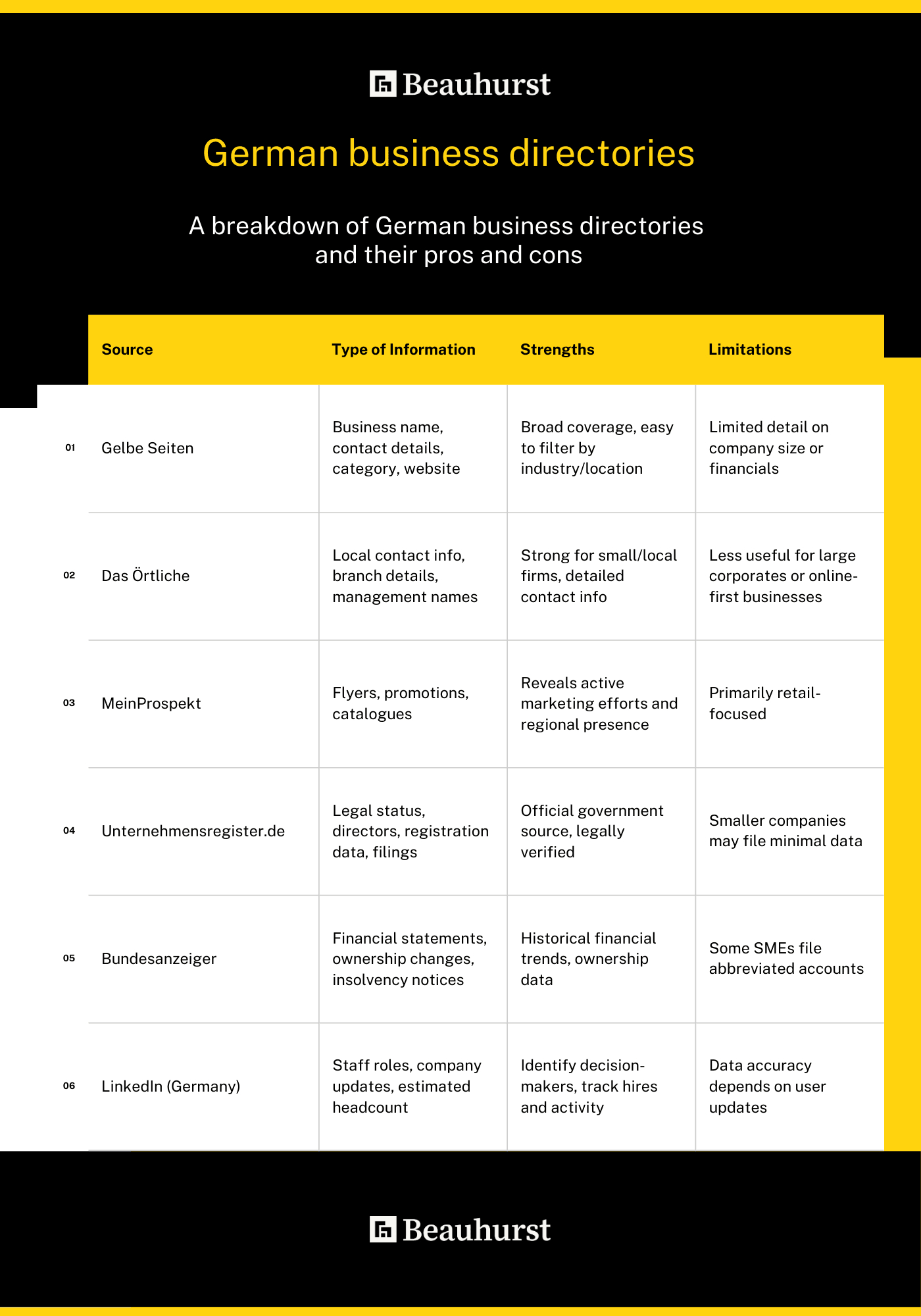
When researching local businesses in Germany, whether for prospecting, partnership scouting, or market analysis, no single source will give you the full picture. Instead, the most effective approach is layered research, combining broad discovery tools with deeper, official intelligence sources.

Traditional directories like Gelbe Seiten and Das Örtliche remain useful for uncovering companies that don’t appear in international databases, while platforms like MeinProspekt offer insight into market activity through local promotions. Once you’ve identified potential targets, Germany’s corporate registry (Unternehmensregister) and the Bundesanzeiger can provide legally verified information and financial filings. You can also use LinkedIn’s German network to find decision-makers, understand company scale, and spot growth signals.

Together, these resources form a multi-stage research toolkit which may be effective, but is time-consuming and resource-heavy.
German business directories and their pros and cons

Germany’s Equivalent to Companies House, Explained

Learn about the German company registration system and how it compares to the UK’s Companies House.

How commercial property teams use Beauhurst

If you’re looking for innovative startups or ambitious scaleups in Germany, we make it easy. The Beauhurst platform allows you to filter by location, sector, funding stage, or growth signal to surface the most relevant businesses. Every company in Germany has a profile that goes beyond the basics, giving you detailed company information, recent activity, and the names of key decision-makers, all in one place.

Instead of piecing together data from multiple sources, you can have a single source of truth. That means moving from search to a qualified list of German companies in minutes, giving you more time to focus on the other things that matter. Let’s take a look at how that works.

Step-by-step: Finding local German businesses on Beauhurst

Step 1

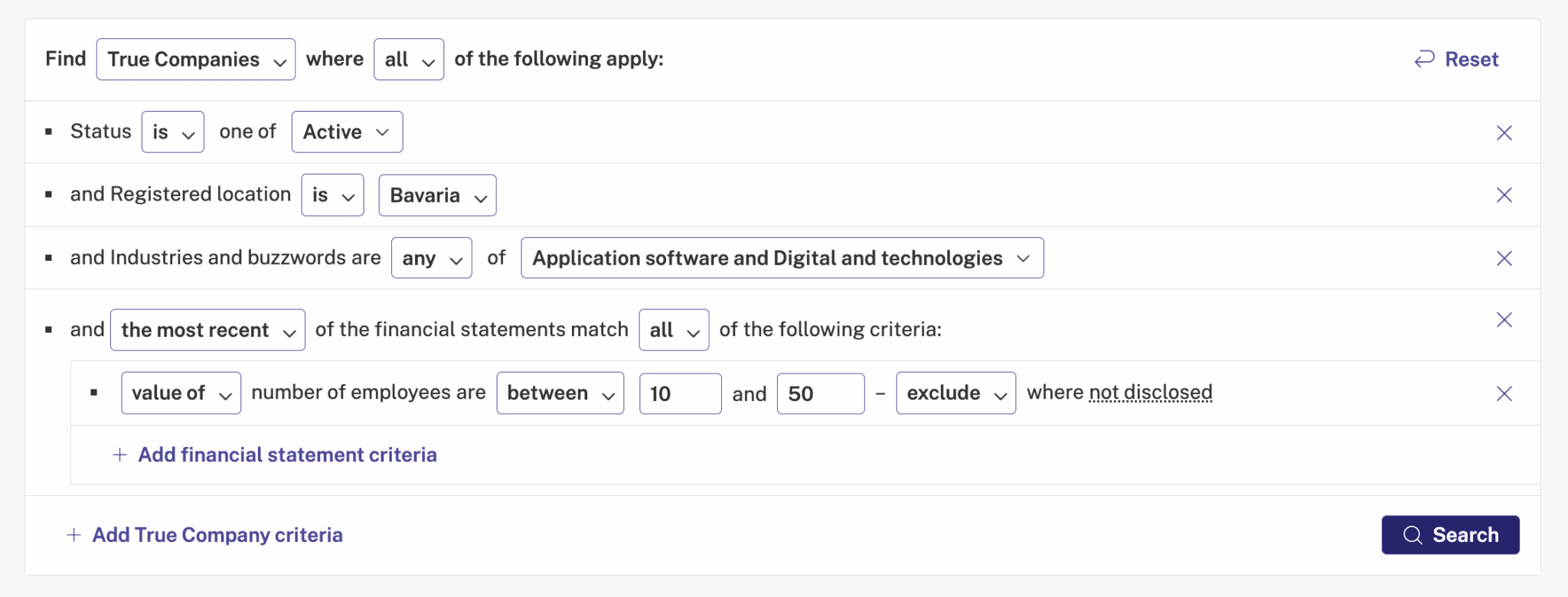
Open the Beauhurst platform, and head to the Advanced Search. Use the drop down to search across ‘True Companies’ and then set the location filter to Bavaria.

Step 2

To focus on your area of expertise, refine the search to companies in the ‘digital and technologies’ and ‘application software’ industries, and select companies with 10–50 employees — large enough to have complex legal needs but still small enough to be in a growth phase.

Step 3

Hit search and within seconds, you’ll get a curated list of companies. Each profile shows more than just a name and address: you see their latest funding activity, revenue, number of employees, recent news, and the names of key decision-makers.

Step 4

You can then export that data to share across teams. Or add that data to a Collection to receive automatic updates whenever there is news or updates on any of those companies. Watch our YouTube video below to see how it works in practice.

The Beauhurst Newsletter

Weekly insights on German and UK companies, direct to your inbox

Beauhurst vs German directories

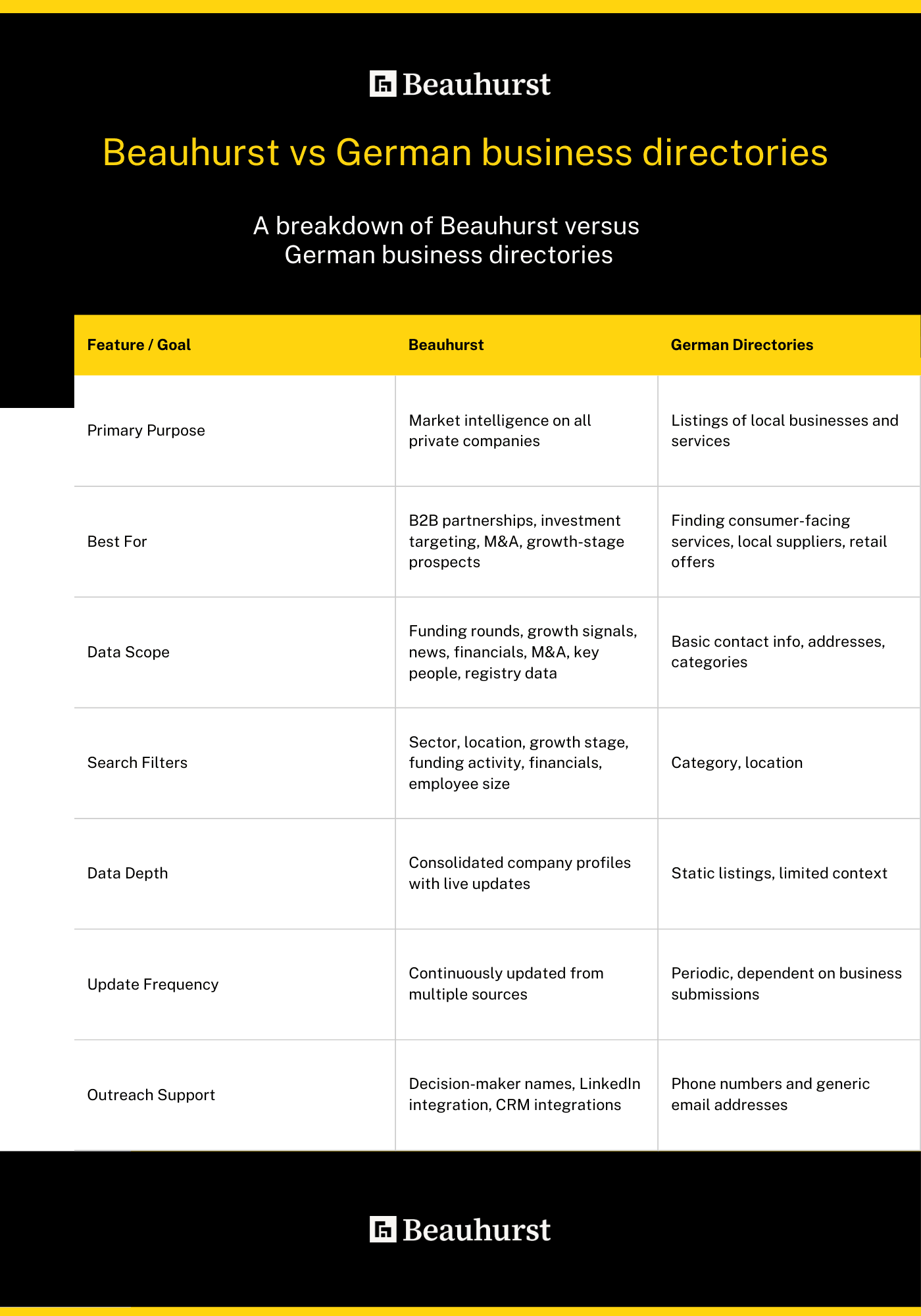
If your goal is to find B2B partnerships, investment opportunities, or high-growth potential companies, Beauhurst offers a fundamentally different approach from traditional German directories.

Platforms like Gelbe Seiten or Das Örtliche are excellent for locating established local services, but they rarely provide the strategic intelligence you need for corporate finance, legal advisory, or business development.

With Beauhurst, you’re not just seeing who exists, you’re seeing who’s growing, who’s raising capital, and who might need your expertise soon. Our filters let you pinpoint companies in your target sector and region, while detailed profiles consolidate registry filings, funding data, news mentions, and decision-maker information into one view. It’s the difference between a phone book and a market intelligence dashboard.

Beauhurst v German directories

Beauhurst’s insider tips for finding German companies

Search in German: Use native-language queries in Beauhurst and other tools, for example “Handwerker Köln” instead of “craftsman Cologne”, to surface locally listed companies.

Understand local payment habits: Many SMEs, especially in trades and retail, still operate in a cash-friendly culture, which can signal traditional business practices or slower digital adoption.

Combine Beauhurst with LinkedIn: Use Beauhurst to identify high-potential German companies, then LinkedIn to connect with decision-makers and personalise your outreach.

Get access to German data now

The best approach to finding German businesses is combining traditional methods, free online tools, and data platforms like Beauhurst. Word-of-mouth, trade fairs, and local directories uncover hidden opportunities, while Beauhurst consolidates registry filings, transaction data, and decision-maker insights in one place.

Ready to discover the most promising German businesses without wasting hours on manual research? Book a demo with an in-house expert today and see how our platform combines real-time company data, growth signals, and key decision-maker insights to help you build a high-quality, future-ready pipeline — all in one place.

Discover our data.

Get access to unrivalled data on the companies you need to know about, so you can approach the right leads, at the right time.

Schedule a conversation today to see all of the key features of the Beauhurst platform, as well as the depth and breadth of data available.

We’ll work with you to build a sophisticated search, returning a dynamic list of organisations that match your ideal customer profile.

Beauhurst Privacy Policy

FAQs

Germany’s economy is decentralised, with strong regional hubs like Bavaria, North Rhine-Westphalia, and Berlin. Many SMEs rely on local networks rather than global directories, and strict GDPR rules can limit online visibility.

Google Maps, German business directories (Gelbe Seiten, Das Örtliche), review platforms like Yelp, and corporate databases such as Unternehmensregister.de are all useful. But for faster, deeper research, a platform like Beauhurst combines multiple sources in one place.

Yes. While Beauhurst started in the UK, it now includes insights on all German businesses through international datasets, registry filings, and trusted local data partnerships.

Recommended for you