Artificial Intelligence: Investment Bubble or Genuine Hypergrowth Market?
Digging into the UK data behind the question on everyone’s lips: is AI a once-in-a-generation growth shift — or the start of the next correction?
Is the artificial intelligence (AI) industry in a bubble? Plenty of people think so. Tech journalists, economists at the IMF, and even CEOs inside the industry have hinted at “irrationality” in today’s AI investment cycle.
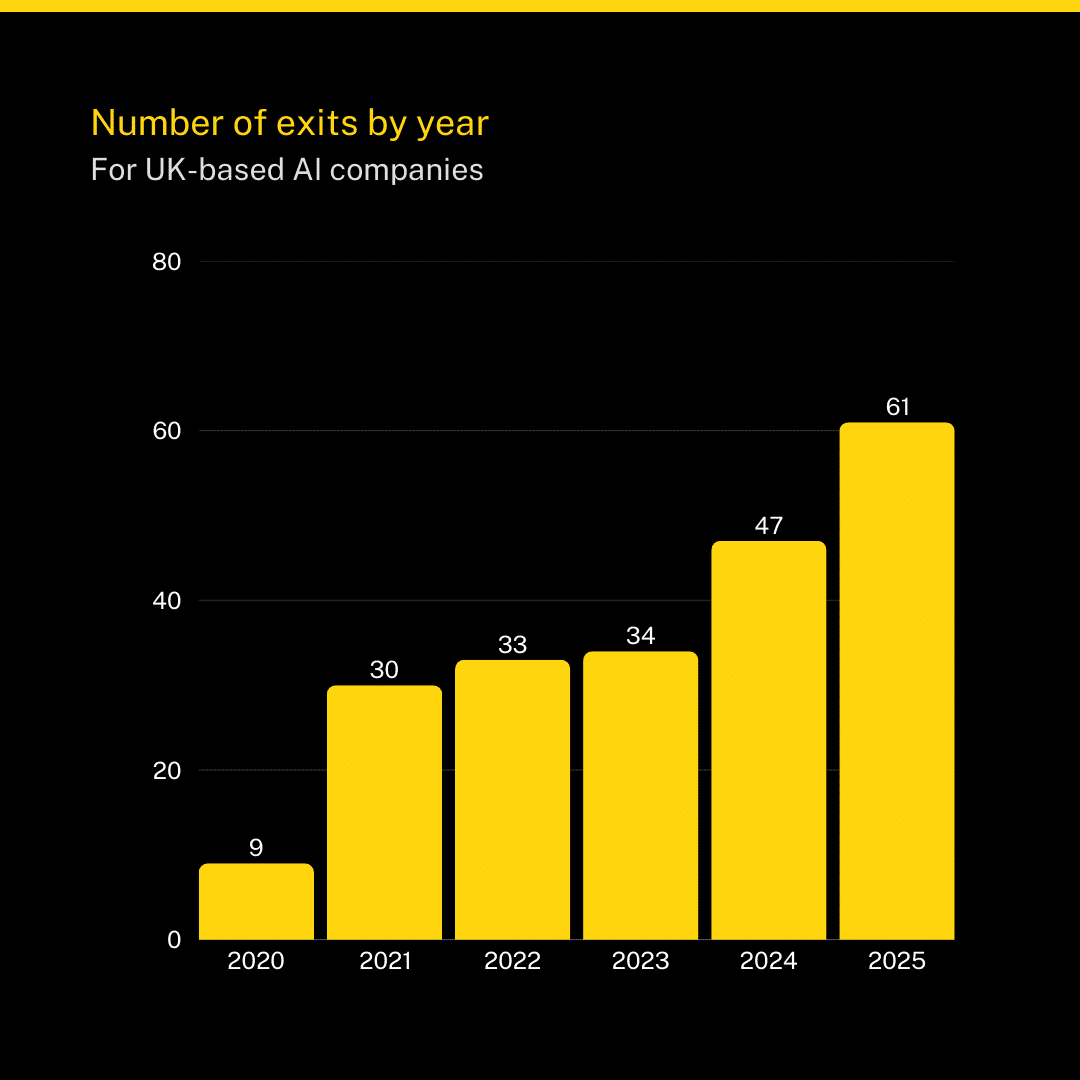
Beauhurst data points to a mixed picture. On the one hand, UK AI exits increased in 2025 (up 23% on 2024), suggesting that more value is being realised and liquidity is returning. On the other hand, employment momentum is slowing and unit costs are proving a challenge to profitability.
The combination of strong capital flow but weaker hiring translation is often one of the earliest signs that a market is starting to move from growth-at-all-costs to capital preservation. So, is AI a bubble? A hypergrowth market? Or something more complicated?
“Our view is that there are potential bubbles in some parts of the stack. Infrastructure looks strong, but there’s a risk of a bubble in the application layer, which problematically is touted as one of the UK’s strengths.”
Henry Whorwood
Managing Director, Research & Consultancy
An overview of the AI stack
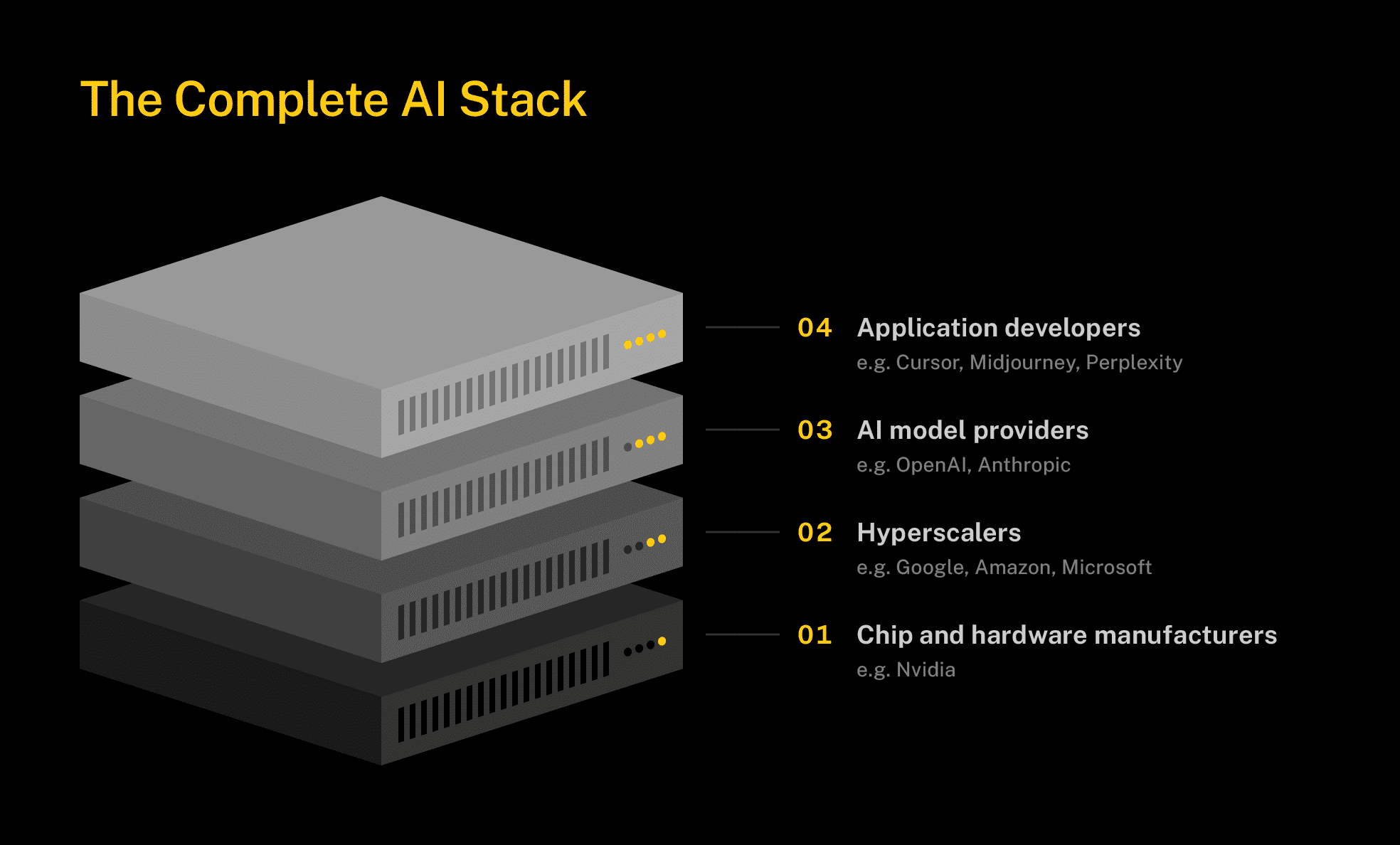
AI is more than just large language models (LLMs), and to illustrate this, we’ve mapped the industry into four layers — each with a different risk profile.
Overall, the AI sector, which comprises 3,276 high-growth companies in the UK, is broadly application-heavy, with a wealth of innovative AI software companies operating in the space. NScale, which raised just under £1b in 2025, now represents the largest homegrown hyperscaler in the UK.
1. Chip and hardware manufacturers
This foundational layer consists of companies that supply the chips (primarily GPUs) that make AI possible.
2. Hyperscalers
Hyperscalers build and operate the data centres, and rent compute at scale.
3. Model providers
Model providers train large language models and sell access via APIs.
4. Application developers
Application developers sit at the top of the stack, building AI products for end users, often on top of third-party models.
For UK startups, most of the immediate bubble risk sits upstream (in the economics of compute and model supply) — but the consequences are felt downstream, particularly by application-layer companies exposed to API pricing, model changes, and inference costs.
The UK's Top 100 AI Companies
Discover the top 100 high-growth artificial intelligence companies in the UK, ranked by total equity investment raised.
The Beauhurst framework: bubble vs hypergrowth signals
Because “bubble vs hypergrowth” isn’t a binary answer, we built a framework of signals we track across UK private companies to spot early signs of market stress.
The goal isn’t to predict a crash. It’s to identify whether a sector is showing signs of investment momentum without operational follow-through, or durable scaling with real progression and exit activity.
These five signals won’t settle the debate alone — but together they highlight a key theme: if there’s a bubble, it isn’t reflected across the whole industry.
Indicator 1: Funding is strong, but hiring isn’t following
One of the earliest signs of market stress is when capital inflows remain strong, but hiring begins to slow or flatten.
Beauhurst analysis shows that only 42% of fundraisings intended for job creation result in headcount increases. Across 641 relevant deals, just 286 were followed by an increase in headcount in subsequent financial statements.
What to watch next? Whether hiring remains flat while funding stays high, especially for Seed and early Venture companies.
Indicator 2: The UK has breadth at Seed, but later-stage progression is bottlenecked
Are AI companies progressing in a healthy way? Are they graduating from Seed-stage to Venture-stage, and so on?
For a bubble, we would expect to see unsustainable, parabolic raises where companies skip critical validation steps, securing huge rounds based on momentum. In hypergrowth conditions, rapid progression happens too, but it’s backed by repeatable revenue growth, retention and expanding usage.
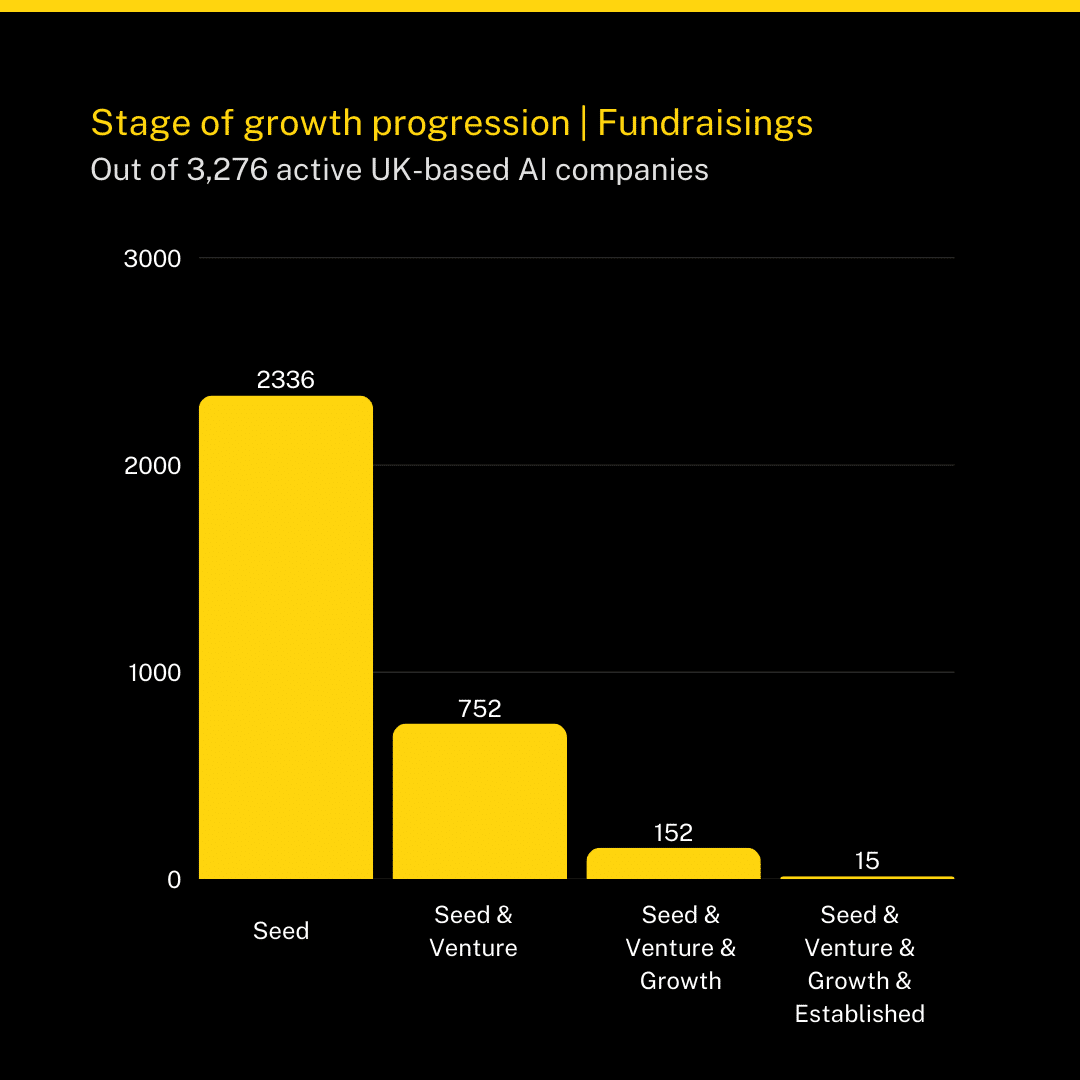
In the UK, the picture looks constrained rather than explosive. Of the 3,276 active high-growth AI companies in the UK, just 15 (0.5%) have raised capital at each stage of evolution, whilst 71% have raised only at the Seed level.
This drops to 23% when measuring companies that have raised at both Seed and Venture-stages. Only 5% of AI companies that have raised Seed funding have gone on to raise Growth-stage investment.
This suggests a narrow gateway into later-stage capital. The key will be whether this changes over time.
What to watch next? Whether that 5% expands meaningfully over the next 12–24 months, or whether most companies remain stuck at the early stage.
Indicator 3: Dependency concentration is a risk, and the UK is downstream
A classic bubble pattern is when growth is sustained by circular financing: suppliers fund customers, inflating demand that ultimately relies on fresh capital.
We’ve seen this risk discussed heavily in the US, particularly around supplier concentration and vendor financing. UK AI has a different profile. Most UK AI companies sit at the application layer, which means their dependency risk is less “stock market crash” and more platform exposure.
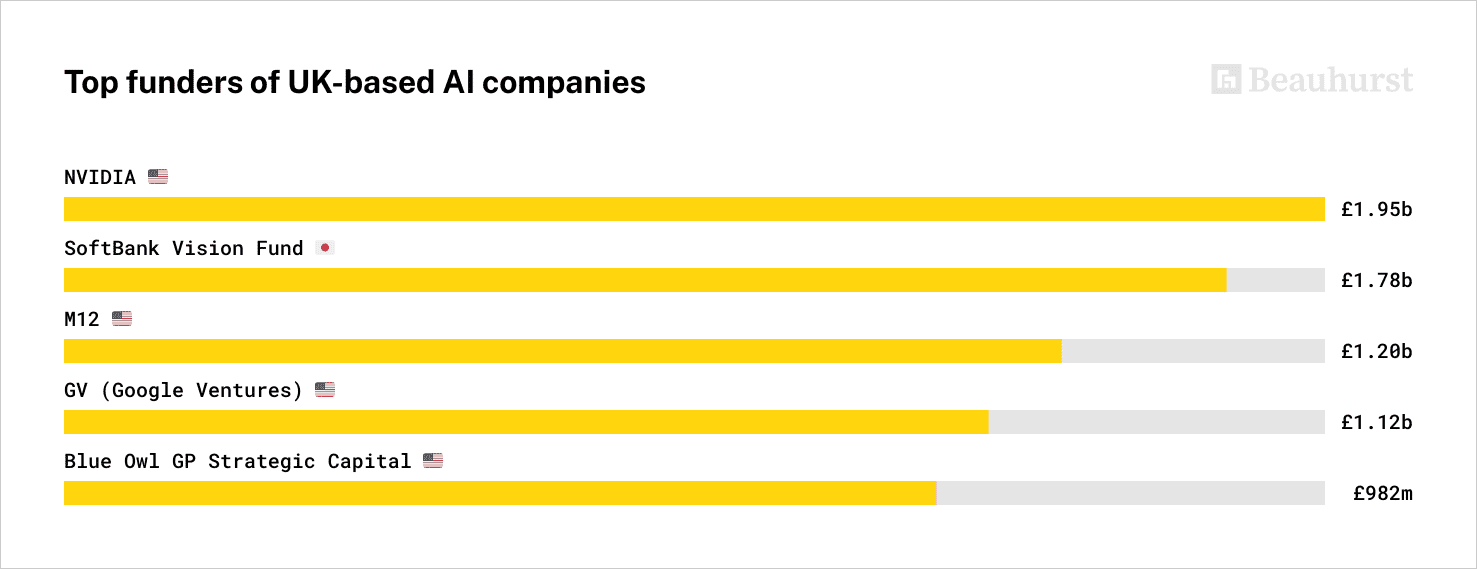
The biggest investors in UK infrastructure remain predominantly US-based tech giants — all of which have a very literal vested interest in AI becoming the next hypergrowth industry.
Conversely, in a hypergrowth market, the expansion is driven by businesses reinvesting their own cash profits into AI to secure measurable productivity gains.
In this scenario, demand outstrips supply, proving that the industry can scale through genuine resource scarcity rather than speculative hype. Data centre vacancies, for example, are at an all-time low of 7.6% in London.
What to watch next? Whether the UK can build its own infrastructure providers in the form of neoclouds and hyperscalers, in addition to NScale.
Indicator 4: Capital efficiency signals
Companies operating in a bubble will burn capital without a clear path to profitability, with revenue lagging far behind valuations. Hypergrowth companies exhibit growth funded by record-high free cash flow and retained earnings, rather than just debt.
Currently, AI revenue is surging across the board, but unit costs remain a significant hurdle. Unlike traditional SaaS, AI requires expensive compute for every query and so has meaningful marginal costs for additional customers.
This creates an “inference tax”, a drag on gross margins that many AI businesses can’t avoid. Now, token prices are trending down, but inference costs can trend upward as reasoning models become more sophisticated and computationally demanding.
That means the key question isn’t “is AI adoption happening?” — it clearly is. The key question is: “can AI businesses deliver value and transformation at a unit cost that supports sustainable margins?”
What to watch next? We’ll be looking at capital efficiencies and evidence of startups reducing dependency through proprietary data.
Indicator 5: Rising exit activity
A functioning market needs exits. Without liquidity, capital stays locked, and early-stage activity dries up. In the UK, exits are trending in the right direction.
The number of exits featuring AI companies rose from 9 in 2020 to 61 in 2025. That kind of increase suggests the ecosystem is producing businesses that incumbents want to acquire and that some value is being realised even as funding conditions tighten.
Most exits are still acquisitions, which is typical at this stage. But the direction matters.

What to watch next? Whether exit activity remains steady through 2026, and whether acquisitions continue to reflect strategic value rather than distressed consolidation.
So… bubble or hypergrowth?
The cleanest answer is: both, depending on where you look.
The debate suggests a reality where the AI market has signs of hypergrowth at the infrastructure level (strong enterprise demand, massive build-out of durable assets), but at the application level, the picture is more fragile (dependence on downstream pricing power, a crowded field).
Long-term success for UK firms will likely favour those who reduce their reliance on third-party platforms by using their own proprietary data to build sustainable competitive moats.
And ultimately, the industry’s stability will depend on the development of lasting physical infrastructure and whether companies can overcome high inference costs to improve unit economics.
Take a tour
What we’re watching next
If you’re building, advising, or backing AI companies in the UK, these are the signals most likely to shape the next 12–18 months:
01. Funding vs hiring: Does hiring continue to lag even as funding holds up?
02. Stage progression: Do more companies break through Venture into Growth, or does the bottleneck persist?
03. Dependency risk: Will the UK be able to solve the problem of a lack of homegrown infrastructure?
04. Inference cost trend: Do reasoning models push costs up faster than pricing comes down?
05. Exit activity: Do acquisitions remain strong, supporting recycling of capital back into early-stage?
Want more UK AI insights like this?
Subscribe to our newsletter for regular analysis, or take a quick online tour to explore the platform.
Discover our data.
Get access to unrivalled data on the companies you need to know about, so you can approach the right leads, at the right time.
Schedule a conversation today to see all of the key features of the Beauhurst platform, as well as the depth and breadth of data available.
We’ll work with you to build a sophisticated search, returning a dynamic list of organisations that match your ideal customer profile.
Beauhurst Privacy Policy