An overview of blockchain
What is blockchain?
Blockchain is a decentralised digital ledger that securely records and verifies transactions across a network of computers, eliminating the need for a central authority or intermediary. This enables the transparent and tamper-resistant tracking of assets, whether they are tangible or intangible.
A blockchain organises data into a series of “blocks”, each containing detailed information about a transaction. These blocks are linked together chronologically in a continuous “chain”, reflecting the movement or change in ownership of assets. Once a block is added to the chain, it is permanently recorded and cannot be altered or deleted.
Each block includes a timestamp and a reference to the previous block, creating a secure and verifiable sequence of transactions. And because transactions are verified by multiple computers, also known as ‘validator nodes’, it’s virtually impossible to edit data on the blockchain once it has been validated by the computers in the chain.
This immutability, which ensures that all records are resistant to tampering and fraud, has understandably garnered an interest from a number of highly regulated industries such as banking and healthcare.
Main uses of blockchain
Blockchain’s technology has applications that extend far beyond its initial use in cryptocurrencies. In data-intensive industries, it offers notable advantages over traditional databases by providing a more efficient, transparent, and secure way to manage large volumes of data.
One of the most prominent applications of blockchain is in supply chain management. Companies such as BMW Group have adopted this technology to track parts and raw materials, creating a transparent record of a product’s journey from origin to destination. This capability reduces fraud, improves efficiency, and enables stakeholders to track every stage of a product’s lifecycle. By doing so, it helps in identifying both the past and present locations of all product inventory, ensuring traceability throughout the supply chain.
Beyond supply chain management, blockchain’s decentralised nature offers substantial benefits across a wide range of sectors. In healthcare, for instance, it can securely store patient records, ensuring data integrity and confidentiality. There are already companies harnessing the powers of blockchain: Mulder Tech operates a medical device traceability platform, which provides a comprehensive view of each device’s lifecycle—from raw material through to patient application and eventual disposal.
However, in the UK at least, applications in public-facing sectors are in a purely exploratory phase right now. As with most new processes, knowledge gaps remain, as do questions around interoperability with existing technology.
Blockchain in the UK’s ecosystem
The UK is home to 546 active and dormant companies within the blockchain industry. As a relatively nascent sector, 60.4% of these companies are in the seed stage of development, 20.6% are in the venture stage, and just 3.00% are in the growth stage. These companies span various industries, with a majority (86.8%) developing application software. Additionally, 33.7% of blockchain companies are also involved in the fintech sector.
The integration of blockchain technology with fintech is transforming the financial sector, leading to the emergence of new models for distributed financial transactions. This convergence facilitates the creation of innovative financial services that operate without traditional intermediaries. Collectively, companies operating in both blockchain and fintech have raised £1.70b in equity, with a significant £218m deal by Blockchain.com.
Furthermore, 72 companies, or 13.2% of the UK’s blockchain ecosystem, are also engaged in the artificial intelligence (AI) industry. The integration of blockchain and AI represents a powerful combination, with each technology potentially enhancing the capabilities and security of the other. Blockchain provides a secure, transparent, and tamper-proof framework for storing and sharing AI models and data, while AI can improve blockchain processes through advanced decision-making, automation, and predictive analytics.
Feast and famine: blockchain booms and crypto crashes
Blockchain has of course experienced a number of market fluctuations, with numerous booms and busts during the 2010s. In 2021, UK-based blockchain-related deals broke records, with funding surging by 305% year-on-year, totalling £648m.
The rapid rise of blockchain in 2021 was largely driven by the explosive growth of decentralised finance (DeFi) and non-fungible tokens (NFTs). The increased corporate and institutional adoption of blockchain technology, combined with a heightened interest in digital transformation during the pandemic, further fueled its global spread.
Cryptocurrencies, which are digital assets that operate on blockchain technology, began with the launch of Bitcoin in 2009, and have since exploded into various forms. These assets are known for their speculative nature, and are highly susceptible to price fluctuations influenced by market sentiment, regulatory developments, and macroeconomic trends.
This volatility often results in boom-and-bust cycles, exemplified by the significant crashes of 2018 and 2022, which saw billions in value wiped out almost overnight. And, three years later, the hype around blockchain is yet to recover from the 2022 crash, which saw the collapse of FTX, with interest go bankrupt, with attention shifting to other emerging technologies such as AI.
Despite these fluctuations, the core concept—the blockchain itself—has remained stable and continues to evolve. Its applications have expanded significantly in areas like cybersecurity and digital identity verification. Notably, the Estonian government has integrated blockchain technology into its public services, ensuring they are both virtually accessible and securely protected.
This diversification has led to a surge in new blockchain business formations, even during periods where there are market downturns. For instance, despite the plummeting value of cryptocurrencies in 2018 and 2022, the number of new blockchain companies grew exponentially, increasing by 55.3% year-on-year in 2018.
Analysis of UK blockchain companies
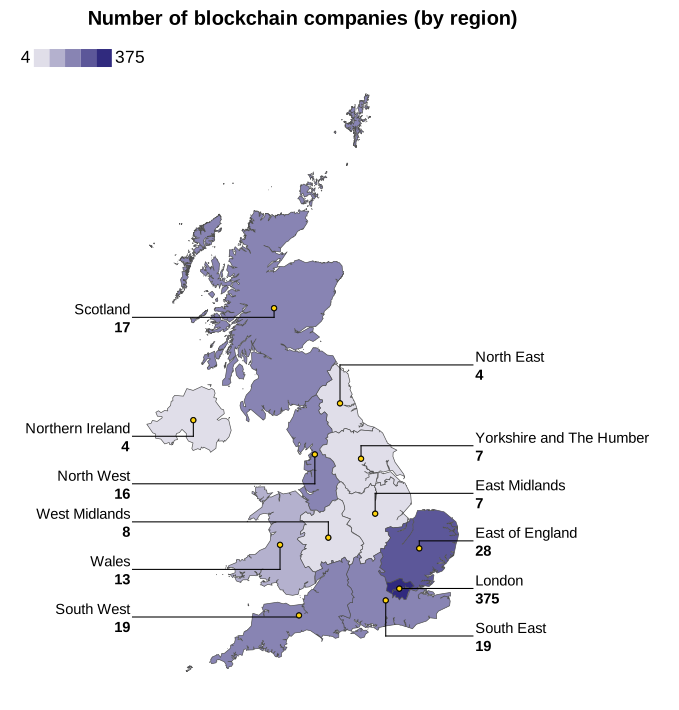
Regional distribution of active blockchain companies (as of September 2024)
London is the main hub for blockchain companies in the UK, housing 375 firms, or 68.7% of the UK total. Within London, the boroughs of Westminster and Hackney represent the highest proportion of blockchain business activity.
The South East ranks second, comprising 8.60% of the UK’s blockchain ecosystem. Notable among these is Blockhouse, based in Oxford, which develops blockchain systems for data protection. Since its launch in 2018, Blockhouse has raised £21.9m in equity via two rounds of funding.
The East of England accounts for 5.13% of the country’s blockchain companies, with a significant 17.8% of these located in St Albans. Meanwhile, the South West represents 3.47% of all blockchain firms, with a total of 19 active companies.