
Starmer's Economic Legacy: The UK Business Landscape

Words Callum Newton

Starmer's Economic Legacy: The UK Business Landscape

Change. The word on the minds of millions of people up and down the country in 2024, and at the forefront of Keir Starmer’s campaign to build “a fairer, healthier, a more secure Britain” after 14 years of Tory rule. The country was tired of the Conservatives, and delivered Starmer one of Labour’s largest ever parliamentary majorities (albeit with only a third of the popular vote). But two years later he’s out of office and many voters now feel short changed.

It’s too soon to say what Starmer’s legacy will be. It could be the Online Safety Act, renationalisation of Britain’s railways or the abolition of Hereditary Peers. It could also be his u-turns around welfare reforms, his appointment of Peter Mandelson or his decision to (sort of) keep Britain out of America’s war with Iran. But how has the economy performed? This week the Beauhurst Insights team wanted to measure the financial, investment and innovation trends of the UK’s business landscape over Starmer’s premiership and how he stacks up against his predecessors.

Company and sector growth under Starmer

Let’s start with the good news. The number of active companies operating across the UK has grown since Starmer took office. London is the real winner, with a six percent bump in the number of companies setting up shop in the capital since the election. But this uptick doesn’t appear to be limited to London. At the economic polar opposite of the country, Beauhurst have recorded similar spikes in company headcount in Scotland (+6%) and the author’s native North East (+6%).

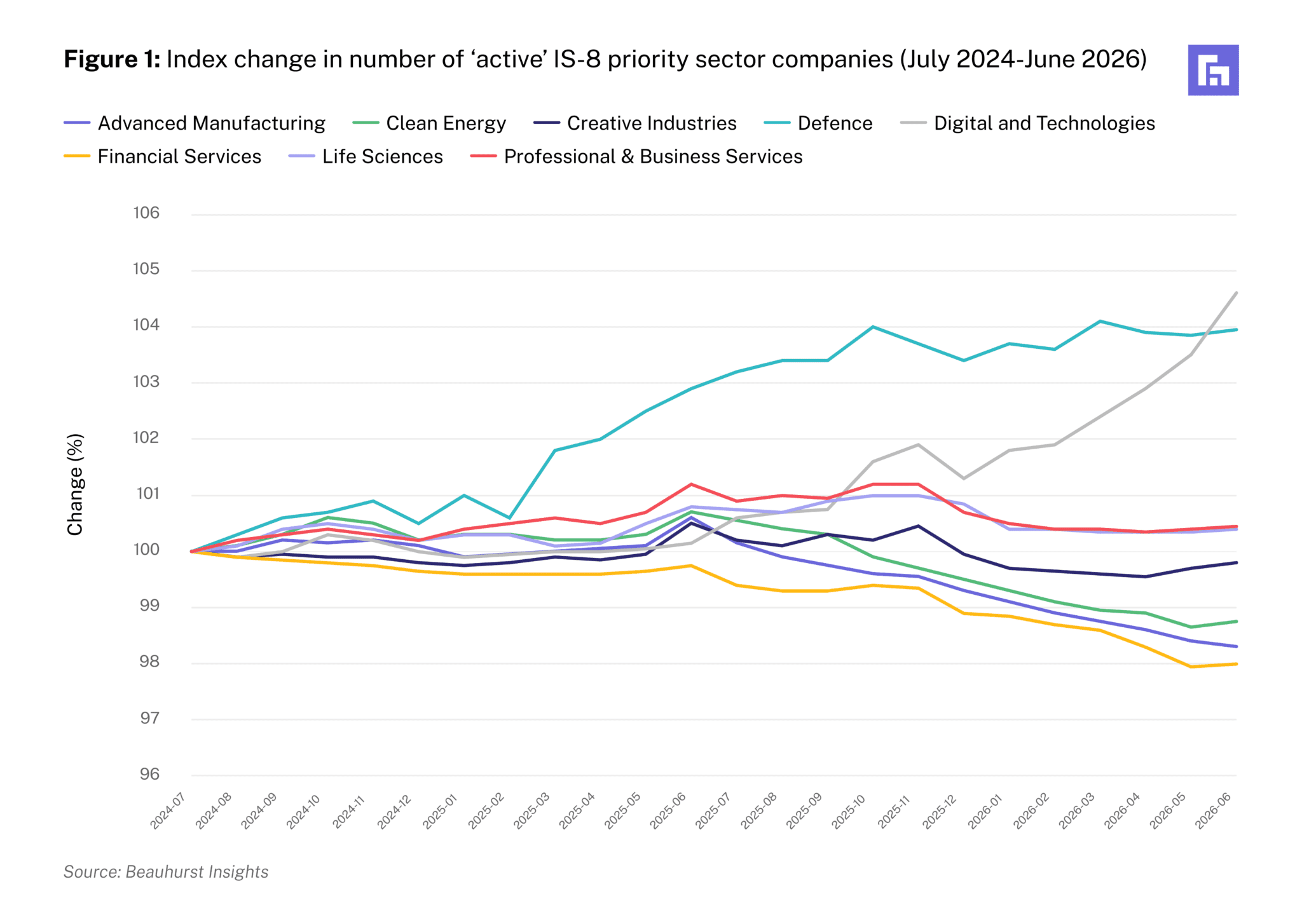
There also appears to be some positive headwinds in some of the priority sectors outlined in the UK’s new Modern Industrial Strategy, particularly in relation to Digital and Technologies (+5%) and surprisingly Defence (+4%) a sector whose failed investment plan was the final straw for his premiership (Figure 1). However, beyond these two sectors little has changed, which is to be expected as the plan was only launched mid-way through his time in office.
line chart 1

But where there are winners, there are losers. And there are plenty under Starmer’s watch.

While the total number of companies has increased nationally, we have experienced a collapse in innovative high-growth firms which are crucial to getting Britain out of its economic funk. For context, the number of patent holding companies has decreased 6%, academic spinouts 3% and companies receiving any form of R&D grant 4%. There is also a clear regional imbalance to company growth as not everywhere shares London’s buoyancy. For example, the number of active companies operating across Wales has fallen 29% since July 2024.

Investment, debt and the funding shift

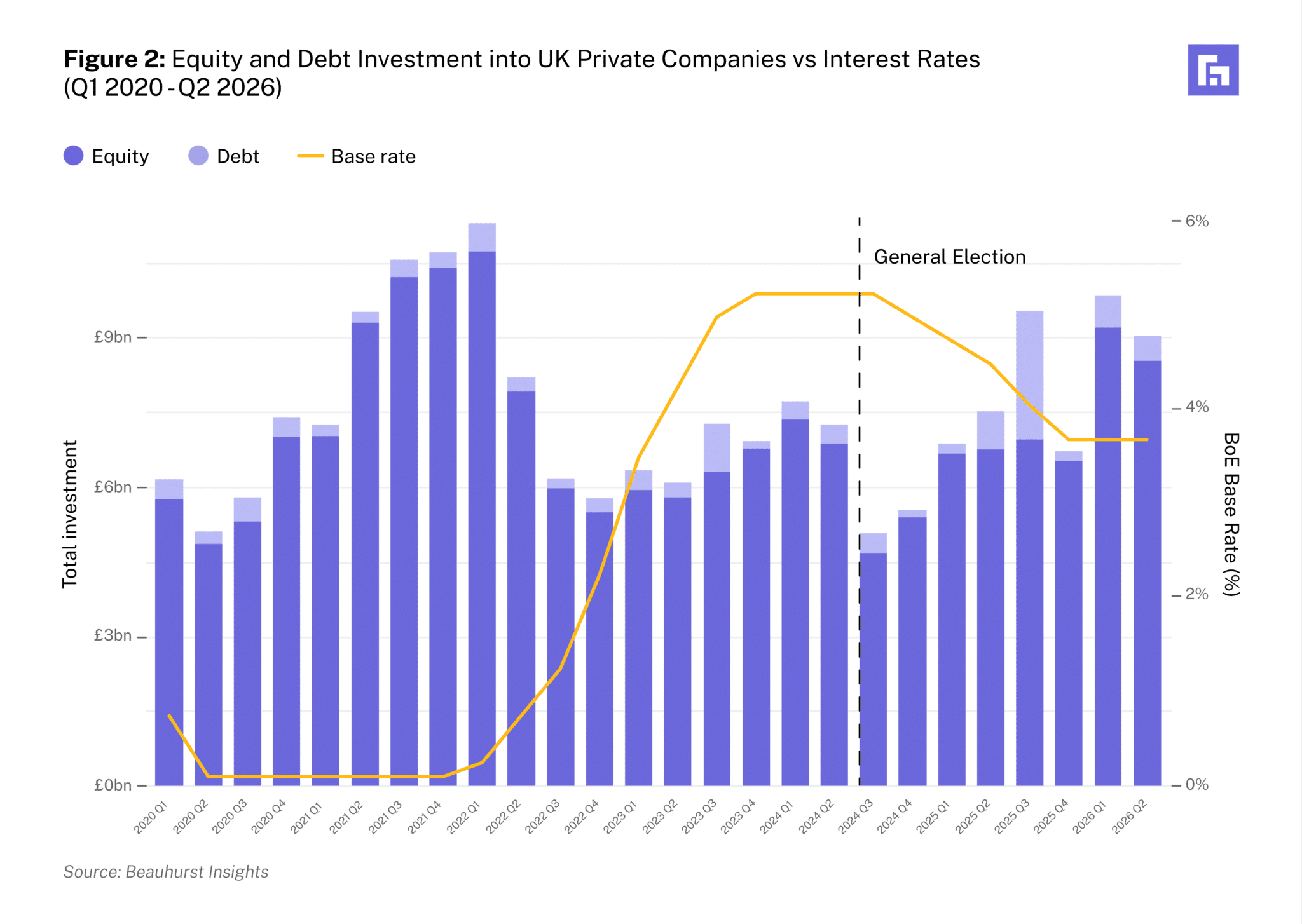
Despite company and sector trends, the investment landscape is more of a mixed bag for Starmer’s government. Generally equity investment and debt financing have increased steadily since the General Election (Q3 2024). Although in Q1 2026 we experienced the highest levels of equity funding into UK private companies since the COVID-19 pandemic, the remaining quarters look markedly similar to the investment activity during the Sunak-era (Figure 2).

Although the dial may not have shifted on an aggregate basis, Beauhurst is recording a shift towards fewer deals but larger sums. Investors are becoming increasingly picky, but if you can secure funding it’s likely going to be much more than what previous founders expected over much of the last decade. This trend is something we cover in more detail in our previous report, The Deal (May 2026).

The knock-on effect of this is interesting. Even though investors have become more selective, the demand for capital has not diminished. Instead we are seeing a greater uptick in companies undertaking some form of debt financing as a means of fueling expansion or simply keeping the lights on. None of this is without risk and is happening exactly at the moment debt is becoming cheaper. Since the General Election the Bank of England has reduced base interest rates down from 5.2% to 3.75%. A long way off the ultra low rates of the pandemic era, but apparently enough to plug the gap from a more selective equity market.

Starmer’s economic legacy: what the data shows

Despite being handed one of the largest majorities in British political history, it is remarkable how unremarkable Starmer’s premiership has been for the UK’s business community. As the above data shows much of the promised “change” agenda has struggled to meaningfully shift the dial on the British economy. Unemployment is up, real pay is down and we have the highest industrial energy costs in Europe.

It would be remiss to say it’s all Starmer’s fault. In many ways he has been the hostage of events on the world stage: Gaza, the Russo-Ukraine war and a blocked Strait of Hormuz to name just a few. But some of the decisions made by him and his Chancellor have certainly hindered rather than helped their “growth agenda”. We can only hope whoever succeeds him is more successful in getting the UK economy growing again, and delivers the change Britain’s business landscape desperately needs.

Want to discuss the data? Drop me a message: callum.newton@beauhurst.com


Subscribe to the Beauhurst Insights Substack

Data-led analysis of the UK’s private companies, straight to your inbox.

Subscribe
Discover our data

Get access to unrivalled data on all the companies you need to know about, so you can approach the right leads, at the right time.

Book a demo today to see all of the key features of the Beauhurst platform, as well as the depth and breadth of data available.

An associate will work with you to build a sophisticated search, returning a dynamic list of organisations that match your ideal customer profile.